DbcultAccessing Vault...
6.4/10
Senior Film Conservator
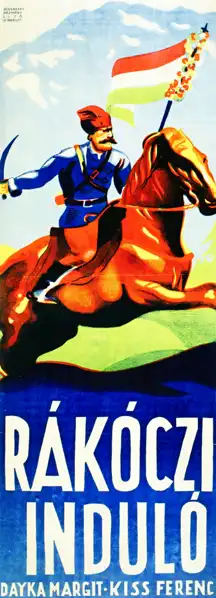
A definitive 6.4/10 rating for a film that redefined the boundaries of cult cinema. Rakoczi March remains a cornerstone of transgressive art.
Alright, so 'Rakoczi March' is a real throwback. If you’ve got a soft spot for those older, earnest romantic dramas, especially ones with period costumes and a bit of military pomp, then yeah, you might find some real charm here. But honestly, if you need fast pacing, complex characters, or anything remotely edgy, this one’s probably not for your weekend watch list. It’s gentle, sometimes a bit too gentle. 😴
The whole thing kicks off with our Hussar captain, all sharp uniform and serious glances. He spots this blonde woman, and the movie makes it clear: instant connection. Like, a long, lingering look across a crowded room sort of thing. It’s that classic 'love-at-first-sight' movie trope, played completely straight. No irony.
There's a scene, I think it’s at some kind of social gathering, where the captain and the blonde, played by Karola Zala, are just talking. The camera sits a little too far back for my taste, almost like we’re peeking in. You can almost feel the movie trying to make this quiet conversation feel hugely significant, even if the dialogue itself is just pleasantries.
And then the shoe drops. This elegant blonde, the one who caught his eye, turns out to be his captain’s sister. 😬 Suddenly, what felt like a simple romance gets a little… complicated. Not in a dramatic, shouting-match way, but more of an awkward, 'oh dear, this is going to be a problem' kind of way.
The film doesn't really lean into the melodrama of this revelation. Instead, it becomes this quiet struggle with duty versus desire. You see it mostly in the captain’s face, a lot of conflicted stares into the middle distance. Pál Jávor, as the captain, does a pretty good job with those internal moments. His eyes carry a lot.
There are some really nice shots of the Hungarian countryside, or what I assume is the Hungarian countryside. Rolling hills, sometimes a horse or two just standing there. They are pretty, if a little static. Almost like postcards inserted between the scenes.
The pacing is definitely from another era. There are long stretches where not a whole lot happens, just people looking at each other, or walking from one place to another. It’s not boring, exactly, but it asks for a certain kind of patience. I kept thinking, *just get to the point already*, but then remembered, oh right, old movies. 🕰️
I distinctly remember a moment where the captain is having a very serious chat with his commander. The commander, played by Ernõ Szenes, has this fantastic mustache. It’s almost a character in itself. The way it twitches when he’s annoyed, it’s just perfect. That mustache really steals a few scenes, honestly.
The whole conflict never feels overly intense. It’s more of a gentle push and pull. Will he risk his career for love? Will she choose her brother over her heart? The stakes feel personal, rather than grand. This isn’t a world-ending crisis, just a heart one.
One scene that stuck with me involved a small musical performance. It wasn't crucial to the plot, but it just *happened*. A few characters gathered around a piano, and someone sang. It felt very natural, almost like a real family evening, but also like it went on a minute or two longer than it needed to. Like the director just let the tape roll. 🎶
The film wraps things up in a way that feels… appropriate for the time. It’s not necessarily a shocking ending, but it’s certainly one that leaves you with a certain feeling. A bit wistful, maybe. Not every loose end is tied up with a neat bow, which I actually appreciate in an odd way.
It’s not a film that will rewrite your understanding of cinema. It won’t be discussed in film theory classes. But as a quiet glimpse into a specific kind of old-world romance, with its own particular rhythms and unspoken rules, it holds its own. A solid, if understated, afternoon watch if you're in the mood for something gentle and a little nostalgic.
IMDb 6.2
1936
Community
Log in to comment.