DbcultAccessing Vault...
5.2/10
Senior Film Conservator
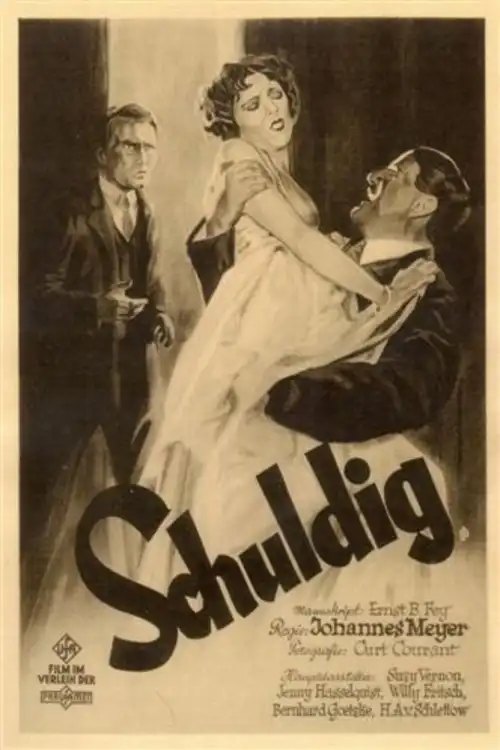
A definitive 5.2/10 rating for a film that redefined the boundaries of cult cinema. Schuldig remains a cornerstone of transgressive art.
Alright, let's talk about Schuldig from way back in 1928. Is it worth tracking down today? Look, if you’re a silent film purist, especially one with a soft spot for German melodrama, then absolutely, give it a go. There’s some real emotional heft here, even if it feels a bit much sometimes. But if you expect snappy dialogue or modern pacing, you'll probably just find yourself confused or bored. This one is for the patient, the curious. 🧐
The setup is pretty stark: Thomas Feld gets out of prison after sixteen whole years. Sixteen! You just feel the weight of that from the very first scenes. He steps back into a world that, predictably, has completely changed. His wife, Magda, and daughter, Maria, are under the thumb of Peter Cornelius, a cabaret owner. It’s a classic 'man returns to ruined home' kind of story.
What struck me immediately was how direct the performances are. Hans Adalbert Schlettow as Thomas really sells the bewildered, heartbroken father. You see it in his eyes, even through the decades-old film grain. He’s trying to understand this new normal. It’s a very physical performance, as you'd expect for the era, but there's a real undercurrent of quiet despair.
Then there’s Bernhard Goetzke as Cornelius. He’s just *so* good at playing these morally ambiguous, yet powerfully charismatic, figures. Here, he’s not just a villain; there’s a smoothness to him. He’s got Maria working in his cabaret, and you can tell he's got a hold on the family. It's not cartoonish evil, which I appreciated. He carries himself like someone who always knows he's in charge. 🕺
The cabaret scenes are interesting. They're not super glamorous, more like a smoky, slightly seedy place where folks go to forget their troubles. Maria (Suzy Vernon) performing there feels less like a choice and more like a necessity. Vernon gives her this fragile strength, which is quite compelling. You feel her trapped, but also like she's doing what she has to. When lawyer Frank Peters (Willy Fritsch) enters the picture and almost immediately falls for Maria… well, that felt a little *too* convenient, even for a silent film. It kinda speeds up the emotional stakes without really earning them. 💔
The pacing, for the most part, is quite deliberate. It lets moments breathe, sometimes a little too much. There’s a scene where Thomas just watches his family from afar, and it just… *lingers*. You almost feel the movie trying to convince you this moment matters. And it does, but you don't need to hold on quite so long. It’s not boring, exactly, but it’s definitely not zippy.
I found myself wondering about Magda, Thomas's wife. Jenny Hasselqvist portrays her. Her despair feels very real, almost palpable. But the film doesn't give her a ton to *do* beyond react to the men around her. It's a shame, because you get glimpses of a really strong, complex character there, but it never quite blossoms into its own storyline. You can almost feel the movie wanting to focus on the father-daughter dynamic more.
The title, Schuldig (Guilty), really sits with you. Is Thomas guilty? Of what? And what about Cornelius? Or even society itself? The film doesn't hit you over the head with it, which is good. It lets you ponder. The ending feels a bit abrupt, almost like they ran out of film or something. Not a clean, tidy bow, which is sometimes more realistic, I suppose. It leaves you with a certain uneasiness. 🤔
Overall, it’s a heavy film. It's not a fun night out, but it's a solid piece of early German cinema. For anyone curious about how stories were told without sound, and with such raw, expressive acting, it’s definitely worth a watch. Just prepare yourself for a journey into some serious human drama. And maybe have some snacks ready. 🍿

IMDb 6.3
1935
Community
Log in to comment.