DbcultAccessing Vault...
7.8/10
Senior Film Conservator
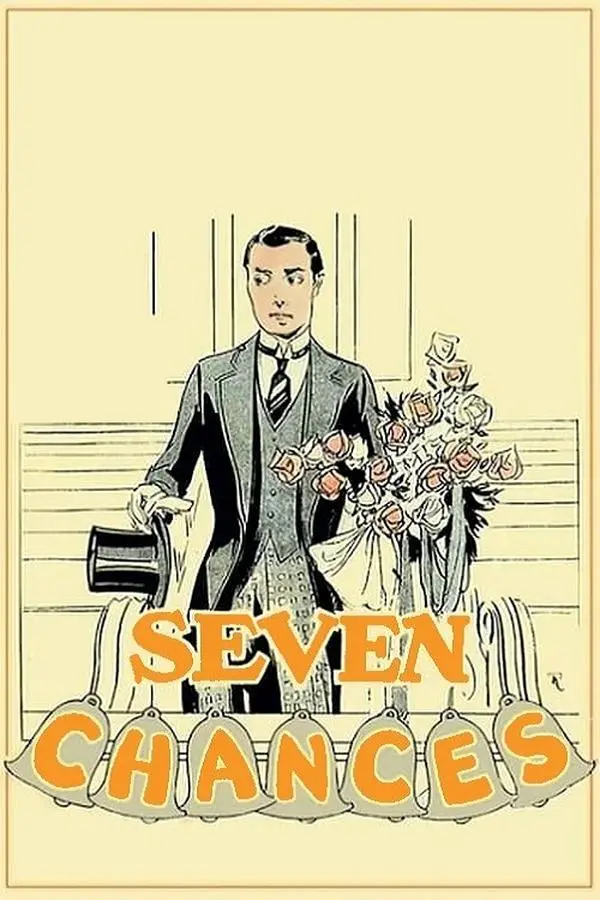
A definitive 7.8/10 rating for a film that redefined the boundaries of cult cinema. Seven Chances remains a cornerstone of transgressive art.
Buster Keaton’s Seven Chances (1925) represents a fascinating intersection between the rigid structures of theatrical farce and the boundless, kinetic possibilities of the cinematic medium. Adapted from a stage play by Roi Cooper Megrue, the film initially appears trapped within the proscenium arch of its own premise. Yet, under Keaton’s meticulous direction and his uncanny understanding of spatial geometry, what could have been a static drawing-room comedy evolves into a breathless, existential sprint. The narrative propellant—a seven-million-dollar inheritance contingent upon a marriage by dusk—is a classic MacGuffin, but in Keaton’s hands, it becomes a crucible that tests the very limits of human endurance and the physical laws of the universe.
The first half of the film is a masterclass in escalating discomfort. Jimmie Shannon, played with Keaton’s signature deadpan resignation, is not a man of words but of movement. His attempts to propose to Mary (Ruth Dwyer) are thwarted by his own reticence, a psychological barrier that mirrors the physical obstacles he will later encounter. Unlike the more overtly sentimental narratives found in films like The Flower Girl, Keaton avoids the saccharine. His romance is a matter of logistical necessity and quiet devotion, frequently interrupted by the cold reality of a ticking clock. This temporal pressure is a recurring motif in silent cinema, often explored with more somber undertones in dramas like Dangerous Days, but here it serves as the metronome for a comedic crescendo.
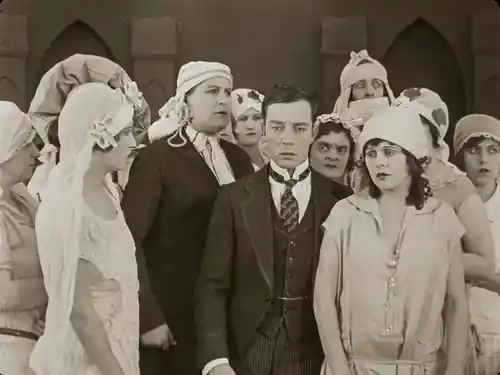
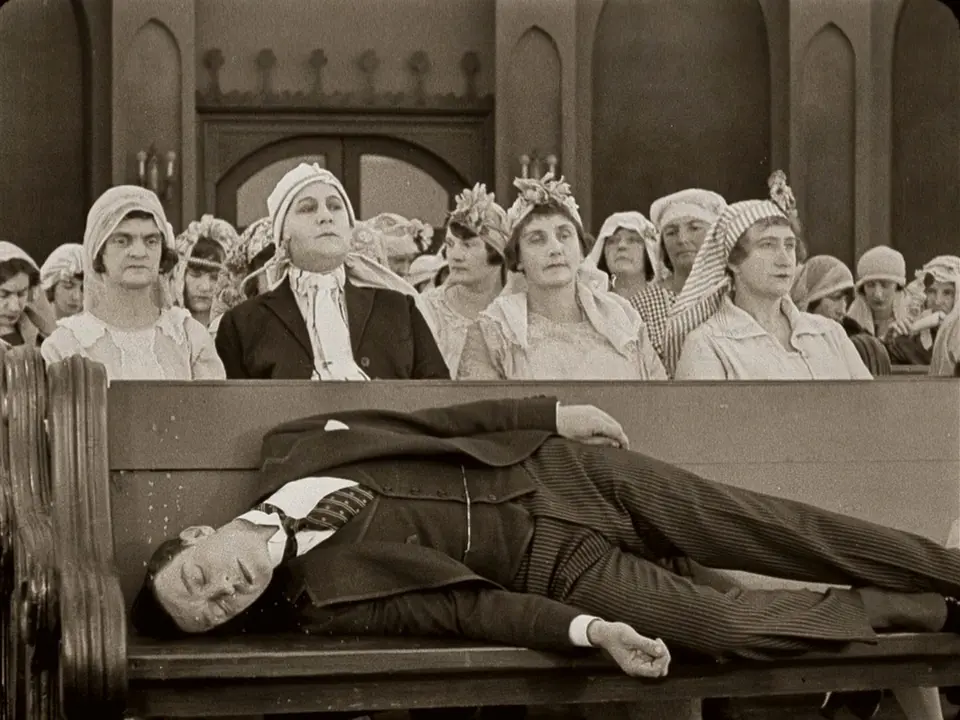
The sequence where Jimmie’s partner, played by the wonderfully eccentric Snitz Edwards, places an advertisement in the newspaper, leads to the film's most iconic and controversial imagery: the assembly of the brides. While modern sensibilities may recoil at the sheer volume of women depicted as a monolithic, matrimonial mob, from a purely formalist perspective, the visual of hundreds of white veils flooding the streets of Los Angeles is an astonishing feat of staging. It transforms the urban landscape into a churning river of lace and fury, a visual metaphor for the overwhelming pressure of societal expectations and the absurdity of the marriage market.
As the chase moves from the city to the outskirts, Keaton’s genius for utilizing the natural environment comes to the fore. The transition from the urban to the pastoral is seamless, yet the stakes increase with every topographical shift. We see a protagonist who is not merely running away from a crowd, but running toward a destiny that seems increasingly improbable. This sense of isolation amidst a crowd is a theme Keaton explored with more pathos than his contemporaries. While a film like The Inner Voice might dwell on the internal monologue of such a struggle, Keaton externalizes everything through his body. His movements are precise, almost mechanical, yet they possess a grace that defies the clumsy world around him.
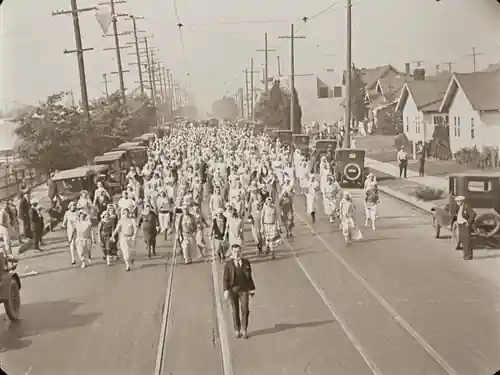
The legendary rockslide sequence—a happy accident discovered during a preview screening when audiences laughed at a few rolling stones—is perhaps the greatest example of Keaton’s improvisational brilliance within a rigid framework. As Jimmie descends the hillside, he is pursued not just by the brides, but by an avalanche of boulders. The choreography required to navigate these falling masses without breaking character or sustaining serious injury is nothing short of miraculous. It is a sequence that rivals the scale of war epics like The Battle of the Ancre and the Advance of the Tanks, yet it is performed for the sake of a gag. The rocks represent the mounting consequences of Jimmie’s procrastination, a physical manifestation of the deadline that threatens to crush him.
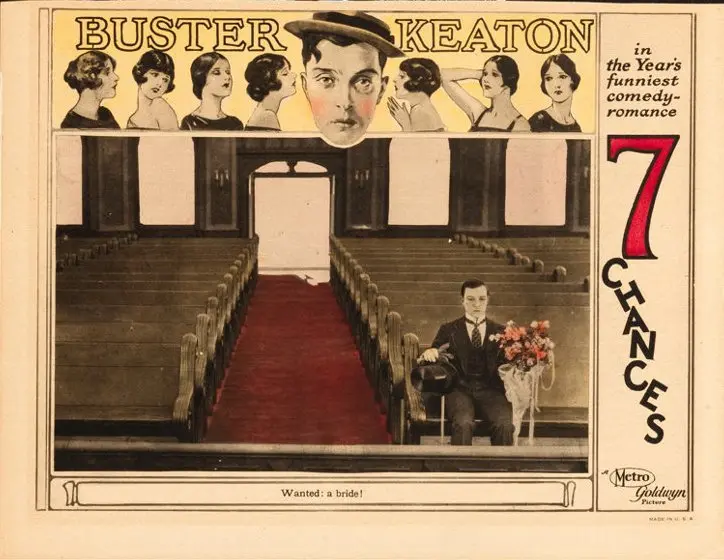
When comparing Seven Chances to other works of the mid-1920s, such as the gritty realism of The Yellow Traffic or the frontier stoicism of The Lone Star Ranger, one realizes how uniquely Keaton blended the mundane with the fantastic. His character is often a cog in a machine he doesn't understand, much like the protagonist in Foolish Lives, but Keaton’s cog has the agency of an athlete. Even in the face of the absurd—whether it’s a crane-operated proposal or a swarm of angry bees—he maintains a dignity that makes his struggle relatable. The film also features a brief, early use of two-color Technicolor in its prologue, a lavish touch that contrasts sharply with the gritty, dusty chase that follows, highlighting the divide between the idealized world of romance and the chaotic reality of survival.
The supporting cast, while largely overshadowed by Keaton’s physical presence, provides essential texture. Snitz Edwards is the perfect foil, his craggy face and frantic energy serving as the catalyst for Jimmie’s misery. The brief appearance of a young Jean Arthur hints at the burgeoning talent of the era, while the various 'chances' Jimmie pursues—from the girl in the barbershop to the woman on the street—offer a satirical snapshot of 1920s archetypes. This social satire is less biting than that found in A napraforgós hölgy, but it is no less effective in its observational humor.
Technically, Seven Chances is a triumph of editing and cinematography. The way the camera tracks Jimmie’s descent, capturing both his micro-expressions and the macro-chaos of the boulders, is revolutionary for 1925. It lacks the static staginess of Miss Crusoe or the theatrical limitations of The Love Letter. Instead, it embraces the 'cinema of attractions' while grounding it in a coherent, albeit frantic, narrative arc. The film’s pacing is impeccable; it begins with the slow, deliberate rhythm of a man walking through the seasons and ends with a velocity that feels modern even a century later.
The resolution of the film, where Jimmie finally reunites with Mary just as the clock strikes seven, is a satisfying, if conventional, payoff. However, the true resolution lies in the survival of the character. Jimmie Shannon survives the mob, the rocks, and the ticking clock, not through luck, but through a relentless, singular focus. This reflects the broader ethos of the silent era’s great comedians: the world is a chaotic, often hostile place, but with enough physical dexterity and a refusal to crack a smile, one can navigate it. It is a sentiment echoed in the survivalist themes of The Jungle Child, albeit in a vastly different context.
In conclusion, Seven Chances is more than just a comedy; it is a structural marvel. It demonstrates Keaton’s ability to take a mediocre stage play and transform it into a piece of pure cinema. While it may lack the epic scale of The General or the surrealist depth of Sherlock Jr., it remains a vital entry in the Keaton canon for its sheer, unadulterated energy. It reminds us that comedy, at its best, is a form of poetry in motion—a series of calculated risks that culminate in a moment of transcendent absurdity. Whether he is dodging a boulder or a bride, Buster Keaton remains the ultimate architect of the cinematic gag, building monuments of laughter out of the very gravity that seeks to pull us down.
Final thought: If you find yourself captivated by the frantic energy of the 1920s, consider exploring the contrasting pace of Lest We Forget or the rugged charm of Two-Gun Betty to see the full spectrum of silent film artistry.
IMDb —
1923
Community
Log in to comment.