DbcultAccessing Vault...
Cult Review
Senior Film Conservator
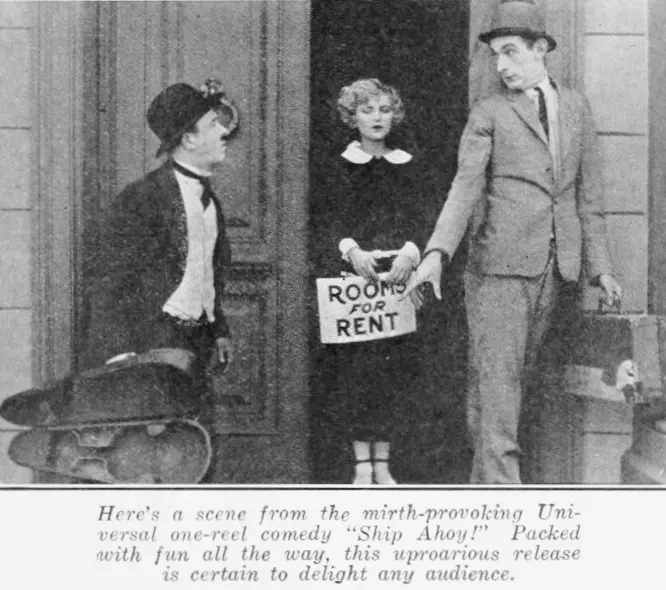
In the early 1920s, the era of silent films was at its zenith, and comedy was a genre that thrived on the visual gags and witty dialogues that could transcend language barriers. Among the numerous silent comedies produced, 'Ship Ahoy!' stands out with its unique blend of mischief, mistaken identities, and an underlying theme of the pursuit of affection.
The story follows Slim, played by Slim Summerville, and Bobby Dunn, who, feeling envious of the attention their sailor friends receive from women, decide to take a dramatic yet rather desperate measure. They rent sailor uniforms to themselves, believing that this will garner them the same level of admiration. However, as with all good comedic romps, their plan quickly spirals out of control.
As the plot unfolds, Slim's uniform is mistakenly stolen by an officer at a nearby house, leading to a humorous scene where the real officer arrives to inquire about his missing outfit. Meanwhile, Bobby, in an attempt to salvage the situation, impersonates the officer, leading to his arrest. The plot thickens as Slim, having switched uniforms with Bobby, finds himself in a predicament when a real guard mistakes him for the officer, and he too is taken in.
The film's success lies in its execution of physical comedy and the way it humorously explores the consequences of their impromptu plan. The visual gags are well-crafted, and the performances by Slim and Bobby are endearing, especially in the moments when they realize the absurdity of their predicaments. The dialogues, though limited by the silent film format, are cleverly written and punctuated with the occasional witty exchange between the characters.
Compared to other films of this era, 'Ship Ahoy!' offers a refreshing take on the genre. While 'The Morals of Hilda' and 'Sacred Silence' delve into more serious or moral themes, 'Ship Ahoy!' maintains a lighthearted and entertaining tone throughout. It is reminiscent of the likes of 'The Birth of Patriotism,' which also explores the dynamic between characters through humor and mistaken identity, albeit in a slightly more dramatic setting.
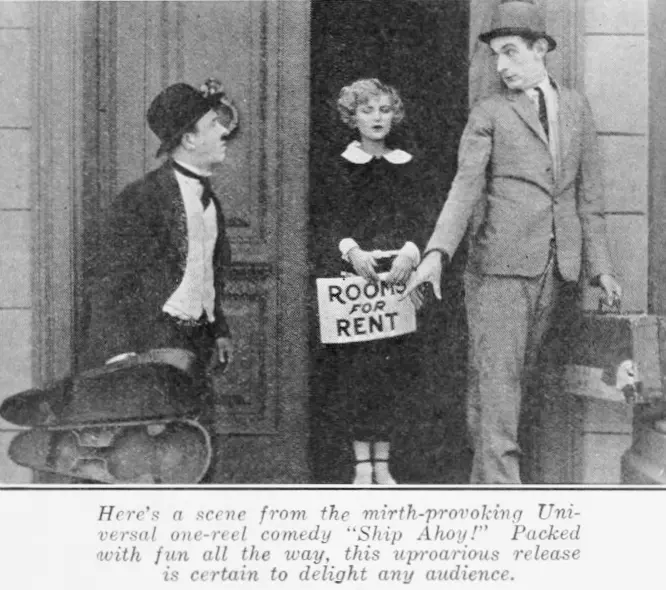
What sets 'Ship Ahoy!' apart is its ability to balance humor with a sense of character development. While the plot is driven by the whimsical idea of renting uniforms, the audience is left with a sense of the characters' growth and the consequences of their actions. This aspect of the film adds depth to the otherwise light-hearted comedy.
The film's production values are commendable, particularly considering the era in which it was made. The set design, costumes, and the overall aesthetic of the film contribute to its charming and nostalgic feel. The cinematography is particularly noteworthy, capturing the playful and at times chaotic scenes with a deft hand.
While 'Ship Ahoy!' may not be the most groundbreaking film in the genre, it is a delightful watch for fans of early silent comedies. Its blend of physical humor, character development, and the clever use of mistaken identities make it a fascinating piece of cinema history.
For those interested in exploring more of this era, 'Tainted Money' and 'The Hidden Law' are worth a watch. Both films offer a similar mix of humor and character-driven storytelling, albeit within different contexts and settings. 'The Morals of Hilda' and 'The Crucible of Life' provide a different perspective on the era, with more emphasis on moral themes and societal commentary.
In conclusion, 'Ship Ahoy!' is a charming and entertaining silent comedy that successfully captures the essence of early 1920s humor. It is a film that not only entertains but also offers a glimpse into the dynamics of relationships and the pursuit of affection. If you are a fan of silent comedy, this film is a must-watch, offering a delightful experience that is both nostalgic and humorous.
IMDb 5.7
1916
Community
Log in to comment.