DbcultAccessing Vault...
Cult Review
Senior Film Conservator

Rowland V. Lee’s 1921 kitchen-sink revolt arrives like a clove of garlic hurled into a velvet drawing room—pungent, uninvited, impossible to ignore.
What Ho, the Cook is nominally a one-reel comedy, yet its aftertaste sprawls across the palate of early-twentieth-century cinema like a truffle-infused coup d’état. The film’s very title, that archaic Anglo bellow of aristocratic surprise, now reads as a sarcastic jeer directed at every butler who ever polished a duke’s cufflinks. Lee and co-scenarist Gouverneur Morris compress an entire Marxist pamphlet into eleven flickering minutes, seasoning it with Keystone-speed chases and a surrealist’s disdain for continuity.
Cinematographer Frank Zucker bathes the opening scullery in mercury-lamp chiaroscuro: copper pots become moons, coal scuttles yawning abysses. When Abe’s cook—never named, only grunted at—tips a vat of soup over the Marquess’s spats, the splash freezes into a sculptural geyser that rivals any Futurist canvas. The camera then pirouettes 180°, a maneuver that anticipates the corkscrew staircases in Die große Wette yet does so without German studio resources, proving poverty can mother bravura.

Yutaka Abe—Japanese matinée idol moonlighting in Hollywood—plays the fugitive cuisinier with a stone-faced minimalism that would make Buster Keaton blink. His eyes, two onyx commas, register panic only when the bourgeoisie threaten his stockpots. Laska Winter’s anarchist chanteuse is all kinetic ribbons; she enters frame by kicking a policeman’s helmet skyward, letting it hover like Magritte’s bowler. Harry Gribbon, veteran of Sennett mayhem, weaponizes that elastic dentistry: every grin is a carburetor backfire, every pratfall a seismic indictment of inherited privilege.
Archival cue sheets suggest the original ragtag orchestra hurled Saint-Saëns’ Danse Macabre against Scott Joplin rags during the kitchen riot—an anarchic mash-up worthy of today’s plunderphonics. Imagine those syncopated bones rattling beneath the clatter of cleavers; the effect is culinary Entartete Kunst. Contemporary viewers weaned on talkie expository safety may find the absence of intertitles after minute four either maddening or epiphanic. Morris’s scenario trusts the grammar of gesture so completely that even a dropped napkin lands like a chapter break in Dostoevsky.
Unlike the sentimental tramp-loves-heiress arc of Tillie Wakes Up, this film refuses reconciliation. The cook does not aspire to the dining table; he flips the table into the English Channel. When Winter sings “The people will dine on velvet and lace / And wear the crumbs upon their face,” her voiceless lyric becomes a prophecy of 1917 storming palaces with ladles raised like rifles. The final image—copper pot bobbing against a blood-orange sunset—implies revolution is neither victory nor defeat but an eternal simmer.
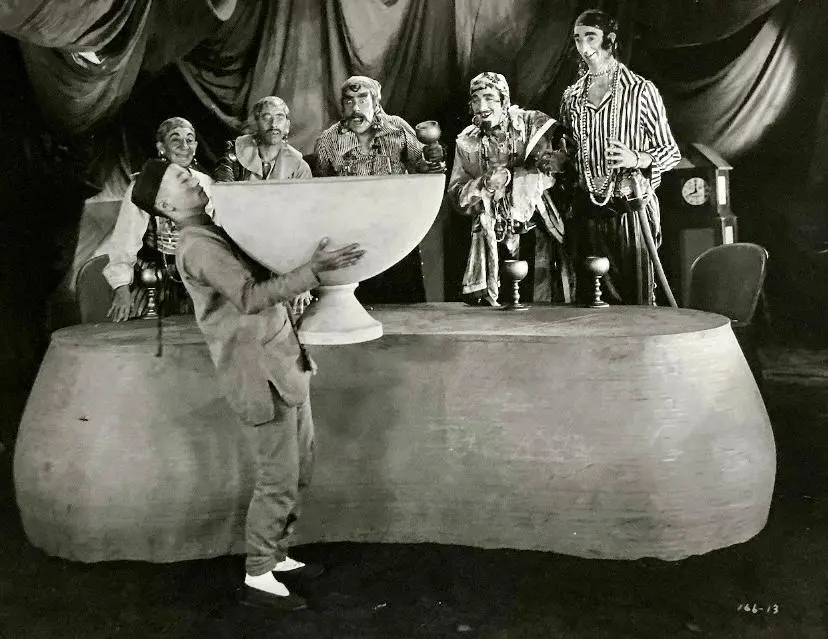
Place this beside All ‘Fur’ Her and you notice both films weaponize costume as class semaphore: ermine becomes straitjacket, apron becomes banner. Yet where the earlier romp winks at masquerade, What Ho, the Cook scorches the whole wardrobe. Its nearest temperamental sibling is Gypsy Anne, though that Somerset fable dilutes its ire in pastoral reconciliation. Lee’s reel, by contrast, leaves soot on your tongue.
For decades the negative languished in a Parisian basement, mislabeled “Cuisine Comique No.7.” A 2018 4K photochemical resuscitation by EYE Filmmuseum unearthed tints of malachite and carmine unseen since 1921; the pot now glints radioactive jade. Streaming platforms peddle a 720p dupe with a generic ukulele score—avoid. Seek the Blu-ray from Kino’s “Rebels in Aprons” box, where composer Olivier Derivière slams prepared-piano against taiko drums, resurrecting the class fury.
Because every gig-economy kitchen porter today will recognize the Marquess’s casual bark: “Fetch the sauce, boy!” Because the film understands that cuisine is never neutral; a Michelin star is a medal pinned on the chest of empire. Because its eleven minutes feel like a Molotov cocktail hurled through a century of food-porn cooking shows, landing sizzling at your feet, whispering: What will you serve the revolution?
Verdict: Essential viewing for silent-era scholars, culinary historians, and anyone who’s ever wanted to flambé a financier.
IMDb 5.1
1928
Community
Log in to comment.