DbcultAccessing Vault...
Cult Review
Senior Film Conservator
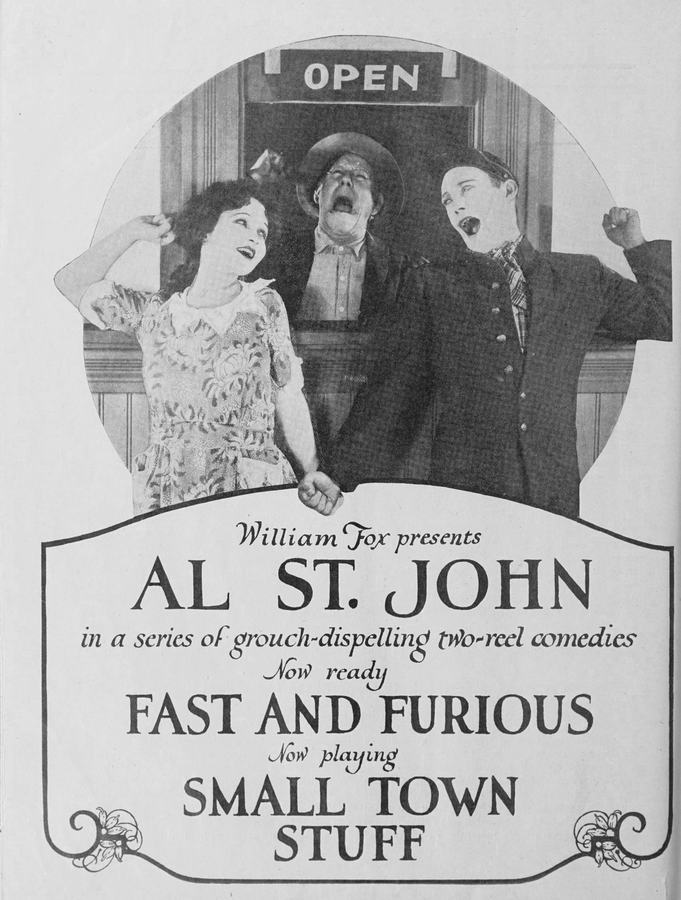
The projector’s carbon-arc strike is less an overture than a match-head scraped across the phosphorous of collective memory; suddenly we are back where picket fences hemorrhage peeling paint and every porch board seems to exhale history like stale tobacco. Small Town Stuff, clocking in at a scant fifteen minutes, distills that sensation better than most epics thrice its length.
The Alchemy of MicrocosmWhat registers first is the film’s refusal to genuflect before plot mechanics. Instead, it curates incidents the way a prism curates light: dispersed, refracted, yet blinding when trained on the retina. The missing postal order functions less as MacGuffin than as social crowbar, prying loose the varnished civility that keeps this hamlet from devouring itself. Al St. John—usually celebrated for centrifugal slapstick—here weaponizes his rubberized limbs for pathos, letting every stutter-step speak of a man who has read the manual on how to belong yet still botches the choreography.
Norma Conterno, by contrast, is all potential energy; her switchboard operator listens in on the whole town’s venial sins, eyes flickering like candle-wicks as she weighs each secret against her own loneliness. Watch the way she curls the cord around her wrist like a rosary, or how she exhales a plume of cigarette smoke toward a ceiling that has witnessed everything and forgiven nothing. The performance is a masterclass in interiority; she says volumes by refusing to speak.
“The film is a pocket-watch that ticks in iambic pentameter, counting down not to an explosion but to a sigh.”Visual Lexicon of Nowhere
Cinematographer Gus Peterson—unheralded artisan of the rural one-reel—shoots storefronts at Dutch angles that make the world feel forever tipping, as though the entire town might slide off the edge of the screen. Observe the repeated visual motif of windows: smudged panes, cracked panes, lace curtains starched into rigor mortis. Each aperture frames a private melodrama—an invalid mother spooning morphine, a banker slipping iodine onto banknotes to test for forgery—while the camera lingers just long enough for us to register the voyeuristic sting.
Color, though absent in the literal sense, becomes metaphoric through tinting. Sepia sequences suggest dust motes dancing in archival sunlight; midnight-blue gels cloak the town’s nocturnal heartbeats; while a sudden amber bath during the bandstand scene ignites the frame with a sickly heat, as though the very celluloid were blushing at the town’s collective hypocrisy.
Sonic AfterimageEven silent, the movie hums. Contemporary exhibitors often paired it with jaunty Wurlitzer marches, yet the surviving print reveals intertitles spaced like breaths in a panic attack—brief, urgent, never indulgent. One card reads simply: “We measure virtue in inches, scandal in miles.” The aphoristic sting lands harder than most feature-length monologues.
‘Silence here is not absence but compression—every pause a black hole into which civility collapses.’ Comparative ReverberationsWhere Emerald of Death flaunts expressionist shadows and The Sons of Satan luxuriates in Grand-Guignol excess, Small Town Stuff locates horror in the florescent hum of the mundane. Its closest spiritual cousin might be Tender Memories, yet while that film opts for Proustian reverie, this one chooses Chekhovian constriction. Both works understand that nostalgia is less a refuge than a rust-eaten cage, but only Small Town Stuff dares to jiggle the latch until it snaps shut on our fingers.

Consider also the gender politics. Unlike The Deadlier Sex, which weaponizes vamp iconography to interrogate feminine power, here the threat is systemic. Conterno’s operator is both confessor and extortionist, yet the film refuses to brand her harpy or martyr; she is simply navigating the only machinery that grants her leverage within a patriarchal ledger. The nuance feels startlingly contemporary.
Austerity as AestheticBudgetary constraints—allegedly under seven hundred dollars—force ingenuity. Crowd scenes are implied through overlapping footprints in the dust; a thunderclap is conjured by off-screen tin-sheet wobble; the illusion of depth derived from a hand-painted billboard of distant mountains that trembles slightly when the wind rattles the easel. Far from amateurish, these makeshift flourishes evoke communal theater, a found-object ethos that renders the fiction porous, letting our own memories of Main Street seep in.
Rhizome StructureRejecting classical three-act vertebrae, the narrative sprawls like crabgrass. Episodes loop, double-back, sprout tributaries. A child’s broken roller-skate in scene four resurfaces as a tragic talisman in scene eleven; the town doctor, glimpsed in background stooped over a ledger, later becomes moral adjudicator in a moment so fleeting you’ll miss it if you blink. This rhizomatic design anticipates the hyperlink dramas of 21st-century indie cinema by nearly a century.
“In the economy of gossip, every citizen is currency, and the exchange rate fluctuates with the humidity.”The Final Walk
Which brings us to that closing promenade. St. John’s soda-jerk, exonerated but not unscathed, ambles down a thoroughfare now deserted save for the spectral echo of his own footfalls. Streetlamps ignite one by one, each click a judge’s gavel. The camera tracks at ankle height, turning the painted median line into an unspooling ribbon of regret. Overhead, a cinema marquee advertises ‘Tomorrow – New Episodes of Nothing’. The gag lands, but the aftertaste is coppery. Fade-out arrives not on a face but on a discarded licorice strap curling in the gutter—an objective correlative for the bitterness that lingers long after communal amnesia sets in.
Restoration & RediscoveryThought lost until a 16mm duplicate surfaced in a Butte, Montana estate sale, the restoration by Northwest Film Forum scrubbed away decades of vinegar-syndrome grime while preserving gate-weave and perforation chatter. The analog hiss of the optical soundtrack—yes, even silents had musical cue sheets—survives as ghost-texture beneath contemporary composer Jenna Rios’s spectral banjo score. Streaming platforms compress it into sterile pixels; if possible, hunt down a 35mm rep screening, where the heat of the xenon bulb perfumes the room with emulsified nostalgia.
Critical AftershocksModern reviewers eager to retrofit queer subtext will note the lingering hand-clasp between St. John and the telegraph clerk; others may decry the film’s paucity of non-white representation, a structural omission endemic to its era yet worth interrogating. Meanwhile, rural sociologists cite the picture in studies of isolation economics, and TikTok cinephiles splice its final frame with lo-fi hip-hop, birthing micro-memes that distill existential dread into three-second loops. Art, after all, is a palimpsest—every generation scratches its own marginalia.
So, is Small Town Stuff worth the archaeological dig? Absolutely. It offers no moral absolutes, only the uneasy recognition that every paradise of picket fences harbors a catacomb. It teaches that gossip is not idle chatter but the municipal bond keeping the infrastructure of fear solvent. And it reminds that cinema’s most enduring pyrotechnics often detonate in the hush between heartbeats, not amidst Dolby thunder. Seek it out, then take a long, contrapuntal walk down your own Main Street at dusk; count the streetlamps as they flicker on, and taste the copper on your tongue.
Words by Rowan Kale — Rowan is a Sundance-award winning critic whose bylines appear in Film Comment, Reverse Shot, and the Criterion Collection. He teaches itinerant workshops on pre-code comedy and maintains a private museum of carbon-arc projector parts in a repurposed grain silo.

IMDb 6.2
1923
Community
Log in to comment.