DbcultAccessing Vault...
7.6/10
Senior Film Conservator
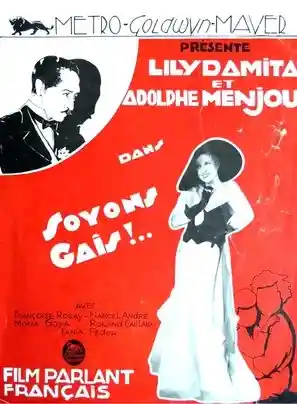
A definitive 7.6/10 rating for a film that redefined the boundaries of cult cinema. Soyons gais remains a cornerstone of transgressive art.
So, Soyons gais. Released in 1930, it’s one of those early French talkies that really gives you a peek into what cinema was doing back then. Is it worth tracking down today? Well, if you’re into the history of film, especially French comedies from this era, absolutely. You’ll probably enjoy the snappy, if sometimes very theatrical, dialogue.
But if you’re looking for modern pacing, big laughs, or anything that feels remotely contemporary, you might struggle. This one is definitely for the classic film buffs, the curious, maybe those who loved plays of the period. Anyone else? Probably a hard pass. It’s a very particular flavor.
The whole thing centers on this socialite named Kitty, played by Lili Damita. She’s divorced, and apparently, the social scene is just buzzing with talk about her. The setup feels very much like a drawing-room play, which makes sense given its origins.
There’s a dinner party, of course. Kitty ends up getting invited to a place where her ex-husband, Bob, will also be. And he’s got a new lady friend. Awkward, right? That’s the basic thrust, leading to all sorts of misunderstandings and a bit of playful revenge.
What really strikes you, especially in those early scenes, is how deliberate everything feels. The camera often just sits there. You get a whole shot of people entering a room, then another shot of them settling into chairs. It takes its time. Sometimes, it takes too much time.
Lili Damita, she’s got this incredible screen presence, even if the sound quality sometimes makes her lines a little muffled. There's a moment when she delivers a sarcastic remark, and her eyes just flicker. You almost miss it, but it's there. A tiny, perfect little detail. Like she’s totally in on the joke, even if no one else is. 🤔
Françoise Rosay, as Clara, plays the role of the older, wiser friend. Her lines are often the most grounded. She’s the one who tries to make sense of the chaos, though sometimes she just adds to it with her own pronouncements. She has this way of raising an eyebrow that speaks volumes without a single word. A real pro, even back then.
The pacing, oh boy. There are stretches where it feels like the movie is just… waiting for someone to remember their next line. Not in a bad way, exactly, more like a stage play pausing for effect. But for film, it can feel a bit drawn out. Especially when the background noise of the set is more noticeable than the actual dialogue. 🎧
One scene, early on, has Marcel André as Bob trying to flirt with a new woman. His attempts are just hilariously clumsy. He keeps adjusting his tie, or fumbling with his glass. It’s a very human touch, that awkwardness. You can almost feel him trying to be charming. It doesn't quite land, and that’s the point.
The costumes are super elegant, which is expected for the period and setting. But then you notice these little things. Like a wrinkle in someone's dress that wasn't quite smoothed out, or a piece of hair that just won't stay put. Small, real world bits that make it feel a little less perfect, a little more alive.
There’s a subplot about mistaken identities later on. It’s pretty standard farce stuff. But the way they handle it, with hushed whispers and exaggerated glances across the room, it's genuinely charming. It reminds you how much of comedy relies on physical staging, even when the sound is new.
What I found myself thinking about most was the courage it must have taken to make these early talkies. The technology, it’s not quite there yet. The sound drops out sometimes, or it gets fuzzy. But everyone just keeps going. The sheer will to make it work is palpable.
It’s not a film that will sweep you off your feet with grand visuals. The sets are pretty basic, functional. But they serve their purpose, creating that upper-crust, slightly claustrophobic world these characters inhabit. That one lamp in the corner of the dining room? It’s always on, casting this strange, yellow glow. I kept wondering if it was meant to be ominous or just… poor lighting.
The film gets noticeably more lively in the second half, once everyone’s cards are on the table, so to speak. The emotional stakes, while still light, feel a bit more present. The rapid-fire exchanges between Lili Damita and Marcel André actually become quite fun to watch. They finally seem to hit a rhythm.
It’s a curious artifact, this one. A window into a different time of filmmaking. Not perfect, not always smooth, but full of these little moments that sparkle. You really do get a sense of the early days of sound, when everyone was figuring it out. And for that alone, it’s a neat experience.
It's an okay watch, especialy if you like to see how films evolved. A definite nod to the stage. 🎭
IMDb —
1920
Community
Log in to comment.