DbcultAccessing Vault...
Cult Review
Senior Film Conservator
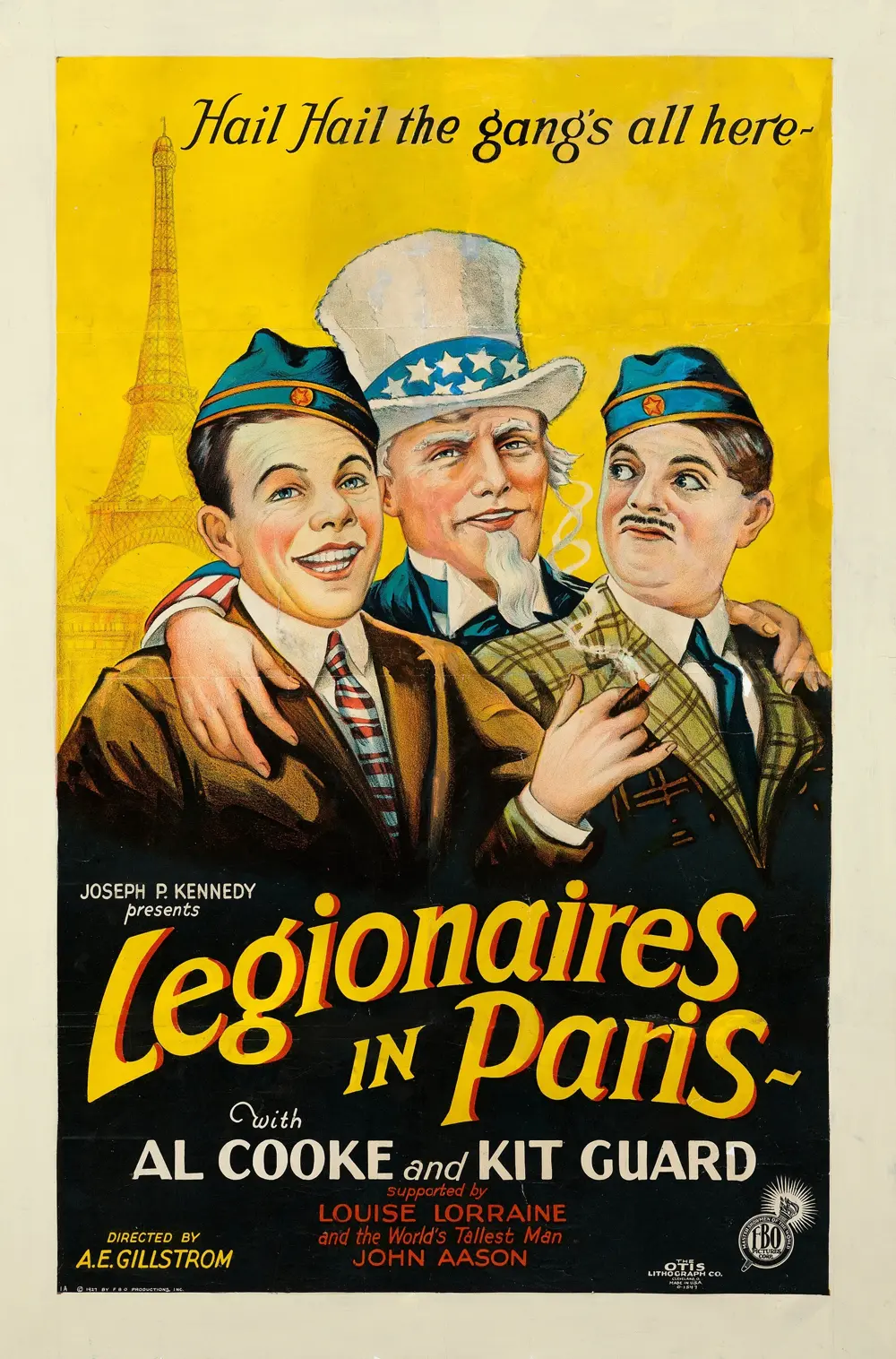
Should you spend your time on a nearly century-old comedy about two panicked soldiers? Short answer: yes, but only if you have a high tolerance for the manic, unrefined energy of late-1920s slapstick that prioritizes motion over logic.
Legionnaires in Paris is specifically for silent film enthusiasts who want to see how the 'buddy comedy' archetypes were being forged outside of the major studios. It is definitely not for those who require a sophisticated plot or high-stakes emotional resonance.
1) This film works because it captures the genuine, unbridled chaos of post-war relief, using the setting of Armistice Day not just as a date, but as a catalyst for narrative hysteria.
2) This film fails because the central conflict—the mistaken belief that they killed a man—is stretched so thin that it threatens to snap well before the third act begins.
3) You should watch it if you are a fan of physical performers like Kit Guard or if you want to see a rare appearance by the 8-foot-tall John Aasen in a comedic role.
The film opens with an energy that mirrors the frantic nature of Buster Keaton’s Cops, but without the surgical precision of Keaton’s geometry. Here, the movement is messier. Kit Guard and Al Cooke play their roles with a wide-eyed desperation that feels almost exhausting. They aren't just characters; they are human pinballs bouncing off the architecture of a studio-backlot Paris.
The inciting incident is a classic comedy-of-errors trope. A scuffle, a fall, and a motionless body lead our protagonists to conclude they are murderers. It’s a dark premise for a light comedy, but the film treats the threat of the law as a cartoonish monster. The way they scramble away from the scene—tripping over their own gear and each other—sets a tone of perpetual motion that rarely lets up.
There is a specific scene in a crowded cafe where the soldiers attempt to blend in while clearly vibrating with guilt. The contrast between the celebrating Parisians and the sweating Americans provides the film's best visual humor. It is a study in social paranoia. They see every gendarme as a personal executioner. It works. But it’s flawed by its own redundancy.
Louise Lorraine provides a necessary grounding element, though her role is largely reactive. Having transitioned from action serials, she brings a certain physical capability to the screen that keeps her from being a mere damsel. However, the real visual hook is John Aasen. Standing at over eight feet tall, Aasen’s presence creates a surrealist edge to the chase.
In one sequence, the soldiers attempt to hide behind what they think is a large pillar, only for the 'pillar' to walk away. It’s a gag that has been repeated in cinema for decades, but seeing it executed with Aasen’s genuine scale gives it a primitive, visceral power. The film leans heavily into the 'big vs. small' dynamic, which was a staple of the era but feels particularly aggressive here.
The chemistry between Guard and Cooke is functional, if not legendary. They lack the poetic synchronization of Laurel and Hardy, but they possess a gritty, vaudevillian timing. They hit each other hard, they fall fast, and they sell the terror of the situation with every muscle in their faces. It is performance as endurance art.
Directorially, the film is a product of its time—efficient and largely invisible. The camera stays wide enough to capture the physical comedy but lacks the inventive angles found in more prestigious contemporary works like Le brasier ardent. The lighting is flat, designed to ensure every pratfall is visible, which robs the 'Paris at night' scenes of any actual atmosphere.
The writing, credited to a trio including Jefferson Moffitt, is a series of 'and then' moments. There is little 'therefore.' The soldiers run here, and then they hide there, and then they meet a girl. It’s a picaresque of panic. Yet, there is a charm in its simplicity. It doesn't pretend to be an exploration of the trauma of war; it treats the end of the Great War as the beginning of a great big joke.
Compare this to the structural tightness of Two A.M., and you’ll see where Legionnaires in Paris struggles. It feels like a two-reeler that was stretched into a feature. The padding is obvious in the middle section, where the soldiers hide in a series of increasingly improbable locations. The pacing stutters when it should soar.
Yes, if you are looking for a window into the transition of silent comedy. It shows the bridge between the short-form slapstick of the early 20s and the more narrative-heavy comedies of the 30s. It is a loud, physical experience that manages to be entertaining despite its repetitive nature.
Pros:
Cons:
There is a strange, almost nihilistic undercurrent to the comedy here. These men have just survived a world war, yet their primary fear is not death, but the embarrassment and legal repercussion of a bar fight gone wrong. It suggests a world where the 'peace' is more terrifying than the 'war' because the rules of peace are harder to navigate. They were heroes in the trenches, but they are incompetent fugitives in a cafe.
Legionnaires in Paris is a frantic, sweaty, and occasionally hilarious relic. It doesn't have the soul of Chaplin or the brain of Keaton, but it has the heart of a circus performer who refuses to stop juggling until the audience leaves. It is a minor work, but for those who love the era, it’s a trip worth taking. It’s loud. It’s fast. It’s slightly annoying. But it works.
IMDb —
1917
Community
Log in to comment.