DbcultAccessing Vault...
Cult Review
Senior Film Conservator
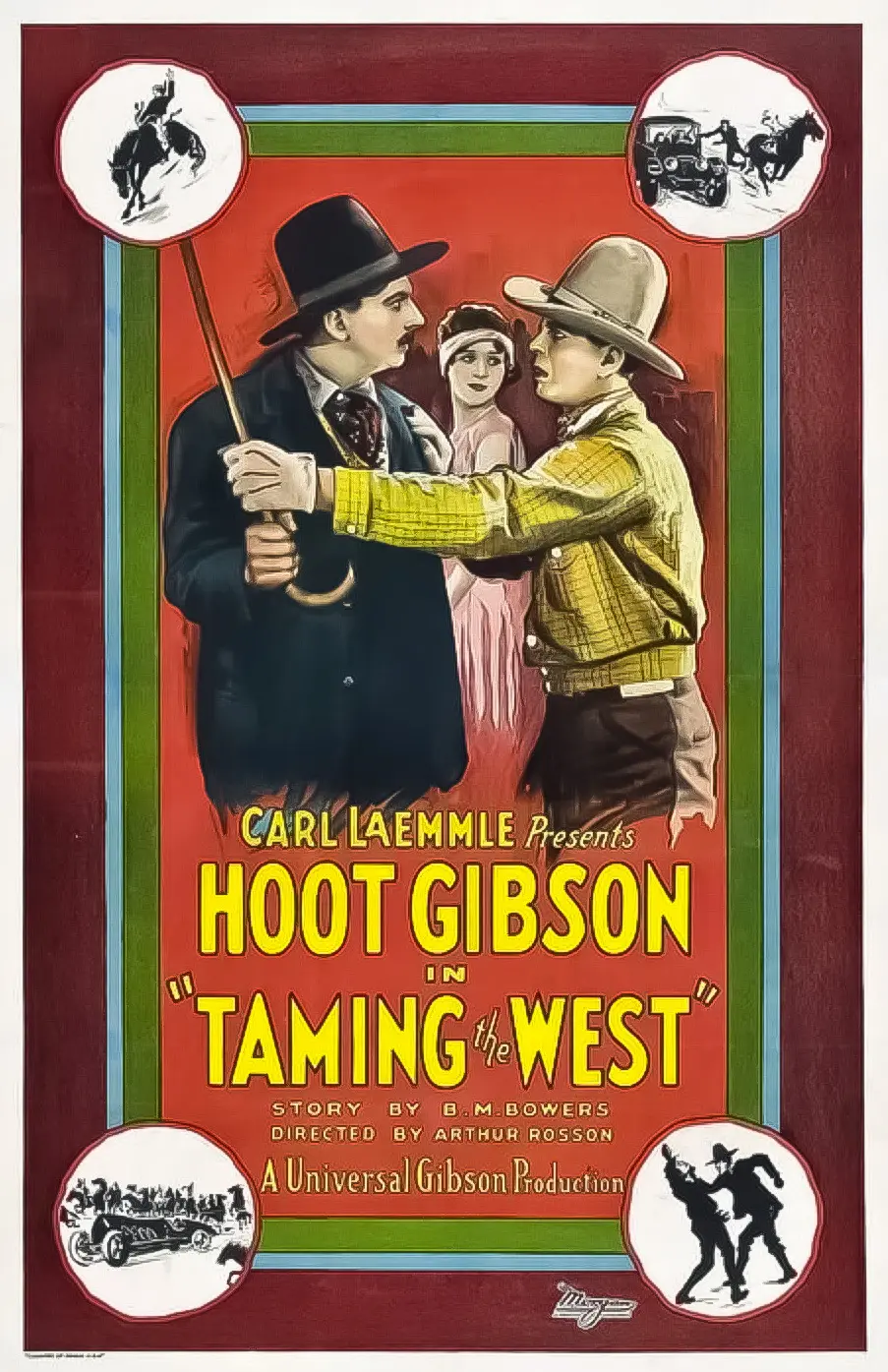
Is Taming the West a hidden gem of the silent era? Short answer: yes, but only if you value the kinetic energy of physical comedy over a narrative that avoids easy clichés.
This film is tailor-made for enthusiasts of early Hollywood stunt-work and those who enjoy seeing the 'city slicker' trope executed with genuine charm; it is decidedly not for viewers looking for the psychological depth of a modern revisionist Western.
This film works because Hoot Gibson possesses a kinetic, self-deprecating charm that bridges the gap between high-stakes action and slapstick comedy.
This film fails because the central conflict between the two fathers—the very engine of the drama—is resolved with a hasty handshake that undermines an hour of tension.
You should watch it if you want to see the exact moment the Western genre shifted from grim morality plays to crowd-pleasing entertainment.
The visual language of 1925 was often blunt, and Taming the West uses John Carleton’s golf suit as a loud, plaid symbol of Eastern decadence. When Hoot Gibson steps off the train, he isn't just a character; he is a punchline. The contrast between his checkered knickers and the dusty, utilitarian leather of the cowhands creates an immediate visual friction that drives the first act. It is a classic setup seen in films like The Nervous Reporter, where the protagonist must shed their urban skin to find their true self.
But Gibson doesn’t play Carleton as a weakling. Instead, he plays him as a man with latent talent who simply hasn't found the right context. The bronco-riding scene is the film's first major pivot. It is not just a stunt; it is a baptism. As the horse bucks and twists, the camera stays remarkably steady, capturing the genuine athleticism required for the role. There are no quick cuts to hide a stunt double here. It is raw, dusty, and effective. It works. But it’s flawed in its predictability.
Yes, for anyone interested in the evolution of the Western hero. Hoot Gibson was the antithesis of the stoic, almost biblical figures played by William S. Hart. In Taming the West, he offers a blueprint for the modern action hero: someone who can fight, ride, and joke in equal measure. While the plot is thin, the charisma of the lead performance carries the weight of the film.
Director Arthur Rosson understood that the audience wasn't there for a lecture on ranching ethics; they were there for the thrill. The pacing is relentless once John arrives at the King ranch. The fight scenes are choreographed with a frantic energy that feels more like a dance than a brawl. Unlike the more static dramatic beats found in The Third Degree, Rosson keeps the camera moving, mirroring Carleton’s own transition from a static city boy to a dynamic man of the West.
The party scene, where John dances with Beryl, provides a necessary breather. Marceline Day brings a sweetness to Beryl, though the script gives her little to do beyond being the object of affection. However, her chemistry with Gibson is palpable during the elopement sequence. The way they navigate the social landmines of the village party adds a layer of 'Romeo and Juliet' tension that, while unoriginal, is executed with a light touch. It reminds one of the romantic tension in Stop That Wedding, though with significantly more dust and gunpowder.
If there is a significant gripe to be had, it is the resolution of the Carleton-King feud. For an hour, we are told these men are bitter enemies. Their hatred is the primary obstacle to John and Beryl's happiness. Yet, when the wedding bells loom, the animosity evaporates with a speed that defies logic. It is a narrative shortcut that feels unearned. The film prioritizes a 'happy ending' over a satisfying thematic conclusion. In a more grounded film like Two Moons, such a conflict might have ended in tragedy or at least a more complex compromise.
"The ending is a total cop-out, trading genuine character growth for a tidy bow that the audience likely didn't even ask for."
Despite this, the final chase to the wedding is a masterclass in silent film editing. The cross-cutting between the irate father, the fleeing lovers, and the arriving Carleton Senior creates a sense of mounting chaos that is genuinely fun to watch. It is in these moments—the pure, unadulterated movement—that Taming the West finds its soul. It doesn't need to be deep when it is this fast.
The cinematography by Harry Neumann is surprisingly sophisticated for a mid-20s Western. He utilizes the natural light of the California locations to create a sense of vastness that contrasts with the cramped, structured life John left behind in the East. There is a specific shot during the elopement where the silhouettes of the horses against the horizon evoke a sense of freedom that words simply cannot capture. It is a far cry from the stagey, indoor feel of La belle Russe.
Furthermore, the supporting cast, featuring veterans like Francis Ford, adds a layer of authenticity to the ranch scenes. Ford, the brother of legendary director John Ford, brings a weathered credibility to the background that balances Gibson's more flamboyant performance. It is this mixture of the old-school Western grit and New-School Hollywood comedy that makes Taming the West such an interesting artifact of its time.
Taming the West is a brisk, enjoyable romp that prioritizes entertainment over artistry. While it won't challenge your worldview, it will certainly make you appreciate the physical demands of early filmmaking. Hoot Gibson proves why he was one of the biggest stars of his era, turning a simple 'fish-out-of-water' story into a showcase for his undeniable charisma. The golf suit may be a joke, but the film’s commitment to fun is dead serious. It is a lighthearted journey that, despite its narrative shortcuts, remains a vital piece of the Western genre's DNA.
IMDb 5.2
1934
Community
Log in to comment.