DbcultAccessing Vault...
Cult Review
Senior Film Conservator
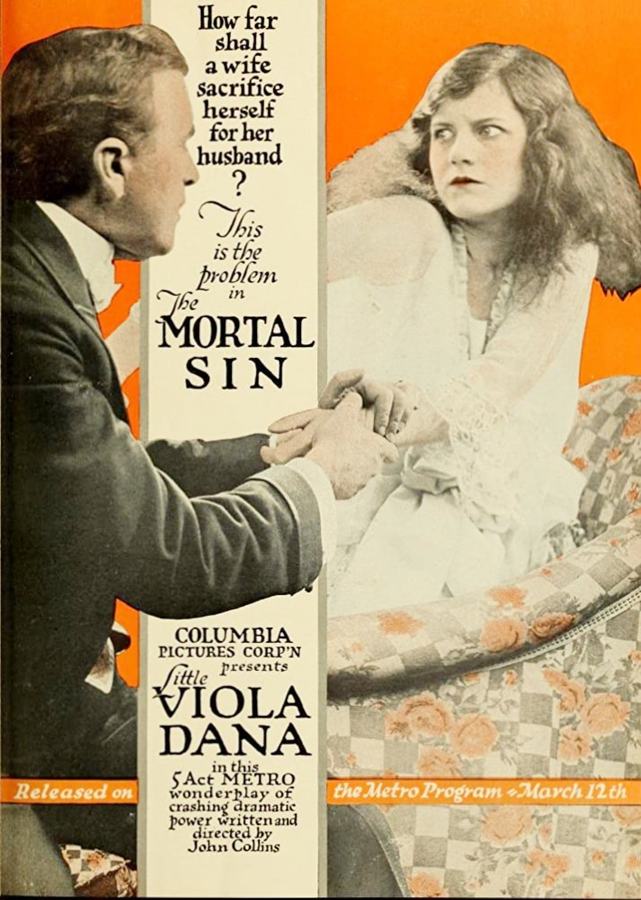
"The Mortal Sin" unfurls not merely as a melodrama of its era, but as a surprisingly sophisticated psychological drama, a chilling premonition woven into the fabric of a struggling artist's tormented subconscious. It’s a film that dares to explore the perilous intersection of creative ambition, marital devotion, and the brutal realities of societal judgment, all wrapped within a meta-narrative structure that elevates it beyond a simple tale of woe. Far from a straightforward morality play, John H. Collins’ narrative plunges us into the fevered mind of George Anderson, a man whose artistic vision is both his salvation and his potential undoing. The film, in its quiet intensity, asks profound questions about the nature of sacrifice, the price of integrity, and the insidious ways in which external pressures can corrupt even the purest intentions.
At its core, the film presents a searing indictment of the commodification of art and the cynical forces that shape public perception. George Anderson, portrayed with a palpable sense of weary determination by Louis B. Foley, is a writer consumed by his magnum opus, "The Mortal Sin." His novel, a daring exploration of a wife's ultimate sacrifice – her honor – to save her husband from consumption, and his subsequent, enlightened forgiveness, is a testament to an idealistic view of love and redemption. Yet, this noble pursuit is juxtaposed with the grim reality of his daily existence: a thankless clerical job under the imperious Emmet Standish, a publisher embodied by Augustus Phillips with an almost villainous pragmatism. Standish represents the antithesis of artistic idealism, a man who believes only in narratives that reinforce conventional morality and, crucially, sell. This tension between George’s artistic integrity and Standish’s commercial cynicism forms the bedrock of the film's initial conflict, a struggle that feels timeless in its depiction of the artist's eternal plight.
The descent into George’s dream-state begins subtly, mirroring the gradual erosion of his health. The doctor's grim prognosis, delivered with stark finality, that only a trip west can save him, injects a terrifying urgency into their already precarious lives. It’s here that Viola Dana, as Jane, steps into the narrative’s emotional spotlight, delivering a performance of quiet strength and burgeoning desperation. Her decision to take George's place in Standish's office is born of pure, selfless love, a sacrifice that echoes the very theme of her husband’s unread manuscript. This act of devotion, however, inadvertently exposes her to the predatory gaze of Standish, whose initial 'consideration' quickly morphs into something far more sinister. The scene where Jane, emboldened by a false sense of rapport, presents George’s novel to Standish is a masterclass in dramatic irony. His outright rejection, predicated on the cynical assertion that "no man would forgive his wife for having been unfaithful to him, no matter what her motive," is a direct challenge to George’s artistic and moral vision. It's a moment that resonates with the brutal honesty of the era's social mores, yet simultaneously foreshadows the profound moral compromises Jane will be forced to make.
Jane’s subsequent struggles – her fruitless attempts to place the novel elsewhere, her desperate turn to posing for Rambeau, the artist, for his painting of the Madonna – are presented with a mounting sense of tragic inevitability. The Madonna imagery, in particular, is a poignant touch, contrasting her external portrayal of purity with the internal moral labyrinth she is forced to navigate. When Standish, the architect of her despair, finds her in a cheap lodging house, the stage is set for the ultimate Faustian bargain. Driven by increasingly desperate pleas from her husband, who believes her still employed and capable of sending funds, Jane agrees to become Standish’s mistress in exchange for the publication of George’s novel. This is where the film truly darkens, delving into the harrowing depths of female sacrifice in a patriarchal society. Unlike the more straightforward moral quandaries in films such as Her Great Hour, where a woman's sacrifice might be for a more immediate, tangible outcome, Jane's deal with Standish is a slow, agonizing erosion of her self, made even more bitter by the necessity of altering her husband’s work. Her agonizing revision of the novel’s ending – transforming forgiveness into brutal retribution – is a visceral representation of her own violated spirit, a chilling testament to how external pressures can distort artistic truth and personal integrity.
The success of the revised novel is a cruel irony, funding George’s recovery while simultaneously cementing Jane’s degradation. The narrative then builds to its devastating climax: George’s unexpected return, hale and hearty, only to stumble upon the horrifying truth. His arrival at Standish’s home, his discovery of a “Mrs. Standish,” and his subsequent, furious confrontation with Jane, are moments steeped in a profound sense of tragic misunderstanding. He, the author of a story of forgiveness, is utterly incapable of extending it to his own wife. His violent act, the cold-blooded strangulation of Jane, is a brutal echo of the revised ending of his own novel, a horrifying blurring of fiction and reality. It’s a moment that could easily descend into sensationalism, but the film maintains a gripping, almost operatic intensity, driven by the raw emotion of the performances.
However, it is the film’s ultimate twist that truly elevates it, transforming a conventional tragedy into a meta-narrative masterpiece. The sudden revelation that the entire harrowing sequence – Jane’s sacrifice, the publisher’s betrayal, George’s murderous rage, and his impending execution – was nothing more than a feverish dream, a terrifying projection of George’s anxieties, is a stroke of narrative genius. This dream device, while sometimes used as a cheap escape in lesser films, here serves to underscore the profound psychological depth of George’s character. It’s not merely a cop-out; it’s an exploration of the artist’s subconscious fears: the fear of failure, the fear of his wife's suffering, the fear that his idealistic vision of love and forgiveness is ultimately untenable in a cynical world. This narrative framing allows the film to explore truly dark and morally complex themes without committing to a relentlessly bleak ending, offering instead a cathartic resolution where George, awakened by Jane, renounces his morbid novel and vows to prioritize his health and, implicitly, their shared reality over the fictional horrors his mind concocted.
The performances, though rooted in the acting styles of the era, convey the emotional weight of the story with remarkable clarity. Viola Dana, in particular, imbues Jane with a quiet dignity that makes her sacrifices all the more heartbreaking. Her transformation from hopeful wife to desperate woman, and finally to the victim of her husband's dream-rage, is handled with a nuanced sensibility. Louis B. Foley’s portrayal of George is equally compelling, capturing the artist’s intensity, his physical frailty, and ultimately, his terrifying descent into a nightmare of his own making. The supporting cast, including Ricca Allen, Henry Leone, Robert Walker, and Lady Thompson, contribute effectively to the film's dramatic texture, creating a believable world for this psychological drama to unfold.
Comparing its intricate narrative to simpler melodramas of the era, such as Hands Across the Sea or even The Infant at Snakeville, "The Mortal Sin" stands out for its ambitious thematic scope and its willingness to delve into the darker corners of human motivation. While films like The Devil's Needle explored social ills with a blunt force, "The Mortal Sin" probes the internal landscape of its characters with a more subtle, yet equally impactful, hand. The psychological realism of George’s dream, and its profound impact on his waking life, anticipates later cinematic explorations of consciousness and narrative subjectivity. It reminds one of the deep psychological dives seen in films like Man and His Soul, albeit with a unique, self-reflexive twist. The moral ambiguity surrounding Jane’s choices and Standish’s machinations offer a more complex ethical landscape than many contemporary pictures, making it a compelling watch even today.
The film’s exploration of artistic integrity versus commercial viability remains acutely relevant. Standish’s pronouncement that George’s original ending is "untrue to life" because it doesn't align with conventional, punitive morality speaks volumes about the pressures faced by creators. Jane's agonizing decision to compromise her husband's vision to save his life is a potent symbol of the sacrifices artists and their loved ones often make, and the ethical dilemmas they face when their work must appeal to a mass market. It’s a commentary on the eternal struggle between art for art's sake and art as a commodity, a theme explored in various ways throughout cinematic history, but rarely with such personal and devastating consequences for the characters involved, even within a dreamscape.
In conclusion, "The Mortal Sin" is a fascinating and often disturbing film that transcends its melodramatic trappings through its ingenious narrative structure and its profound psychological insights. It’s a testament to the power of dreams as a mirror to our deepest fears and anxieties, and a poignant exploration of the sacrifices made in the name of love and art. The film challenges its audience to consider the fine line between reality and imagination, and the devastating consequences that can arise when those boundaries blur. Its enduring appeal lies not just in its dramatic tension, but in its sophisticated use of a dream narrative to explore universal themes of love, betrayal, artistic compromise, and the ultimate redemption found in choosing life over the seductive, yet destructive, power of a tragic vision. It demands a re-evaluation, positioning itself as a quietly groundbreaking work that dared to look beyond surface narratives into the complex, often terrifying, landscape of the human mind.
IMDb 6.9
1936
Community
Log in to comment.