DbcultAccessing Vault...
Cult Review
Senior Film Conservator
If you are the kind of person who enjoys looking at grainy black-and-white textures and doesn't mind a story that moves like molasses, then yes. You should watch it today.
However, if you need explosions or fast-paced dialogue, you are going to absolutely hate this. It’s a movie for people who like to look at the corners of the frame.
It’s a melodrama, through and through. It feels like a stage play that someone decided to film at the last minute.
There is this one scene near the beginning where the shadows on the wall are so big they look like monsters. It’s clearly a choice by the director, but it makes the living room feel like a haunted house.
The acting by Juan José Martínez Casado is... well, it's a lot. He has this way of looking off into the distance like he’s seeing a ghost, even when he’s just talking about dinner.
I found myself staring at the background extras more than the main cast. They look so uncomfortable, like they were told not to move a single muscle or they’d ruin the sound recording.
Speaking of sound, the audio has this constant hiss. It’s like the movie is breathing at you.
It reminded me a bit of the atmosphere in Nuestra Natacha, though that one feels a bit more modern in its head. This one is stuck in the past.
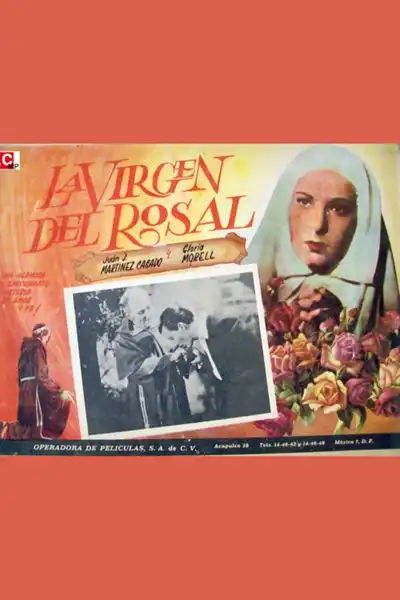
The movie is called The Blessed Rosebush, so obviously, the plant is important. But honestly, it’s just a plant.
There is a shot where the camera lingers on the roses for so long I thought the film had jammed. It’s supposed to be symbolic, I guess.
The writers, Antonio Sáenz and Juan Bustillo Oro, clearly wanted this to be a big statement on faith. Bustillo Oro went on to do much bigger things later, but here you can see him struggling with the weight of the drama.
Sometimes the dialogue is so heavy it feels like the actors are lifting weights with their tongues. It’s very 1930.
It’s slow. Really slow. Like, 'watching paint dry in a damp basement' slow.
But there’s a beauty in that. We don't get movies that just sit anymore.
Every time a character enters a room, they have to walk across the whole floor. We see every single step.
It makes the house feel like a real place, not just a set. Even if the set looks like it’s made of cardboard.
It lacks the nationalistic punch of something like Bir Millet Uyaniyor. It’s much more private and small.
The final ten minutes are where everything finally boils over. It’s a lot of crying and very loud music.
I’m not sure if the emotional payoff actually works. I felt more tired than moved by the time the credits rolled.
Still, I kept thinking about that rosebush. Why was it so important? I don't think the movie ever really answers that in a way that makes sense to a modern brain.
It just is.
I wrote down 'too many candles' about halfway through. Seriously, the fire hazard in this house must have been insane.
The movie is a bit like looking at an old family photo of people you don't know. You don't know their names, but you can feel their sadness anyway.
It’s not a masterpiece. It’s a curiosity.
If you’ve seen The Market of Vain Desire, you’ll recognize that same obsession with social standing and 'what the neighbors think.'
I’m glad I watched it, but I don't think I’ll ever watch it again. Once is enough for this kind of blessing. 🌹
The lighting in the garden scenes is actually quite pretty, even if it looks totally fake. It has that dream-like quality that early cinema does so well by accident.
You can tell they were trying so hard to be serious. Sometimes that effort is more interesting than the story itself.
Anyway, go watch it if you want to see where Mexican cinema started its long walk toward the Golden Age. Just bring some coffee.
IMDb 4.7
1932
Community
Log in to comment.