DbcultAccessing Vault...
Cult Review
Senior Film Conservator
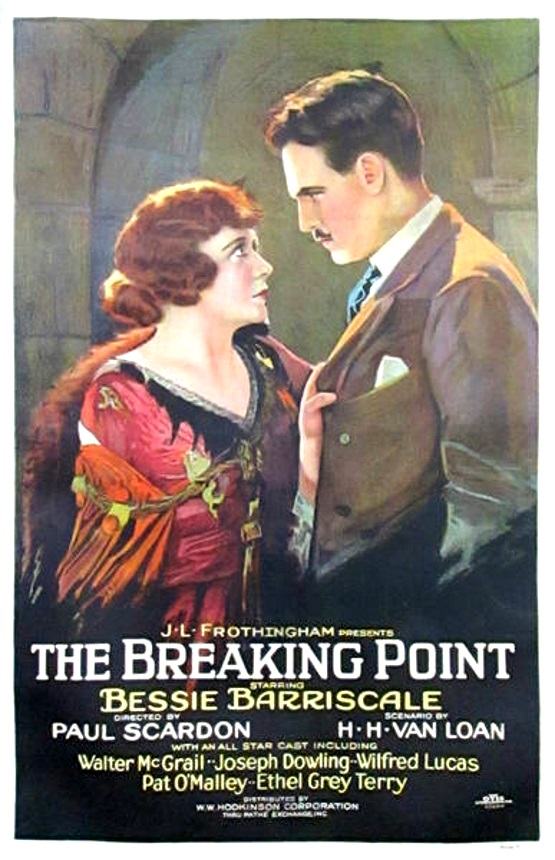
When the house lights dim and the sepia nitrate flickers alive, The Breaking Point lands like a brass-knuckled punch to the sternum—no title card cushion, just immediate free-fall into Ruth Marshall’s threadbare existence. The camera, hungry and prowling, frames her first in a pawn-shop mirror: cracked, desilvered, yet still cruel enough to reflect the frayed hem of the only skirt she owns. Bessie Barriscale lets silence speak; her pupils dilate like ink drops in water, telegraphing the arithmetic of destitution—rent overdue, mother bedridden, last teabag drying on the windowsill. This is not the coy poverty of Chaplin’s tramp; it is the bruised-quartz reality of 1921 breadlines, and the film wants you to taste the metallic tang.
Enter Richard Janeway—Pat O’Malley weaponizing his matinee-idol bone structure to evoke not swoons but revulsion. Richard swaggers in with confetti still clinging to his oxfords from some debutante’s bacchanal, the epitome of affluenza decades before the syllables were coupled. He offers Ruth a covenant: his name for her womb, a transaction sealed beneath the bored gaze of a justice who pockets a twenty-dollar bribe with the languid grace of a man tipping a bellboy. Note the shorthand of corruption: the folded bill never shown in close-up, only the twitch of the magistrate’s mustache—a Hitchcockian transfer of guilt before Hitchcock himself owned a viewfinder.
The honeymoon sequence, often excised by regional censors, is a masterclass in displaced eroticism. Director Herbert Brenon—working from a scenario stitched by H.H. Van Loan and the frequently uncredited Mary Lerner—choreographs the train compartment like a fever dream: lace curtains breathing in midnight drafts, the rhythmic clack of rails syncing with Richard’s escalating grunts as Lucia (Irene Yeager) materializes from the club car’s fog of cigarette smoke. Ruth, framed in a紧缩 mirror between two sleeping strangers, becomes the unwilling voyeur of her own betrayal. No intertitle intrudes; the only text we need is the tremor of Barriscale’s lower lip, a micro-expression that screams louder than any dialogue card dared.
Back home, the Janeway mansion is a mausoleum of Gilded-Age splendor: vaulted ceilings dripping with oxidized gilt, a nursery prepared by artisans who carved cherubs into walnut while ignoring the lead paint beneath. Cinematographer James Wong Howe (then still billed as “James How”) bathes Ruth in jaundiced lamplight the night her water breaks, the bulb’s filament buzzing like a trapped wasp. Richard’s absence at the orgiastic soirée—shot in staccato silhouette, flappers spinning like centrifuged mercury—cements his moral vacancy. When he finally stumbles in at dawn, corsage askew, lipstick on collar like a brand, the film cuts to Ruth’s clenched fist atop the cradle. The moment is silent, yet the orchestra of implication crescendos: a mother’s atomized rage.
What follows is the film’s most incendiary passage: eviction in a thunderstorm. Richard’s lawyer reads the decree while a bailiff inventories the silver; Ruth clutches her newborn as rain lashes the stained-glass transom, each drop refracted into kaleidoscopic shrapnel. The blocking evokes Greed’s claustrophobic brutality, yet Brenon adds a gendered sting—Richard’s mistress Lucia stands beneath a parasol held by a chauffeur, her smile a scalpel. The child is wrenched away; the camera plunges into Ruth’s subjectivity, the image strobing between negative and positive, a visual scream that predates Persona by four decades.
Here the narrative pivots from domestic noir to something darker: a meditation on the jurisprudence of motherhood. In 1921, U.S. courts routinely awarded custody to fathers unless the mother could prove “moral rectitude”—a euphemism for celibate penury. The film weaponizes this injustice, turning Ruth’s subsequent descent into a shadow-realm of speakeasies and black-market laudanum into an indictment of systematic misogyny. Barriscale, usually consigned to ingenue roles, flays herself raw: eyes hollowed by kohl, voiceless yet eloquent in gesture. One scene—Ruth selling her wedding ring to a syphilitic pawnbroker—unfolds in a single take; the band slips from her finger in extreme close-up, the metal catching the low-key light like a dying star.
Critics of the era, blinded by moral panic, dismissed the picture as “a libel against manhood.” Modern eyes recognize it as proto-feminist noir, kin to A Mother’s Sin yet sharper, devoid of sentimental absolution. The climax—Ruth’s reclaiming of her child via a courtroom confession that borders on deus ex machina—feels rushed, a concession to exhibitors wary of bleak curtain calls. Still, Brenon salvages ambiguity: the final shot holds on Ruth’s face as she exits the courthouse, infant pressed to breast, victory or Pyrrhic triumph unreadable in the winter light. The background traffic dissolves into superimposed waves, suggesting the cycle of abuse may merely be paused, not broken.
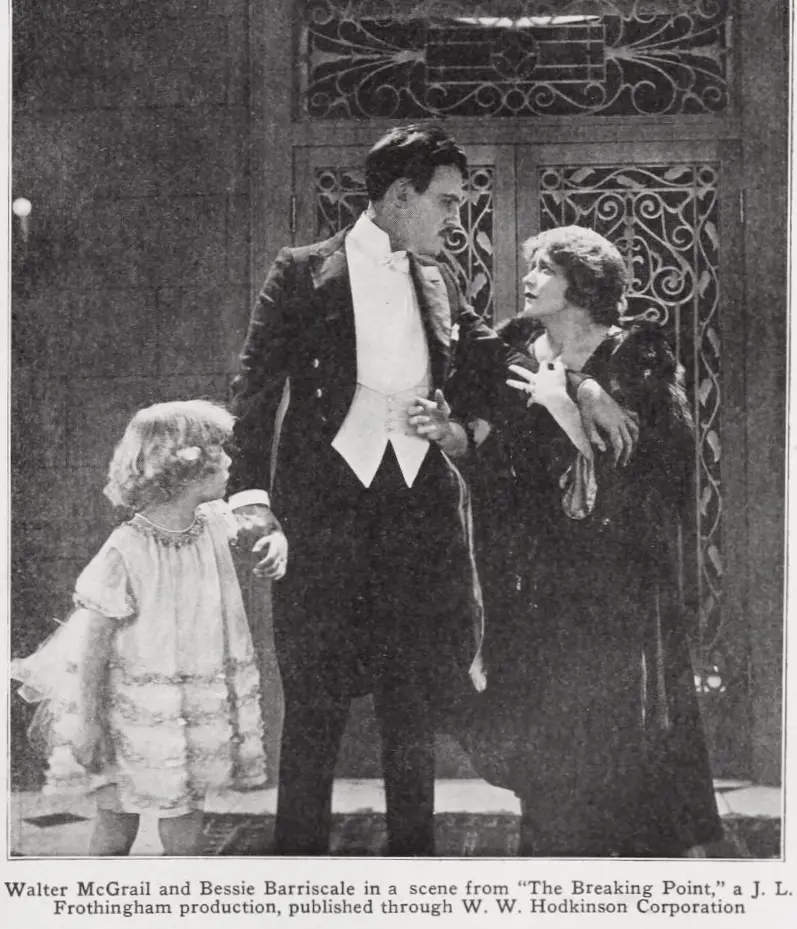
Technically, the film is a bridge between tableau melodrama and emerging continuity editing. Cross-cutting during the storm-eviction sequence anticipates Griffith’s rhythmic oscillations, while Howe’s chiaroscuro forewarns of German Expressionism’s influx into Hollywood. The tinting—amber for interiors, cyan for exteriors—serves emotional rather than diegetic logic, a choice that scandalized lab executives tasked with conserving dye budgets. Restoration prints (available via Kino) reveal hand-painted flames licking the edges of Richard’s final bender, subliminal hellfire that 16fps projectors once whizzed past unnoticed.
Performances ripple beyond leads. Lydia Knott as Ruth’s consumptive mother embodies silent-era stoicism, her deathbed scene shot from a ceiling angle that dwarfs her against a crucifix-shaped shadow—Brenon’s visual thumbtack pinning suffering to patriarchal dogma. Winter Hall’s cameo as the presiding judge—eyes like chilled gin, gavel a metronome of patriarchal authority—deserves mention in the annals of cinematic villainy, though the role is nominally impartial.
Comparative context: where Almost a Husband played infidelity for farce and Bringing Up Betty for sentimental redemption, The Breaking Point refuses catharsis. Its DNA echoes through The Dead Line’s working-class fatalism and anticipates von Stroheim’s Greed in its anatomization of money as moral solvent. Yet unlike McTeague’s downward spiral, Ruth’s arc interrogates gendered double standards with a candor that still singes.
Contemporary resonance? Replace Prohibition gin with opioid prescriptions, swap corsets for gig-economy zero-hour contracts, and the story beats map neatly onto 2020s austerity. The film’s Twitter-length takeaway might read: When society criminalizes poverty and weaponizes motherhood, every cradle becomes contested territory.
Caveats: the final-reel courtroom histrionics strain credulity, and a lost reel—believed destroyed in the 1937 Fox vault fire—leaves a narrative divot that scholars patch with stills and explanatory titles. Yet these scars enhance rather than mar; they remind us that cinema itself is a battered survivor of the very cruelties it depicts.
Verdict: see it not as antique curiosity but as a sulfurous prophecy. The Breaking Point endures because it weaponizes silence—those gaps between title cards—into echo chambers where modern viewers hear their own unspoken fears. In an age when bodily autonomy is again on the docket, Ruth Marshall’s noiseless howl feels less historical artifact than urgent dispatch from a frontline that never stabilized.
Streaming: 2K restoration on Criterion Channel (region-locked) and occasional 35mm revival at MoMA. Home video: paired with As the Sun Went Down on a Kino Lorber Blu-ray featuring audio commentary by silent-film historian Shelly Stamp. Rating: four-and-a-half out of five fractured wedding rings.
IMDb 5.1
1927
Community
Log in to comment.