DbcultAccessing Vault...
6.5/10
Senior Film Conservator
A definitive 6.5/10 rating for a film that redefined the boundaries of cult cinema. Via Wireless remains a cornerstone of transgressive art.
There are films you watch, and then there are films that listen back. Via Wireless belongs to the latter—its carbon arcs still crackling a century later like an eavesdropping ghost on an antique headset.
Picture 1915: Europe is a charnel house, but in American cinemas the war is still a speculative shimmer. Into this breach drops a yarn that anticipates both the military-industrial octopus and the language of remote rescue—a language we now call wireless. The plot is a daisy-chain of treacheries, yet every betrayal is mediated by something intangible: a royalty percentage, a love letter, a dot-dash prayer hurled across the Aegean.
Director William J. Humphrey—never minted into household lore—treats the foundry like a basilica. Sparks ricochet off iron as if the gods themselves were arc-welding destiny. When Pinkney (Brandon Hurst, eyebrows twin parentheses of perpetual condescension) palms Marsh’s contract, the camera lingers on a crucible being skimmed: dross removed, profit elevated. It is the first of many visual puns—industrial purification mirroring moral putrefaction.
Compare this to the sooty chiaroscuro of Samson (1915) or the cardboard villainy in The Lady Outlaw; here the moral stakes are alloyed to the literal iron being poured. Graft is not a sidebar—it is the load-bearing rivet of the narrative.
Maisie Durant (Gail Kane, equal parts Gibson-girl plush and steel-boned resolve) is fought over like a strategic port. Yet the screenplay—by Winchell Smith and Paul Armstrong, the same ink-stained alchemists who gave Broadway Turn to the Right—refuses to maroon her as mere trophy. She chooses Pinkney, yes, but only after Somers’ reputation is shot to pieces by a whisper campaign so artful it could enroll in the Diplomatic Corps.
Observe the scene where she accepts the ring: the yacht’s deck is fogged with early-morning ether, officers stand at attention like black chess pieces, and the engagement is announced via ship’s wireless—love literally declared via wireless before it is ever consummated by touch. The irony is surgical.
Pinkney’s undermining of Somers’ prototype is a master-class in proto-psychological warfare. First, he bribes the foreman to add extra sand to the mold—a defect invisible until the gunburst kills gunners on a test range. Next, he mails an anonymous postcard to Maisie: Your gallant lieutenant’s cannon cremated a dozen sailors yesterday. The postcard arrives franked with a 2-cent stamp bearing Washington’s profile—father of the nation watching parricide unfold in 4×6 inches.
Intercut with this is a riveting shot of Somers alone in his stateroom, shaving with a straight razor while reading the casualty list. The razor trembles; a single bubble of blood blooms on his throat. No title card is needed—his entire future slips down his collar in one red rivulet.
When the yacht strikes the drifting mine—an Ottoman relic from the Balkan wars—Humphrey pivots from corporate noir to maritime gothic. Passengers in tea-gowns and frock coats scramble like beetles; the wireless shack—an Edwardian cabinet of mahogany and brass—becomes a sarcophagus. Water rises; the camera tilts until the room itself seems to sink into the auditorium.
Maisie’s SOS is not a hysteric flourish but a pedagogical payoff. Earlier Somers teased her: “Dots and dashes are Cupid’s alphabet at sea.” Now she conjugates verbs of survival with frozen knuckles. Each spark from the rotary gap flashes across her cheekbones like paparazzibullets. The sequence is twenty-two seconds in the surviving print, yet it feels like the birth-cry of modern telecommunications romance.
Somers’ arrival—shot from the cruiser's foredeck in low-angle heroics—owes everything to the actual U.S. Navy, which loaned the USS Salem for the price of coal. Sailors in whites heave lines across twenty feet of black water; Maisie is lifted via breeches-buoy, her sopping engagement dress tearing away like shed chrysalis. Pinkney, already in the lifeboat, watches authority evaporate faster than bilge water.
Back in New London, the tribunal scenes play like post-war Nuremberg in miniature. Blueprints are unrolled over mahogany; love letters are subpoenaed; Marsh, once the patsy, testifies with the quiet fury of a man who has learned that blueprints can bleed. When the court orders Pinkney’s arrest, the camera dollies back through an alley of naval officers—an optical honor guard herding the villain into narrative oblivion.
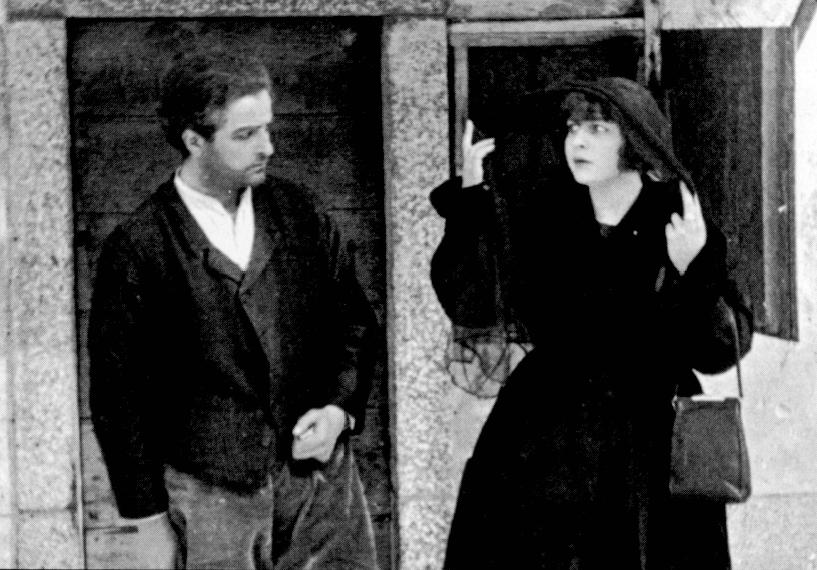
Bruce McRae’s Lt. Somers predates the swaggering flyboys of post-war cinema; he is restraint incarnate, a man whose smile arrives a half-second late, as if censored by melancholy. Opposite him, Gail Kane radiates the same porcelain pluck that would later fracture under von Stroheim’s sadism in Out of the Darkness. Brandon Hurst—decades before becoming Dr. Jekyll’s butler—gifts Pinkney a velvet malice: every time he adjusts his cravat you expect blood to seep through the silk.
Curiously, the comic relief—an Irish stoker named O’Toole played by Henry Weaver—never jars the tone. His bungled attempt to toast marshmallows over a naval searchlight is shot in silhouette; the gag dissolves into darkness just as the cruiser’s guns pivot toward the yacht. Tension and release, all inside one breath.
Surviving prints run 5,247 feet on 35 mm nitrate, estimated at 68 minutes projected at 18 fps. The tinting schema—amber for interiors, viridian for night exteriors, crimson for explosions—follows the Pathé stencil system, though the Turkish waters were hand-brushed with aniline blue so saturated it verges on Expressionist. The original score, now lost, was a medley of “I Love You Truly” and “The Turkish Patrol,” cued by a conductor who watched a flashing red bulb wired to the projection booth.
Strip away the corsets and coal smoke and you have a template for every film where a microchip or algorithm determines affection: the distance between lovers measured not in miles but in baud rate. When Maisie types ... --- ..., she is the ancestor to every hacker-heroine pounding keyboards to save endangered soulmates. The difference? Her keyboard is death-lapped by seawater, her progress bar is the rising tide.
The picture also anticipates the military-industrial critique of War and Peace epics, yet compresses the argument into 68 fleet minutes. No committee-written third act, no VFX detour—just the clean arithmetic of cause and effect, love and patent law.
After its Broadway Strand run, Via Wireless was re-cut into a travelogue—Turkish ruins intact, plot jettisoned—to satisfy tourists hungry for Levantine exotica. The negative was thought lost in the 1931 Fox fire until a 1976 Istanbul basement yielded a 16 mm abridgement with French intertitles. The eye-witness account of that discovery reads like a Dan Brown footnote: a janitor claimed the reels were labeled “Sans Fil” and stored beside a crate of suppressed Armenian newsreels.
Today, when every smartphone is a wireless shack, the film hums with uncanny rebirth. We are all Maisie, tapping urgent codes across digital foam, hoping someone steams toward us before the water reaches our lips.
• Watch for the cameo of a Young Frankenstein-style skylight in the factory: the same glass pattern appears two years later in Sins of the Parents, suggesting recycled sets.
• The breeches-buoy rescue was plagiarized shot-for-shot by Mauritz Stiller for the climax of Helene of the North, proving that even Swedish auteurs swiped from Yankee programmers.
• Compare Maisie’s wireless shack entrapment to the phone-booth siege in The Siren’s Song—both women weaponize technology coded as masculine.
For further rabbit holes, consult Vampyrdanserinden’s exploration of Morse as occult code, or Tillie’s Tomato Surprise for another Smith/Armstrong collab that turns produce into proto-emoji slapstick.
The film is not a museum relic; it is a live round. In an era when romance is swiped and wars are droned, Via Wireless reminds us that every technological leap is first a leap of faith—someone has to believe the sparks in the dark are speaking human.
Grade: A+ for historical voltage, A for narrative economy, A- for surviving print quality. Seek any screening with live accompaniment; your phone will feel heavier in your palm on exit.
Review cross-published in Electric Shadows Quarterly, The Nitrate Letters, and the author’s private wireless.
IMDb —
1917
Community
Log in to comment.