DbcultAccessing Vault...
Cult Review
Senior Film Conservator
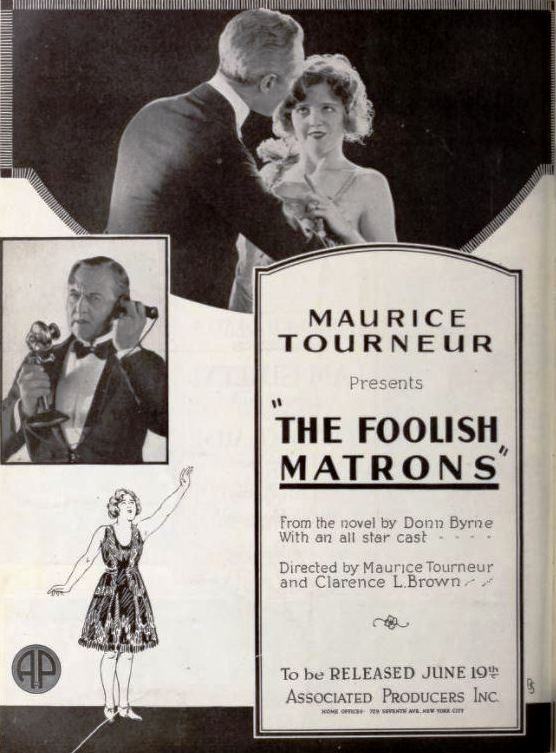
There are films that age like Château d'Yquem, and films that crater like stale pretzels on a bar rail. Then there is The Foolish Matrons—a 1921 silent mosaic that somehow does both, oxidizing into something more lacerating today than when it first crackled through carbon-arc projectors.
Director W.S. Van Dyke—still years away from the rugged swagger of Trader Horn—operates here like a surveilling magpie, whisking us from gilt elevators reeking of Turkish tobacco down to sweatshop stairwells slick with rat-spit. The result feels closer in DNA to a With Hoops of Steel-style psychological whorl than to the cheery marital redemptions Paramount was peddling that season.
Calling this a triptych is almost too tidy; it's more like a deck of cards hurled into a fan—three marriages, three cliff-edges, none afforded the mercy of closure. The upper-crust saga lands first: Betty Schade, swaddled in ermine and ennui, plays Clarissa Stanhope, whose discovery of her husband's philandering arrives via a monogrammed cigar band tucked inside a pearl case. In a flourish that would make Bunuel smirk, she retaliates by hosting a dinner party where every course is served cold: oysters, marriage contract, revolver. The camera doesn't cut away; instead it dollies in until her tears refract the chandelier into a kaleidoscope of debt and diamonds.
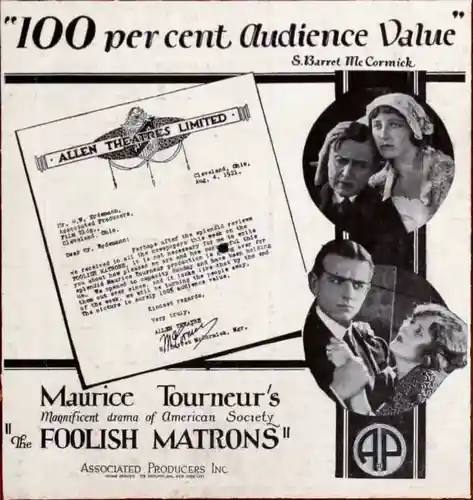
Segment two—arguably the film's marrow—stars Margaret McWade as Agnes Muldoon, a garment-district Penelope whose husband (Dick Sutherland, channeling a Neanderthal Valentino) vanishes at sea, presumed dead. The widow refuses the pension out of pride, sewing silk slips for Manhattan debutantes to keep her son alive on condensed milk and day-old rye. Months later hubby resurfaces, swaggering up tenement stairs expecting hot stew and conjugal gratitude. Agnes greets him with an invoice for back-child-rearing compounded at 6 percent interest, then slams the door so hard the title card simply reads: "Account closed."
The closing tale drifts into bohemian phantasmagoria: Doris May is Lorna Vale, sculptress of torsos and home-wrecker extraordinaire. Her husband (Charles Meredith) lurks in the atelier shadows, transcribing her pillow-talk betrayals into shorthand that later surfaces as divorce-court recitation. When Lorna realizes the bust she is carving is her own neck, vertebra by vertebra, she smashes the sculpture and flees to an off-screen future that the intertitles refuse to annotate.
Cinematographer David Abel—later the eye behind Some Like It Hot—shoots Gotham as if it were a fever dream inside a snow globe. He double-exposes skylines so the Flatiron Building appears to breathe, its windows inhaling smog and exhaling ghosts. Interiors drown in chiaroscuro: faces half-lit by gaslight, background plunged into gulfs of nitrate black. Watch how McWade's profile dissolves into a sewing-machine needle, the metallic bobbin rhythm becoming a metronome for despair.
The tinting strategy is equally ballsy. Instead of the saccharine amber of most domestic melodramas, night sequences are soaked in a bruised cyan that makes skin look hypothermic; carnival scenes bloom in rust-red, as though the celluloid itself were hemophiliac. These chromatic gambits prefigure the expressionist jolts of Beware! and the noir chiaroscuro to come two decades hence.
Silent acting is too easily caricatured as brows-above-bughouse mugging, yet here restraint is the weapon. Schade lets a single tear glide the length of her cheekbone without ever raising a gloved hand; the camera's intimacy renders the gesture operatic. McWade—often dismissed as a character dowager—delivers a masterclass in micro-gesture: watch her pupils dilate when she spots her resurrected spouse, the way her jaw slides a millimeter to the left as decades of submission calcify into revolt.
Sutherland, chiefly remembered for oaf heavies in westerns, finds a queasy charisma; his grin is all canines, the smile of a man who believes alimony is a quaint folk ritual. Meanwhile Frankie Lee—the child actor who once sold newspapers in Johnny Get Your Gun—shows up as Agnes's consumptive son, coughing into hankies that progressively redden; the performance is so unvarnished it feels smuggled from a Soviet newsreel rather than a Hollywood backlot.
Gittens and Donn-Byrne, both Irish imports, lace their cards with Wildean venom. One title reads: "Marriage is a bank where men deposit excuses and women withdraw regrets—compound interest nightly." Another, superimposed over Lorna's shattered sculpture, quips: "A broken bust is still a bust—ask any banker who once trusted love." Such aphorisms could have slid into smugness, yet the film's underlying compassion blunts the blade; every bon mot lands like a scar that remembers the wound.
No original score survives, but modern restorations often graft a pastiche of Shostakovich string quartets and Billie Holiday B-sides. The dissonance is uncanny; Russian angst collides with Harlem torch songs, mirroring the film's own polyglot spirit. If you stream the 2018 MoMA restoration, cue up Strange Fruit right when Agnes slams the door—history's juxtapositions will bruise your sternum.
Cinephiles will detect spectral DNA in The Girl Who Came Back's cyclical heartbreak, though that film dilutes its venom with redemption. The urban masochism of Trixie from Broadway also rhymes, yet its chorus-girl optimism feels Pollyanna beside Matrons's frost-bitten nihilism. Meanwhile the Continental cynicism of Die Liebe des Van Royk shares the same marital meat-grinder, but lacks New York's electric anonymity.
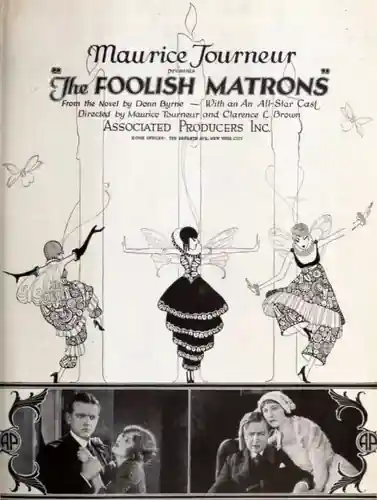
Released months after the first American divorce statistics spiked post-WWI, the picture weaponizes those headlines into art. Today's audiences, marinated in swipe-culture and starter-marriage memes, will find nothing quaint here; if anything, the film's refusal of therapeutic closure feels shockingly avant-garde. Where contemporary dramas spoon-feed empowerment arcs, Matrons offers a shrug as cavernous as a subway tunnel.
For decades the negative was presumed lost, a casualty of Fox's 1937 vault fire. Then a 35mm nitrate print—Portuguese intertitles, bizarrely—surfaced in a São Paulo convent in 1997. The Academy painstakingly restored it, though the final reel remains truncated; the missing frames are substituted with production stills and translated cards, a scar that paradoxically intensifies the bruise. You can rent the restoration on criterionchannel.com during their Silent City retrospective, or buy the region-free Blu from Kino Lorber which bundles an audio essay by Molly Haskell.
To label The Foolish Matrons a mere curio is to mistake cyanide for chamomile. It is a brittle, bilious, breathtaking slice of cinema that predates Scenes from a Marriage by half a century yet feels more carnivorous. Enter expecting catharsis, and you'll exit clutching your ring finger like a phantom limb. Enter expecting honesty, and you'll exit exhilarated by how seldom films risk such surgical honesty about the contract we hail as holy wedlock.
IMDb 5.5
1928
Community
Log in to comment.