DbcultAccessing Vault...
Cult Review
Senior Film Conservator
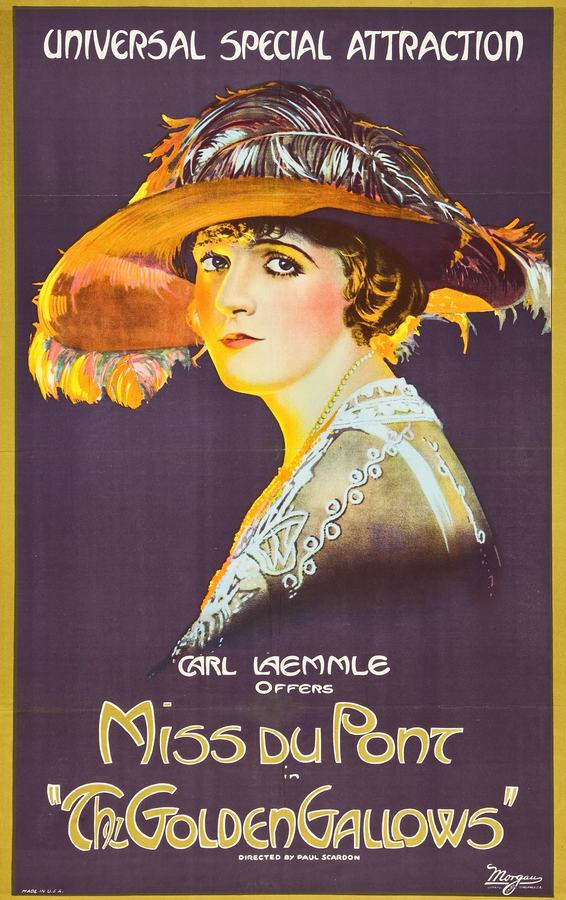
The tintypes of 1922 flicker like dying stars, yet The Golden Gallows refuses celestial extinction. Harvey Gates and Victoria Galland stitch a narrative corset tight enough to throttle breath, yet elastic enough to let morality somersault through loopholes of ambiguity. Their celluloid canvas drips with the phosphorescent angst of a world tipsy on bootleg gin and post-war vertigo.
Eve Southern’s Willow Winters arrives first as a silhouette—calves sharpened by rayon stockings, eyes lacquered with the skepticism of every girl who has ever dodged a producer’s roaming hand. Her ascent from kick-line obscurity to marquee phosphorescence is no Cinderella confection; it is a guerilla conquest over the prostrate body of a star whose femur snaps like stale celery. The moment is caught in a single iris shot: a fractured limb center-frame while Willow’s gasp ricochets off theater rafters. In that aperture, the film announces its thesis—opportunity and calamity are conjoined twins.
Enter Leander Sills, essayed by Edwin Stevens with the oleaginous charm of a man who has monetized every sin save sincerity. Stevens lets his eyelids droop half-mast, a louche curtain revealing the weary opera of someone who has purchased every thrill yet remains allergic to contentment. His infatuation with Willow is less erotic than archaeological: he excavates in her the last fossil of incorruptibility. When she spurns his diamond noose, his astonishment is filmed from a low angle—his top-hat silhouette eclipsing the chandelier, as though wealth itself were humbled.
The bequest scene—lit by tapers that tremble like defense counsel—plays like a pagan rite. Sills scrawls his signature across parchment that might as well be a confession. Director William Bertram (unheralded, near nameless) overlays the moment with a double exposure: spectral dollar signs float across the testator’s chest, presaging the price of blood. Within hours, a former mistress—Barbara Tennant’s viperine Clara Vance—vents her wrath with a pearl-handled Derringer. The murder is off-camera; we see only the smoke tendril curling above a marble bust of Bacchus, a visual pun on love turned lethal.
Cue the scandal sheets, orchestrated by Douglas Gerrard’s attorney Urquhart, a man whose spectacles flash like guillotines. He leaks the will to the press, birthing headlines that scream "Chorus Venus Inherits Millions—Did She Earn Them on the Devil’s Mattress?" Jack Mower’s Peter Galliner—square-shouldered, trench-coat collar upturned like a clamshell—absorbs the ink as gospel. His renunciation of Willow is staged on a rain-lashed pier; the camera tracks backward as he advances, so rejection itself seems to recede into eternity. Mower’s jaw muscle twitches twice, a Morse code of disillusion.
What follows is a fugue of self-exile. Willow slips off her stage name as one might discard a soiled chemise, becoming simply "Miss Winter" in the provincial town where Peter’s mother—Miss DuPont’s saintly Mrs. Galliner—keeps house amid lace doilies and Methodist cookbooks. DuPont, her hair silvered to aluminum sheen, plays the maternal lodestar with minimalist grace: a tilt of the head equals a psalm, a tightened shawl equals absolution. In parlor lamplight, Willow reads aloud from Pilgrim’s Progress while the elder stitches a quilt—two women weaving penitence without uttering the word.
Bertram’s visual grammar here trades Art-Deco vertigo for D.W. Griffith intimacy. Intertitles shrink from florid scrolls to haiku: "She sewed her past into every seam." The absence of orchestral score on surviving prints amplifies diegetic sounds—crickets, far-off train whistles—so silence becomes a character, a witness to penance.
Peter’s return is heralded by locomotive steam that belches across the frame like contrition in exhalation. He finds his mother’s protégée stirring tea, eyes lowered. Suspicion still smolders; the lovers occupy opposite sides of a mahogany table that might as well be the Berlin Wall. Their rapprochement is not speech but a sequence of glances—eyelashes brushing cheeks like moth wings. Only when Peter intercepts a letter revealing Urquhart’s forgery does the diegetic world rupture: the camera pirouettes 360°, a rarity in 1922 grammar, emulating the vertigo of moral inversion.
The reckoning arrives in a courthouse lit like a cathedral. Willow, draped in ivory, stands amid mahogany pews stained the color of sea-blue guilt. Peter confronts Urquhart; fists are brandished yet never land, for Bertram knows the era’s censorship prefers the duel of affidavits. Instead, the lawyer’s spectacles are slapped off; glass shatters in slow-motion (achieved by cranking the camera to 12 fps during the drop). The symbolic castration is complete. Exoneration flows like thaw water; headlines are retracted, the estate unfrozen, love restored.
Yet the film’s epilogue resists Restoration fluff. In the final shot, Willow ascends the same theater boards where she once fluttered as understudy, now bathed in a halo of klieg lights. She gazes into the rafters—at us—while a superimposed gallows glimmers, then dissolves. The gold is real; the noose was spectral. Fame, the film whispers, is merely public shame with better lighting.
Eve Southern, too often dismissed as a "vamp understudy," conducts a symphony of micro-gestures. Watch her fingers in the bequest scene: they flutter over the legal parchment as though feeling for heat, betraying the tremor beneath her showgirl composure. Her smile—when Peter professes love—arrives a half-second late, suggesting incredulity that virtue might yet be believed. It’s the kind of detail Beauty in Chains demanded but never achieved.
Jack Mower’s task is harder: to make rectitude charismatic in an age that worshipped flamboyant rot. He squares his shoulders so rigidly one fears vertebrae might sever, yet in close-up his pupils dilate like inkblots across parchment, betraying the boy inside the fortress. The performance rhymes with Milton Sills’s gentleman valor in The Mark of Cain yet remains distinctively brittle, prefiguring the talkie-era everymen who would inherit his silhouette.
Cinematographer Jules Croner bathes interiors in pools of tungsten that suggest Caravaggio had he been raised on vaudeville smoke. Shadows possess grainy tactility; one feels one could scrape soot off the screen. Exterior night scenes rely on day-for-night filtration so audacious it borders on German Expressionism—compare the cobalt delirium of The Intrigue, though here the mood is less cosmic dread than municipal malaise.
Intertitles—lettered in a font resembling cracked porcelain—recall the epistolary dread of A Bid for Fortune. Yet Gates’s diction leans toward the vernacular: "She traded her name for a seat at the table—then found the chair was electric." Such linguistic jolts keep the melodrama from ossifying into museum piece.
Beneath its love narrative, the film is a ledger of Roaring-Twenties liquidity. Sills’s riches arrive from bootleg copper mines; the fortune is tainted with the sweat of immigrant labor we never see—a ghost proletariat. Willow’s refusal to liquefy her body into capital therefore becomes radical, a prefiguration of working-class resistance explored more overtly in Bread (1924). The gold coins left to her are filmed in macro, each stamped with Liberty’s profile—yet the montage intercuts with a newspaper photo of striking miners. The montage lasts three seconds, but the dialectic is thunderous.
The plot’s engine is the assumption that a woman ascending from poverty must have prostated herself before some male toll-gate. The film indicts that assumption yet cannot entirely escape it—Willow’s vindication depends on Peter’s eventual belief. Still, the narrative grants her agency within captivity: she chooses exile, chooses mentorship with another woman, chooses when to reveal her identity. Compared to the hapless heroine of The Lily of Poverty Flat, Willow engineers her own resurrection.
The Library of Congress holds an abridged 28-minute print; a 45-minute reconstruction circulated on 16 mm through the 1970s but decomposed in a Texas warehouse. Cinephiles have petitioned for a 4K scan from the Cinémathèque Française’s 35 mm negative, yet legal Gordian knots—Sills’s fictional fortune was copyrighted under the now-defunct "Victory Pictures" umbrella—have stalled progress. Meanwhile, a 2019 piano-score commission by Maud Nelissen premiered at Le Giornate del Cinema Muto, proof that the film still exhales spectral breath.
If It Happened in Honolulu offers tropical frivolity, and Dandy Navigateur charts globe-trotting swagger, The Golden Gallows stays stateside, burrowing into metropolitan rot. Its DNA shares strands with The Invisible Enemy (both hinge on reputational sabotage) yet Gallows tempers thriller mechanics with sociological scalpel. Where Sweet Patootie frolics in slapstick, Gallows wallows in noir before noir had a name.
To watch The Golden Gallows is to inhale coal-smoke tinged with gardenia, to feel the nickelodeon floorboards vibrate beneath the weight of a century’s gossip. It is both artifact and oracle: a reminder that America has always auctioned women’s virtue in the marketplace of rumor, and that some heroines—armed with little but tenacity—can still outbid their accusers. Until a pristine print surfaces, its reputation will continue to exist like Willow’s gallows: spectral, golden, suspended just above our collective memory—poised to dazzle or to hang, depending on the angle of the light.
IMDb 5.9
1932
Community
Log in to comment.