DbcultAccessing Vault...
2.7/10
Senior Film Conservator
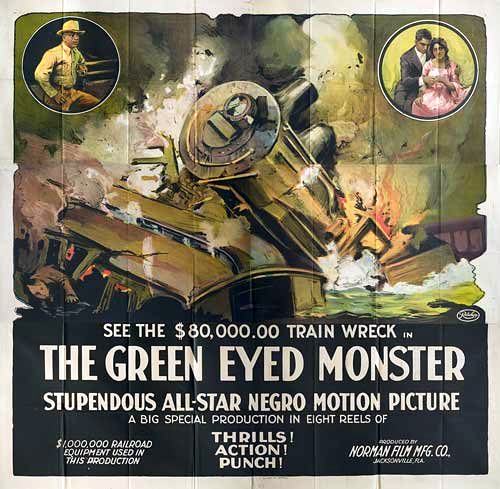
A definitive 2.7/10 rating for a film that redefined the boundaries of cult cinema. The Green-Eyed Monster remains a cornerstone of transgressive art.
When the reels of The Green‑Eyed Monster begin to spin, the viewer is thrust into a world where iron rails become arteries of desire, and the clatter of wheels echoes the restless pulse of the human heart.
From the opening tableau, the Norman Film Manufacturing Company establishes a visual lexicon that feels both grandiose and intimate. The camera sweeps across the sprawling Oklahoma horizon, then snaps to the soot‑stained faces of two men—Jack Austin’s brooding engineer and Steve Reynolds’s affable counterpart—whose camaraderie is as sturdy as the steel they lay down. Their friendship, however, is a fragile veneer, ready to crack under the weight of a shared infatuation.
Louise Dunbar, portraying the eponymous love interest, is introduced not as a passive prize but as a luminous force whose laughter reverberates like a whistle across the tracks. Her eyes, though captured in monochrome, convey a spectrum of longing, independence, and an unspoken challenge to the men who vie for her affection.
The narrative’s engine roars to life when the two railroad companies discover that a lucrative government mail contract hangs in the balance. The script, though sparse by modern standards, cleverly uses the contract as a metaphor for societal validation, while the impending race becomes a crucible for testing loyalty, ambition, and the corrosive green‑eyed monster of jealousy.
The race sequence is a masterclass in early stunt choreography. Contemporary accounts claim that the production invested the equivalent of a modern blockbuster—over one million dollars in railroad equipment and an $80 000 simulated train wreck. The resulting spectacle is a kinetic ballet of steam, smoke, and shattered wood, filmed with a daring camera that tracks the locomotives at breakneck speed, immersing the audience in the perilous ballet of metal and momentum.
Beyond the spectacle, the film delves into the psychological terrain of its protagonists. Austin’s character, a stoic engineer haunted by a past betrayal, channels his suppressed rage into a relentless pursuit of victory. Reynolds, in contrast, embodies a more naive optimism, believing that love can be won through sheer determination. Their divergent approaches to the race mirror their internal philosophies: one seeks redemption through domination, the other through earnest effort.
The supporting cast, including Robert A. Stuart as the unscrupulous railroad magnate, adds layers of corporate intrigue. Stuart’s character manipulates the race as a pawn in a larger game of power, reminding viewers that the personal drama is inextricably linked to the machinations of capitalism—a theme resonant in other period pieces such as The Right Direction and The Race.
Visually, the film employs chiaroscuro lighting to accentuate emotional tension. Shadows creep along the train cars, echoing the characters’ hidden motives, while bursts of sunlight pierce the gloom during moments of revelation—most notably when Dunbar confronts the two men, demanding agency over her destiny. This scene, though brief, is a pivotal moment that subverts the era’s typical damsel‑in‑distress trope.
The screenplay’s dialogue cards, though limited, are peppered with poetic phrasing that elevates the melodrama beyond mere melodramatic excess. Phrases such as “the rails bind us as surely as fate” and “my heart races faster than any locomotive” reveal a lyrical ambition that aligns the film with the expressive stylings of Kilmeny and the thematic depth of Love and Hate.
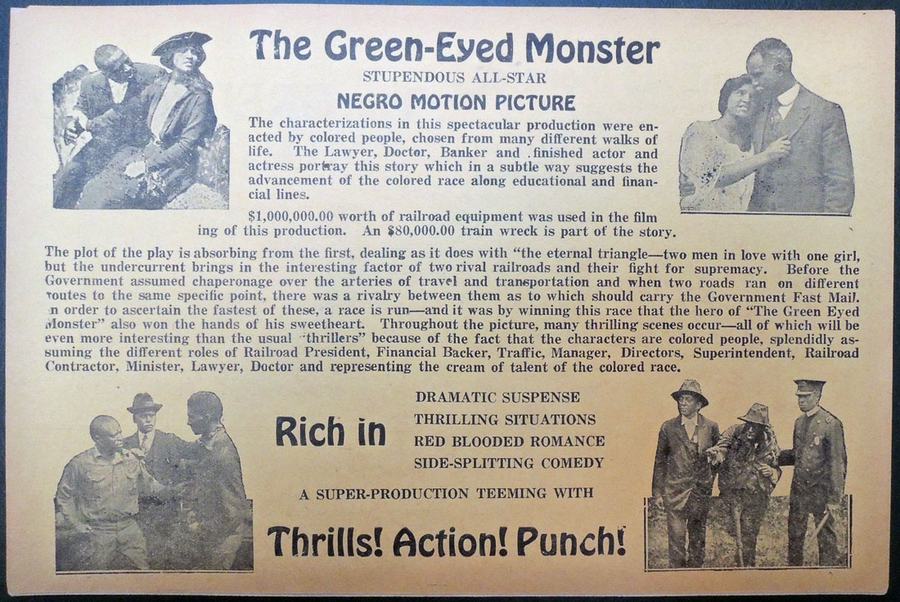
From a technical standpoint, the editing rhythm mirrors the pulse of the race itself. Quick cuts during the collision sequence heighten tension, while lingering long shots of the countryside provide a contemplative respite, allowing the audience to absorb the emotional stakes. The intertitles, rendered in a bold serif typeface, punctuate the action with a cadence that feels both urgent and poetic.
The film’s climax—an explosive train wreck that claims both a locomotive and a symbolic piece of the protagonists’ pride—serves as a cathartic release. As twisted steel smolders, the surviving characters confront the futility of their rivalry. Austin’s engineer, bruised but enlightened, extends a hand to Reynolds, suggesting that brotherhood can survive even the most corrosive jealousy. Dunbar, standing amid the wreckage, declares her autonomy, refusing to be a trophy and instead choosing a path of self‑determination.
In hindsight, The Green‑Eyed Monster anticipates narrative motifs later explored in films like Rip Roaring Rivals and The Highway of Hope, where personal ambition collides with collective responsibility. Its influence can be traced through the evolution of African‑American cinema, marking a moment where black filmmakers dared to blend spectacle with substantive storytelling.
The performances merit particular commendation. Jack Austin delivers a nuanced portrayal of restrained fury; his eyes convey a storm that words cannot capture. Louise Dunbar, meanwhile, radiates a quiet strength; her gestures are measured, her smile a subtle rebellion against the patriarchal expectations of the era. Steve Reynolds provides comic relief without undermining the drama, his timing impeccable in scenes where the tension threatens to overwhelm.
While the film’s pacing occasionally lags—especially during extended expository intertitles—the overall rhythm remains compelling, propelled by the relentless momentum of the race. The occasional melodramatic flourish, a hallmark of silent-era storytelling, feels purposeful rather than gratuitous, reinforcing the thematic undercurrents of envy, ambition, and redemption.
The Green‑Eyed Monster also functions as a cultural artifact, reflecting the aspirations and anxieties of African‑American communities in the early twentieth century. Its depiction of black protagonists navigating corporate intrigue and personal desire offers a counter‑narrative to the dominant white‑centric cinema of the time, aligning it with works such as The Guilt of Silence and Satyavan Savitri.
In terms of legacy, the film’s ambitious production values—particularly the costly train wreck—set a precedent for future black‑owned studios to invest in large‑scale set pieces, challenging the notion that budget constraints must limit artistic vision. This daring approach paved the way for later genre hybrids that blended action, romance, and social commentary.
Ultimately, The Green‑Eyed Monster endures as a testament to the power of silent cinema to convey complex emotional landscapes without uttering a single word. Its blend of high‑octane spectacle, lyrical storytelling, and socially resonant themes ensures its relevance for contemporary audiences seeking both historical insight and timeless drama.
For modern cinephiles, revisiting this 1919 masterpiece offers a rare glimpse into a period when black filmmakers were forging a distinct cinematic language—one that balanced grandiosity with intimate human truth. The film’s enduring appeal lies in its ability to make the viewer feel the rumble of the rails, the sting of jealousy, and the triumph of reconciliation, all within a single, unforgettable reel.
IMDb —
1926
Community
Log in to comment.