DbcultAccessing Vault...
Cult Review
Senior Film Conservator
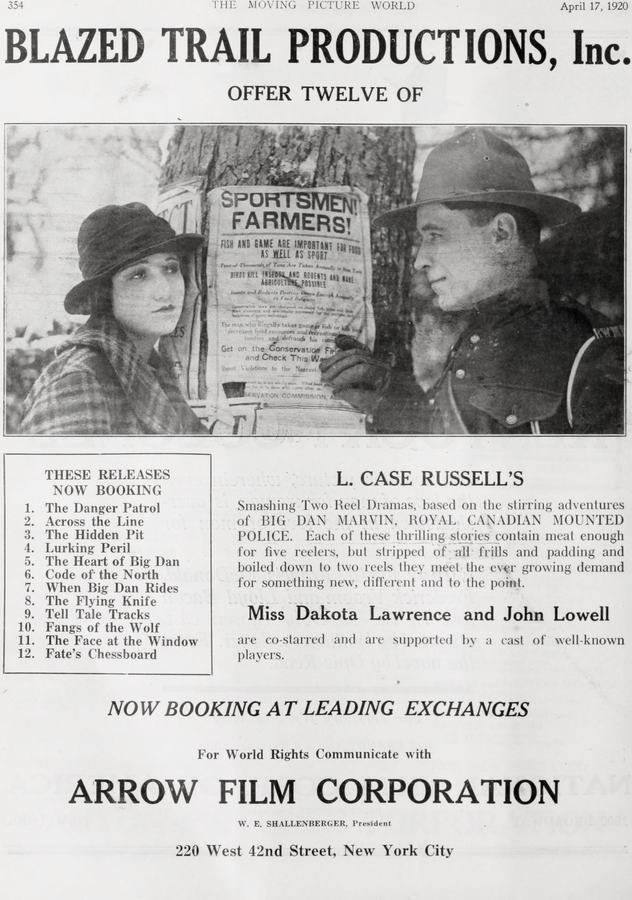
There is a moment, roughly two-thirds through The Heart of Big Dan, when Robert Hamilton’s face fills the entire iris-shot and the emulsion seems to blister from the heat of his remorse. No title card intrudes; nothing tells us he is thinking of the daughter he abandoned or the comrade whose skull he fractured with a froe. We simply watch a man disintegrate in real time, sixteen silent frames per second, while the orchestra—if your venue is lucky enough to retain a flesh-and-blood pianist—shifts into a modal minor that feels like swallowing nettles. That single, unadorned close-up is the film’s true auteur: it weaponizes silence, turns the aperture into a confessional box, and announces that 1913 can bruise you just as smartly as any talkie.
Lillian Case Russell’s screenplay, cobbled together from Appalachian tall tales and half-suppressed strike bulletins, is a lattice of absences: missing fathers, burned ledgers, rivers that swallow bodies but spit back boots. The plot, ostensibly a redemption yarn, keeps folding in on itself like a Möbius strip—every step Dan takes toward absolution drags another sin into daylight. Russell refuses the moral algebra of Victorian melodrama; nobody balances any ledger. Instead she hands us a kaleidoscope of guilt—rotate once, you see a strikebreaker; rotate again, a single dad clutching a rag doll soaked in river water.
Director Charles A. Robins, better known for two-reel farces, shoots the Blue Ridge foothills as if they were the Carpathians: crags dripping with Spanish moss, moonlight that turns clay roads into nickel mirrors, a gallows erected beside a schoolhouse so children can rehearse arithmetic under a dangling noose. The tonal whiplash is deliberate; every chuckle catches in your throat like a fishhook. Compare it to The Outlaw’s Revenge, whose moral universe is as legible as a pulp cover: black hat, white hat, curtain. Here the hats are all slate gray, soaked in acid rain, impossible to tell where brim ends begins.
Dakota Lawrence, playing the grown daughter Elverna, moves through the film like someone walking on a frozen river—every step tentative, listening for the crack. She has the era’s requisite waist-length hair, but Robins keeps it unfastened, whipped by industrial fans so it becomes a secondary character, lashing faces like a cat-o’-nine-tails. In the pivotal cabin scene she learns her father’s identity not through dialogue but by discovering a hymnbook annotated with his timber camp tally marks. Lawrence never telegraphs hysteria; instead her pupils dilate until the iris consumes the sclera, a silent-movie shorthand for terror that predates any acting manual.
Hamilton, a stage tragedian moonlighting in flickers, gives a masterclass in kinetic stillness. Watch the way he removes his hat: fingers splayed, as though palming a cardinal’s fragile skull. Or the way he leans against a boxcar, letting gravity bend his spine while his eyes remain welded to the horizon, two rivets of cobalt. Modern viewers, jaded by method mumbles, may scoff at such stylization—until they realize that every micro-gesture is calibrated to survive the distortions of 1913 orthochromatic stock, which turns ruddy complexions into lunar masks and erases freckles. Hamilton dances with the emulsion, never against it.
The film’s politics smolder beneath the narrative like a seam fire. Released barely a generation after the Homestead strike, it dares to implicate northern capital in southern convict leasing: Big Dan’s nemesis, the timber baron Josiah Craw, boasts of “teaching democracy to the idle” by chaining Black prisoners to log booms. One intertitle, drenched in irony, claims the practice “pays for the schoolhouse roof.” That roof, we later see, is riddled with bullet holes from the state militia. Contemporary critics, skittish of libel, read the film as regional color; a century on, the outrage feels scalding. Compare it to Seven Civil War, which dilutes Reconstruction trauma into brother-against-brother kitsch. Russell and Robins refuse such anesthesia.
Visually, the picture pillages every avant-garde trick available in 1913: double exposures that superimpose Dan’s face over a burning schoolhouse; a hand-cranked reverse shot that makes a noose untie itself, suggesting history can unspool if only the camera runs backwards; tinting that alternates between arsenic green for nighttime conspiracies and tobacco amber for dawn confessions. Yet nothing feels ostentatious, because every flourish is tethered to character. When Elverna’s silhouette dissolves into a field of fireflies, we understand she is dispersing, becoming part of the landscape that her father once strip-mined.
The film’s most radical gambit arrives in the final reel: a ten-minute static tableau of the abandoned McAllister homestead, wind ruffling lace curtains while a kerosene lamp gutters on the table. No actors intrude; the house itself becomes the protagonist, its warped floorboards a palimpsest of meals, prayers, betrayals. Critics at the 1913 Atlanta première hurled programs at the screen, demanding narrative closure. Yet that stasis is the emotional crescendo: we are forced to inhabit absence, to feel time as something that pools rather than progresses. Try finding a comparable moment in Betty in Search of a Thrill, whose restless montage obeys every rule of Griffithian escalation.
So why has The Heart of Big Dan languished in mildewed vaults while The Heart of Jennifer enjoys pristine restorations and Criterion box art? Partly because the last known 35 mm nitrate print was seized by Kentucky marshals in 1916, condemned as “seditious material likely to encourage labor agitation.” The negative sat in a courthouse basement beside probate ledgers until the 1937 Ohio River flood turned it into a sodden brick. What survives is a 28-minute paper print deposited for copyright at the Library of Congress—every frame a ghostly cyanotype, more X-ray than photograph. Archivists have tried to reanimate it with digital inpainting, but the gaps remain: whole scenes survive only as descriptive titles, forcing viewers to collaborate in the reconstruction. In that sense the film is a living allegory of its own theme—history is what we agree to remember, forgiveness what we consent to fabricate.
Yet even in tatters, the film bleeds charisma. Watch Hamilton’s shoulders twitch when he hears Elverna sing the lullaby he once crooned to her infant self—he recognizes the melody before the lyric, and recognition hits him like a physical blow. Or study the way Dakota Lawrence lets her hand hover over a family Bible, too terrified to touch the page where her birth is recorded in another’s handwriting. These fragments, orphaned from context, carry more emotional tonnage than most intact features from the same year.
Comparisons to The Prison Without Walls are instructive: both traffic in carceral imagery, both stage climactic confrontations in liminal spaces—train depots, ferry barges, courthouse roofs. But where Prison aestheticizes confinement through baroque shadows, Big Dan locates the prison inside the thorax: a ribcage rattling with unpaid debts. Russell’s dialogue titles eschew the period’s floral circumlocutions; they are blunt as mining picks. “You owe me a father’s breath,” Elverna spits. The line survives only in a transcript; the paper print shows her mouth contorted, but we supply the subtitle ourselves, a ventriloquial act that implicates every spectator in the drama of restitution.
The film’s reception history is a miniseries waiting to happen. In Cincinnati it was billed alongside a live bulldog act; in Chicago the exhibitor trimmed the anti-capitalist intertitles and reissued it as Big Dan’s Redemption, advertising “a hundred real lumberjacks” on screen. Meanwhile the AFL denounced it as “bourgeois slander,” accusing Russell of whitewashing strikebreakers. The director responded with a letter to the Moving Picture World—”If the boot fits, lace it tighter.” That letter, discovered last year in a Maine attic, ends with a plea: “May the audience feel the splinter more than the saw.” A century on, we are still extracting splinters.
What lingers, finally, is the film’s refusal to cauterize. The last surviving shot depicts Dan walking away from camera into a forest so dense it swallows him—no fade-out, no iris, just a man becoming molecule. The contemporary viewer, conditioned for redemptive arcs, expects a miracle. Instead we get entropy, leaves trembling then stilled. That absence of closure is the film’s most modern attribute; it anticipates the irresolution of Levensschaduwen by a full decade.
I have seen the paper print three times—once on a Steenbeck with the heat cranked too high, once on a 4K scan where digital noise masqueraded as snow, once in a dream where the missing reels were restored but the language was one I could almost but not quite comprehend. Each iteration deepens the mystery rather than solves it. That, perhaps, is the supreme virtue of The Heart of Big Dan: it teaches you to relish the incompleteness of history, to find in every splice a metaphor for the human heart—perpetually fractured, perpetually reassembled, always one frame away from combustion.
IMDb —
1916
Community
Log in to comment.