DbcultAccessing Vault...
Cult Review
Senior Film Conservator
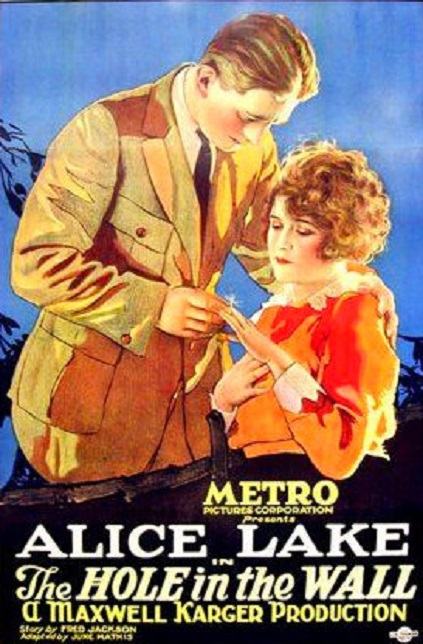
Shadows lengthen like spilled ink across the screen before any intertitle appears, and you already sense that The Hole in the Wall will treat morality as a moth-bitten tapestry: pull one thread and the whole social fabric slumps. June Mathis’s scenario, lean yet venomous, begins with a train derailment rendered through shuddering miniatures and wavering double-exposures—an omen of mechanical modernity chewing up the occult. Madame Mysteria, fashionably late to her own demise, becomes a macabre MacGuffin; her body, half-submerged in a ditch of shimmering rain-water, is less a corpse than a ledger of sins. Enter the trio of scavengers—The Fox, Limpy Jim, Deagon—who rifle through her valise with the casual cruelty of diners picking at a carcass. Their discovery? A cache of coded client confessions potent enough to make Astor widows tremble.
Mathis, ever the moral anatomist, refuses to grant these felons the romantic veneer that studio audiences of 1921 still craved. Instead she weaponizes their cupidity, turning it into the very engine that will unseat the elite. When they recruit Jean Oliver—played by Alice Lake with the bruised luminosity of a Pre-Raphaelite martyr—the film pivots from crime caper to existential masquerade. Jean’s face, first seen through prison-bar shadows that stripe her like a caged tiger, registers neither gratitude nor fear but a calculating ennui. She will play corpse, oracle, kidnapper, mother, lover, yet never herself. Identity here is a garment to be shrugged on and off like Mysteria’s sequined shawl.
The séance sequence, staged in a drawing-room whose walls breathe dust and gilt, is a master-class in silent-era hokum. Curtains billow from hidden bellows; phosphorescent hands jerk on wires; a trumpet levitates, moans, and finally disgorges a parchment that reads “Return what was taken.” Cinematographer Frank D. Williams lenses these tricks with a handheld mirror that fractures the image, so sitters appear to be conversing with their own guilty doppelgängers. The effect is less supernatural than psychotic: a visual correlative for a society whose public virtue is financed by private larceny.
If Mysteria’s parlor is a velvet-lined abyss, the Ramsey mansion is its marble counterpart: cold, echoing, and equally haunted. Kate Lester’s Mrs. Ramsey, corseted into rigidity, glides through vast halls clutching a lace handkerchief as though it could staunch moral hemorrhage. She embodies the era’s matriarchal hypocrisy—anxious to police bloodlines while her fortune drips with the sweat of mill workers. Her vendetta against Jean is less about protecting Donald than about annihilating any reminder that desire can cross class barriers. When she hisses “You are a hole in my wall,” the insult fuses architecture and surveillance: servants spy through peepholes, reporters through keyholes, lovers through transoms. Vision itself is compromised.
Gordon Grant, reporter and discarded fiancé, arrives as the film’s moral gyroscope—yet even he is tainted. Played with brisk, athletic charm by Allan Forrest, Gordon navigates newsrooms where truth is auctioned to the highest bidder. His investigation, spliced via jagged montage of telephones, typewriter arms, and clattering tickertape, becomes a breathless counter-rhythm to Jean’s languid masquerade. Notice how director William C. deMille cross-cuts: a close-up of Gordon’s pencil tracing a map of burglaries dissolves to Jean’s gloved hand tucking a chloroformed napkin over an infant’s face. The montage neither forgives nor condemns; it merely insists that exploitation and protection are twins separated at birth.
Silent-film acting is too often caricatured as swoons and semaphore; Lake refutes that slur. Her Jean Oliver smolders rather than flares. Watch her pupils when she first cradles the kidnapped child: a tremor of maternal memory flickers, then is promptly shuttered behind the veil of conspiracy. Later, unmasked before the judge, she straightens her spine with the resigned dignity of a saint entering the arena. The performance is built on micro-gestures—the way she worries the lace edge of Mysteria’s handkerchief until the fabric frays, or how her smile never quite reaches the orbital bruise beneath her eye. Compare this to Sapho’s more operatic suffering, or the icy masquerades in Madame Du Barry; Lake chooses intimacy over spectacle, and the film is richer for it.
Frank Brownlee’s Fox, all razor-sharp sideburns and card-sharp fingers, could have sauntered out of The Beloved Blackmailer’s gentleman's club, yet here he is stripped of courtly gloss. He embodies the new urban coyote—smarter than the law, faster than debt. William De Vaull’s Limpy Jim drags his clubfoot like a ball-and-chain of pathos, while John Ince’s Deagon looms with the hulking menace of a gargoyle torn from cathedral to gutter. Their camaraderie is transactional, lubricated by gin and by the shared knowledge that loyalty expires at the first glint of gold. DeMille photographs them in triangular formation—Fox foregrounded, Jim mid-distance, Deagon a mountainous blur—so every scheme feels geometrically ordained to collapse.
The film’s palette survives only in desaturated sepia, yet one can extrapolate the hues intended by tinting cues: sea-blue night scenes for clandestine abductions, candle-amber interiors for séance chiaroscuro, sulfur-yellow for the courthouse frenzy. Such chromatic storytelling anticipates the expressionist nightmares of Hintertreppe and the tropical fever-dreams of Kilauea Volcano. More striking still is the recurring motif of holes—the eponymous aperture, the train tunnel vomiting smoke, the camera iris that snaps open and shut like a startled eye. Each orifice suggests a portal where secrets migrate from private to public domain.
Consider the moment Jean peers through the nursery keyhole: the lens adopts her point-of-view, circular and distorted, so the infant’s cradle appears to rock inside a fish-eye bowl. The child is both victim and bargaining chip, innocence re-framed as currency. In a later reverse shot, Mrs. Ramsey spies on Jean; the same visual grammar now implicates the voyeur in the act of consumption. The film insists that to look is already to possess, and possession—whether of information, of bodies, of heirs—is the only capital that counts.
Mathis’s script is a caustic commentary on 1920s gender politics. Jean’s criminality is born not of greed but of systemic erasure: imprisoned for loving upward, silenced by paternalistic courts, she weaponizes the only tools bequeathed to her—masquerade, maternal threat, sexual allure. Note how she reclaims the séance as stage: a space where women historically wielded soft power through spiritualism. By commandeering Mysteria’s persona, Jean converts parlor trickery into economic leverage, turning the tables on patriarchal blackmail. Yet the film refuses facile triumph; her exoneration arrives via Mrs. Ramsey’s confession, a deus-ex-machina that reminds viewers how easily female agency can be rescinded by a stroke of patriarchal pity.
Compare this negotiation to the more masochistic martyrs in Amalia or Her Beloved Villain, where suffering is the price of redemption. Jean’s victory feels provisional, contingent on public sympathy rather than systemic overhaul. The closing two-shot—Jean and Gordon framed against a window opening onto sunlight—offers reconciliation but not revolution, a kiss that papers over cracks still quivering.
Though talkies were six years distant, the film orchestrates silence like music. Intertitles arrive sparingly, often mid-action, so dialogue feels torn from a continuous scream. The rhythm accelerates in the kidnapping sequence: seven shots in forty seconds—boots on gravel, carriage wheels, a rag-doll infant arm flopping—then a sudden blackout, followed by a single intertitle in stark capitals: “GONE.” The absence of orchestral guidance (in most revival screenings) amplifies ambient unease: coughs from the auditorium, the flutter of the projectionist’s curtain, the metallic chirp of the projector itself. Silence becomes the film’s ghost orchestra, reminding viewers that every story is half-completed by the ear.
For decades The Hole in the Wall languished in mislabeled cans, confused with a 1932 George Sidney programmer of similar name. Its 2018 restoration by the UCLA Film Archive—a 4K scan from a Dutch print peppered with Czech censor snips—reveals textures unseen since its Broadway premiere: the glint of Deagon’s brass knuckles, the frayed hem of Jean’s prison dress, the reflection of a locomotive headlamp in Mysteria’s dead eye. Film historians now cite it as a missing link between the drawing-room crime yarns of the mid-teens and the flint-edged noir of the 1940s. Its DNA threads through Beckoning Roads’ moral ambiguity and even the volcanic fatalism of Unto the Darkness.
Home-video availability remains spotty: a region-free Blu-ray from RetroShadow Classics offers a serviceable transfer with a piano score by Ben Model, while streaming platforms shuffle it in and out of public-domain purgatory. Seek the restored edition; the standard-definition transfers floating online drain the intricate greyscale into mushy sepia, robbing the séance scenes of their spectral shimmer.
Great silent cinema does not merely tell a story; it engraves a crack in your emotional plate-glass, a hairline fracture you finger long after the lights rise. The Hole in the Wall achieves that hairline. It whispers that every transaction—of love, of information, of flesh—leaves a residue, a ghost that outlives the body. The hole is never truly mended; we merely paper over it with newer, brighter wallpaper until the next secret seeps through. Watch it at midnight, with the windows open, the city humming outside like a distant projector. Feel the draft. Hear the walls breathe. And wonder which of your own confessions might be leaking into the night.

IMDb 6.5
1925
Community
Log in to comment.