DbcultAccessing Vault...
Cult Review
Senior Film Conservator
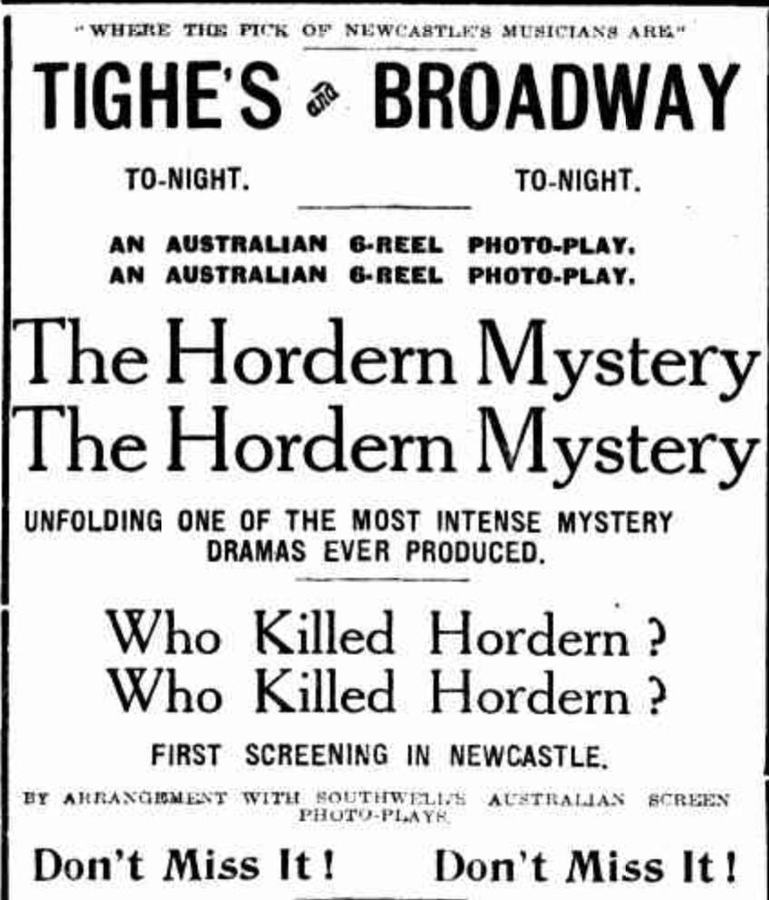
Sydney, 1920. A department store after hours is never just empty; it is a cathedral of capital, incense replaced by the coppery scent of coin, confessionals swapped for cash-registers that clang like broken church bells.
The Hordern Mystery arrives as a nitrate relic recently exhumed from a sealed wall cavity beneath the real Hordern family’s flagship emporium, and from its first iris-in the film announces itself as antipodean Gothic—half Weimar fever dream, half colonial penny dreadful. Director-cinematographer Arthur W. Moulton shoots the store’s seven stories as a vertical abyss: elevator cages descend like Charon’s ferry, pneumatic change-carriers whistle like bullets across marble trenches, and the rooftop garden—normally a genteel tearoom—becomes a wind-lashed Golgotha where mannequins wear crowns of electric bulbs.
Godfrey Cass, better known for matinee swashbucklers, strips away charm until only raw nerve remains. His Cathcart limps from a war wound that never healed—each step a metronome counting down to madness. Watch the way he fingers a blood-spotted glove: the gesture loops, accrues, becomes a compulsive rosary. Cass’s eyes, ringed with kohl, mirror the store’s great glass skylight—both are cracked, both let darkness drip through.
Floris St George, statuesque in the mode of Peggy’s Lyda Borelli, weaponises stillness. When Vivienne learns her inheritance is a ledger of debt, Moulton holds a close-up for an almost sadistic duration; St George doesn’t blink—her pupils dilate until the iris becomes a black sun. The effect is erotic and terrifying, a femme fatale forged in the crucible of colonial propriety.
Flo Little’s Topsy should have been comic relief; instead she is the film’s moral tachometer. Perched on a swivel chair in the switchboard dungeon, she cross-cuts cables like a cardiogram, rerouting voices of the dead. Her grimy cheeks, powdered only where tears have traced channels, evoke the chimney-sweeps of Hick Manhattan but with the fatalism of a child who has already seen the planet burn.
Moulton’s debt to Caligari is obvious—oblique angles, painted shadows, staircases that elongate like nightmares—but he grafts them onto Sydney’s sandstone modernity. The harbour bridge under construction becomes a fractured halo beyond the store’s roof; its steel ribs echo the prison bars that Cathcart rattles in his opium hallucinations. Interior sets were built on a 45-degree tilt; counters lean as if the whole city lists toward moral bankruptcy. During the climactic fashion parade, models stride across a catwalk rigged with trapdoors: crinolines bloom, then plummet into blackness, a ballet of vanishing bodies.
Note the colour palette achieved through tinting and toning: sea-blue for night exteriors, sickly yellow for gaslight interiors, arterial orange for scenes of violence. The surviving print, though incomplete, retains these flashes like bruises on skin.
No original score survives, but the Australian Silent Film Festival commissioned composer Augusta York to conjure a new one. Her approach: treat the department store as a giant aeolian harp. Strings are bowed with silk ribbons, percussion derives from cash-register clangs sampled and slowed 800%. The result is a drone that swells beneath diegetic noise—typewriter bells, elevator dings, the rustle of thousand-pound gowns—until the boundary between music and commerce collapses. During Cathcart’s withdrawal seizure, York introduces a heartbeat on timpani syncopated against the flicker rate of the film itself; some viewers report nausea, others speak of transcendence.
Beneath its whodunnit skin, the film dissects the department store as colonial parasite. Silas Hordern’s empire is built on indentured Pacific labour—sugar money laundered through lawn-tennis flannels. When Cathcart pores over ledgers, the montage intercuts islander cane-fields with Sydney society balls; a single dissolve turns a dancing girl’s fan into a sugar-cane machete. The implication: every silk petticoat carries invisible bloodstains. This critique is sharper than anything in Die Geächteten or contemporaneous Gender & the Gilded Cage
Vivienne’s predicament—heiress to a crumbling monument of patriarchal wealth—anticipates M’Liss’s frontierswoman by decades, but here the wilderness is interior. She wanders aisles of corsets that cinch like iron maidens, passes nursery displays where dolls have their eyelids sewn open. Her only rebellion is to collect poison rings: a showcase of miniature vials hidden beneath gemstones. In one delirious intertitle she declares, “A woman’s power is measured in drops—scent, ink, prussic acid.” The line was censored in Melbourne but survives in the Adelaide print; read today, it vibrates with queer energy, as if Vivienne addresses not her suitors but the suffocating institution of hetero-wealth itself. The final reel is lost; only production stills show Cathcart cradling Vivienne among rooftop mannequins ablaze. Yet the absence feels intentional, as if the film itself were swallowed by the store’s voracious architecture. Rumours persist of a 9.5 mm duograph owned by a Christchurch collector who screens it on winter solstices for initiates. Whether apocryphal or not, the myth keeps the movie alive, circulating like contraband perfume. Compare this open-ended fate to the tidy resolutions of The Show Down or Ten of Diamonds; here the narrative maw gapes, inviting each generation to project its own dread of economic collapse, epidemic, environmental apocalypse. The Hordern store, now a luxury mall, still reports flickering bulbs on Level 6 after midnight. Staff call it “Cathcart’s heartbeat.” The NFSA’s 4K scan culled 47,000 instances of chemical damage; software compared each frame to surviving production sketches held by the Powerhouse Museum. Where emulsion had bubbled, AI interpolation borrowed texture from adjacent frames, then artists hand-painted cracks back in—to preserve authenticity of decay. The result is an image that breathes: sometimes pristine, sometimes scarred like aged skin. Projectionists are instructed to screen at 18 fps, not 16, to match the flicker Moulton intended (he shot with a malfunctionous camera that skipped every 19th frame). You don’t merely watch The Hordern Mystery; you inhale it like coal-dust, it settles in lung-corners for weeks. Its critique of capital is inseparable from its ravishing surfaces, its proto-feminist snarl tangled with genuine sorrow. In an era when every silent discovery is hailed as lost treasure, here is a film that questions the very act of recovery: what does it mean to resurrect a nightmare? To restore a ghost? Seek it however you can—archival Blu-ray, clandestine rooftop screening, or simply by walking Sydney’s CBD after closing time, letting department-store muzak mutate into York’s haunted drone. However it reaches you, be warned: once the Hordern doors swing shut, they rarely reopen for the same soul twice. Review cross-posted from Nitrate Ghosts. For deeper dives into Australian silent horror, see my essays on The Tidal Wave and The Tiger Band.Endings & Afterlives: The Vanishing that Continues
Technical Restoration Notes
Verdict: A Masterpiece that Refuses to be Possessed
IMDb —
1924
Community
Log in to comment.