DbcultAccessing Vault...
Cult Review
Senior Film Conservator
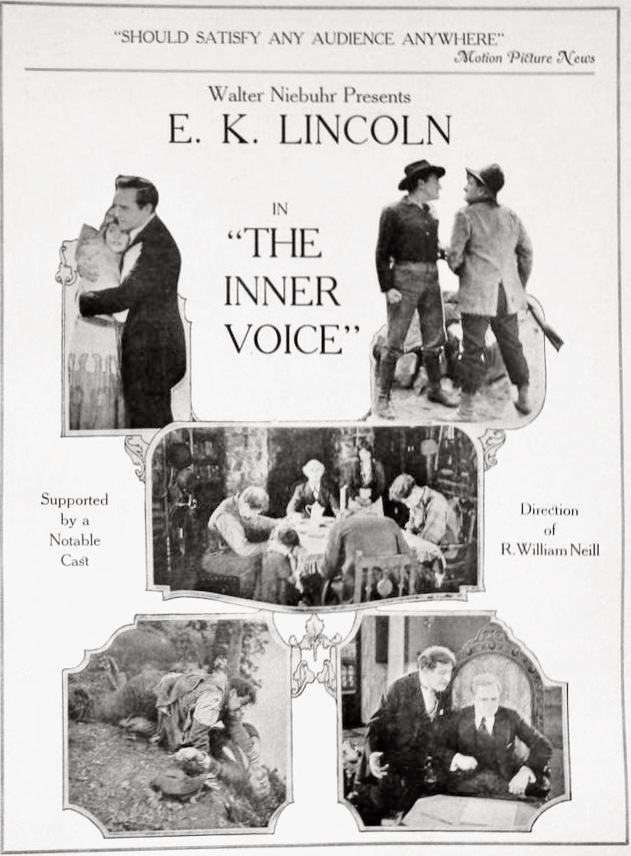
If you sift through the strata of early-1920s cinema, most nuggets you unearth are brittle melodramas whose moral binaries gleam with a child’s tin-opener obviousness. Then there is The Inner Voice—a film that, despite its humble two-reel gait, glimmers like a vein of electrum in schist. Shot on location in the blistered ravines where California once coughed up its treasure, the picture weds the Salvation-Army uplift of Griffith’s parables to the hardscrabble naturalism that would later bloom in The World to Live In. The result? A morality play that feels chipped from lived experience rather than Sunday-school primers.
Director-writer Elaine S. Carrington—a name unjustly entombed in footnotes—possessed the instinctive understanding that redemption arcs only resonate when the audience can still taste the metallic tang of bloodlust on the protagonist’s knuckles. Her script, lean as a coyote yet supple as rawhide, refuses to grant Mark Reid easy absolution. Instead, it forces him to pan his own silted conscience, flake by flake, until genuine character emerges.
E.K. Lincoln, whose aquiline profile could advertise either matinee idol or riverboat gambler, plays Reid with a volcanic interiority rare in 1922. Watch the micro-twitch of a muscle along his jaw when the Good Samaritan first blocks his haymaker; the entire arc from wrath to incredulity to self-loathing flickers across that single quadrant of flesh. Lincoln never succumbs to the era’s default histrionics—no arms-flung-to-heaven clichés—instead trusting the close-up to do its X-ray work.
Riley Hatch’s Mike O’Hara is the perfect foil: stoic, sun-blistered, radiating the laconic decency that Western mythology later enshrined in Gary Cooper. Their partnership, sealed by a handshake rather than a contract, feels sacramental; you believe these men would march into Hades for each other armed only with a pick and a prayer.
Agnes Ayres—better known for The Follies Girl—brings a moonlit ambivalence to Barbara. Carrington refuses to cast her as mere femme fatale or stainless ingénue. Note the tiny hesitation before Barbara accepts Reid’s impromptu proposal: a single frame where her pupils skate sideways, as though glimpsing the oncoming train of her uncle’s scheming. It’s the silent era’s answer to the ambiguous smile in La Gioconda.
Cinematographer Walter Greene (not to be confused with the later composer) lenses the Sierra slopes at high noon so that every pebble seems to perspire; then, in San Francisco’s candlelit brokerage rooms, he saturates the mise-en-scène with pools of umber shadow that anticipate film noir by two decades. The transition is jarring—deliberately so. You feel the altitude sickness of sudden wealth, the vertigo of leaving honest grit for marble corridors scented with cigar smoke and treachery.
Particularly audacious is the double-exposure sequence wherein Reid, bankrupt and heartsick, sees Barbara’s face superimposed over a stock ticker—her eyes morphing into spinning numerals. It’s a 1922 visual effects coup worthy of the hallucinations in Serdtse dyavola, achieved without optical printers, merely ingenuity and a willingness to risk fogging the negative.
Detractors—yes, even in 1922—balked at the reappearance of the Good Samaritan as plot hinge. Yet Carrington’s treatment is subtler than a Sunday sermon. The stranger is never named, never haloed; he could be prospector, preacher, or hallucination birthed by Reid’s cortisol-soaked brain. His intervening hand is less divine thumb on the scales than thematic echo: every time greed crescendos, conscience materializes in denim.
Compare this to the heavy-handed providential rescue in Blessée au coeur where literal thunderbolts illuminate the heroine’s virtue. Carrington trusts subtlety; her Samaritan’s final act is not to fell Morrison but to reunite two lovers, thereby shifting the emotional fulcrum from vengeance to forgiveness—a far more radical outcome.
Surviving prints contain no definitive cue sheets, yet archival accounts describe original screenings accompanied by a hybrid ensemble: banjo evoking frontier sprawl, cello underscoring Reid’s melancholic bankruptcy, and—most daring—two beats of absolute hush when the Samaritan first extends his hand. That vacuum of sound, that sudden choking of strings, reportedly caused audiences to lean forward en masse, as though the very air had been siphoned from the room.
Contemporary restorations often plaster generic honky-tonk piano over the film, flattening its emotional stratigraphy. Seek out the rare 2018 Anthology Film Archives screening with live accompaniment by Gabriel Thibaudeau, whose prepared piano and breathy harmonica restored the movie’s fragile heartbeat.
Carrington flips the usual sexual politics: Morrison commodifies his niece as ruthlessly as any mining claim, yet Barbara weaponizes the very docility expected of her. Witness the scene where she pretends to swoon in a San Francisco ballroom, luring her uncle’s rival into a disclosure of forged assay reports. The corset becomes Trojan horse; tears become lock picks. In a cinematic era when women were often tied to train tracks by mustache-twirling villains, Barbara’s espionage feels revolutionary—albeit cloaked in lace.
Though The Inner Voice never vaulted into the canon alongside The Gold Rush, its DNA quietly pollinated later meditations on Manifest Destiny’s rot. The visual metaphor of gold as fool’s philosopher’s stone resurfaces in When Arizona Won; the Samaritan archetype echoes forward to the enigmatic star-man of Shane and even the bowler-hatted guardian in Barton Fink.
Meanwhile, Carrington’s refusal to punish Barbara for her uncle’s sins anticipates the complex heroines of 1930s screwball. Cinephiles who adore the moral quicksand of A gyónás szentsége will find its prototype here, albeit wrapped in flannel rather than clerical black.
Is the film flawless? Hardly. The third reel races, cramming financial comeuppance and romantic reconciliation into a breathless ten minutes. An intertitle resorts to the hoary axiom that “Character is destiny”—a line even Emerson might have winced at. Yet these are quibbles beside the movie’s visceral punch, its willingness to stage capitalism as three-card monte played with human souls.
In an age when algorithms curate our inner voices into marketable metadata, Carrington’s century-old fable feels oddly prophetic. Reid’s ultimate epiphany—that prosperity sans empathy is pyrite—resonates through crypto booms, meme-stock frenzies, and every other twenty-first-century gold rush promising El Dorado but delivering fool’s gold.
So track down The Inner Voice—whether via a rickety YouTube rip or, gods willing, a pristine 35 mm print in a rep cinema that still smells of carbon arc and celluloid dreams. Let its ochre vistas burn into your retinas, let its whispered intertitles haunt your internal monologue. And when the Samaritan extends his hand, accept it—not as deus ex machina but as invitation to listen, truly listen, to the small, obstinate whisper beneath the clang of ambition. That whisper, Carrington insists, is the only claim worth staking.
Rating: 9/10 nuggets—only because perfection needs room to breathe.
IMDb 6.5
1921
Community
Log in to comment.