DbcultAccessing Vault...
6.8/10
Senior Film Conservator
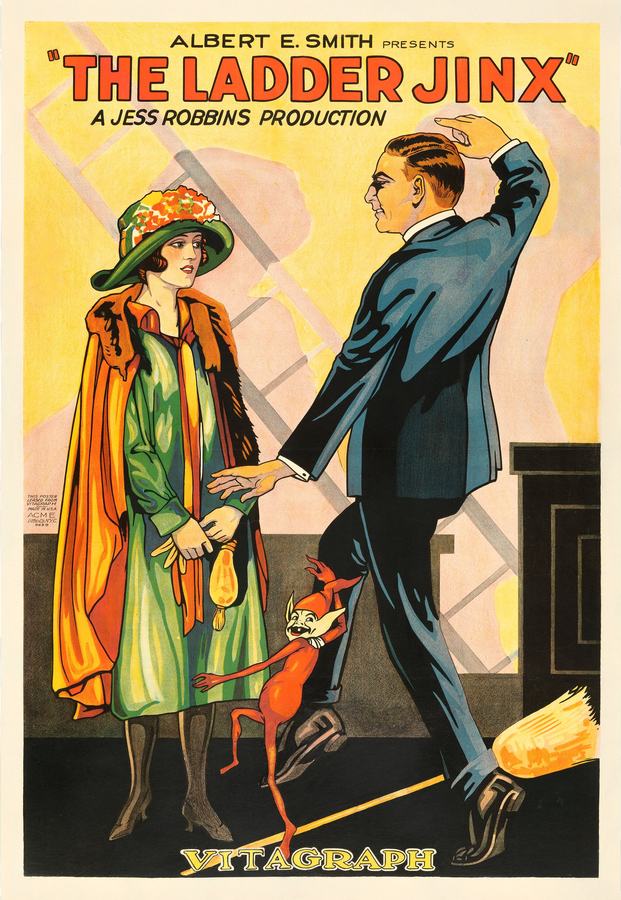
A definitive 6.8/10 rating for a film that redefined the boundaries of cult cinema. The Ladder Jinx remains a cornerstone of transgressive art.
The Ladder Jinx (1925) arrives like a mischievous wink from the vaults of silent cinema, a breezy 60-minute parable that suspends rational gravity the instant Arthur Barnes steps beneath that fateful ladder. What follows is less a plot than a domino-topple of coincidences, stitched together by flappers, fedoras, and the flicker of nitrate whimsy.
Director David Kirkland, trading custard-pie chaos for urbane anxiety, frames superstition as both punchline and social currency. The film’s Manhattan is a place where a boardroom coup can hinge on a nephew’s surname and where crossing one’s path under painted wood becomes tantamount to grand larceny. It is, in other words, the Jazz Age in miniature: giddy, materialistic, and terrified of its own shadow.
Peter Stalton’s farewell is no sentimental handshake; it is a last-gasp attempt to mint Richard Twing as successor, thereby sealing both bloodline and brand. The board’s refusal feels almost modern—meritocracy intruding on feudal fantasy—yet the film refuses to moralize. Instead, it pivots to Arthur Barnes, whose only crime is ambulatory bad timing. The ladder he passes under might as well be a metaphysical turnstile, flipping him from anonymous clerk to public enemy number one.
Helen Wilbur’s superstition is rendered with screwball sincerity: she bargains with fate the way Wall Street bargains with margin calls. Her demand that Arthur re-cross beneath the ladder is less a ritual than a prenuptial clause, and the camera lingers on her eyes—wide, glistening, equal parts love and fear—as though she already intuits the pandemonium she is midwifing.
Once the accusation detonates, the film morphs into a kinetic cartograph of civic spaces: brownstone stoops, cobblestone alleys, the Beaux-Arts façade of the bank itself. Kirkland orchestrates movement with a percussive elegance—every stride, stumble, and taxi-honk lands like a snare hit. The pursuit anticipates the manic topography of Fellow Citizens (1922), yet substitutes that film’s political bile with feather-light existential panic.
Arthur and Helen’s tandem dash through traffic is filmed from a low-mounted camera strapped to a moving vehicle—an embryonic version of the modern dash-cam—so the audience feels every jolt of pavement. The effect is half thrill, half jitters, a visceral reminder that destiny in this universe is merely a matter of spatial coordinates.
Sam, the Black janitor, occupies the film’s moral fulcrum, yet the text cannot decide whether he is savior or stereotype. Played by Ernest Shields with a knowing gleam, Sam wields his mop like a marshal’s baton, sweeping away Twing’s fabricated alibi with a single testimony. The film’s denouement hinges on his word, but the camera grants him no close-up comparable to Helen’s. Still, within the confines of 1925, the very act of vesting truth in a Black laborer registers as quiet revolution—one that resonates louder than any pratfall.
Compare this to the Orientalist reveries of Life of the Jews of Palestine (1913) or the expressionist shadows of Nachtgestalten (1920), where marginalized figures remain ornamental. Here, Sam’s intervention is structural, not decorative—a narrative keystone disguised as comic relief.
Edward Everett Horton, still a year away from his definitive fussbudget persona, imbues Arthur Barnes with a stammering decency—eyebrows arching like question marks, limbs that seem to debate their next move. Opposite him, Margaret Landis’s Helen oscillates between flapper flippancy and Victorian vapors, sometimes within a single intertitle. Their chemistry is less smolder than static cling, yet that awkwardness suits a courtship founded on ladder-based litigation.
Tom McGuire’s Stalton exudes the entitled lethargy of a man who has mistaken tenure for virtue, while Will Walling’s granite-jawed president channels boardroom patriarchy with one raised eyebrow. Together they sketch a microcosm of corporate gerontocracy, a pre-Depression tableau ripe for toppling.
Kirkland, himself a former Keystone gagman, understands that silence amplifies absurdity. A ladder, after all, is just two poles and rungs until it is framed between a cop’s waving nightstick and a fleeing fiancé. The film’s visual puns hinge on negative space: the hollow rectangle of the ladder becomes a portal through which luck drains out. Watch how cinematographer Edgar Franklin composes Arthur’s silhouette inside that rectangle—an inverted halo forecasting doom.
Intertitles, often the clunky expository gears of silent storytelling, here crackle with epigrammatic flair. When Helen warns, “Step under, step into perdition,” the words flare crimson against obsidian, a typographic shiver that anticipates noir.
The 4K restoration premiered at Pordenone reveals textures long buried: the herringbone weave of Arthur’s waistcoat, the opalescent sheen of Helen’s silk stockings, the chalky motes that float like plankton when Sam’s broom slaps the marble floor. The score—commissioned from Monica Hennegin—pairs pizzicato strings with syncopated woodblocks, evoking the clatter of typewriters and the hiccup of automobile backfire. It is a soundtrack that refuses nostalgia, instead matching the film’s caffeinated heartbeat.
Purists may carp about tinting choices—amber for interiors, cyan for exteriors—but the alternation underscores emotional temperature, transforming chromatism into dramaturgy.
Set The Ladder Jinx beside Das Grand Hotel Babylon (1922) and you witness two philosophies of luxury: the continental opulence of Grand Hotels versus the brisk, Protestant functionality of American banking halls. Where Babylon wallows in velvet corruption, Jinx polishes its brass railings until they gleam with moral rectitude—then laughs as destiny smudges fingerprints across them.
Equally instructive is the contrast with Boy Scouts of America (1917): both films deploy coincidence as curriculum, yet where the latter moralizes civic duty, Jinx treats ethics like loose change—necessary, but apt to jangle at inopportune moments.
Some silents feel embalmed in their own innocence; The Ladder Jinx pulses with a skepticism that feels startlingly contemporary. Its thesis—that merit and malfeasance are separated by the thinnest of rungs—lands with the crispness of a slapstick snap, yet lingers like a morality hangover. See it for Horton’s proto-nebbish charm, for the kinetic grammar of early automotive chases, for Sam’s subversive gravitas. See it, above all, as a reminder that destiny sometimes needs only a carpentry prop and a whispered superstition to upend an entire life.
Stream it, beam it, scream it across rooftops—just don’t walk under anything wooden while the credits roll.
IMDb 6.4
1937
Community
Log in to comment.