DbcultAccessing Vault...
Cult Review
Senior Film Conservator

From the moment the credits unfurl, ‘The Law of Men’ ensnares its audience in a meticulously crafted web of artistic aspiration, high society intrigue, and the chilling specter of murder. This cinematic endeavor, a testament to the narrative prowess of Ella Stuart Carson and John Lynch, transcends mere genre classification, offering a profound meditation on the precarious balance between creative freedom and societal expectation. It is a film that demands attention, not merely for its central whodunit, but for its astute character studies and the palpable tension it cultivates throughout its runtime. The story, at its core, revolves around a gifted sculptress, a figure of burgeoning talent, whose trajectory towards artistic renown is abruptly and violently disrupted by the assassination of her influential patron. This calamitous event serves as the catalyst, propelling the narrative into a relentless exploration of guilt, suspicion, and the often-unforgiving gaze of public opinion.
The film’s brilliance lies in its ability to paint a vivid picture of the art world's gilded cage, where patronage, while offering liberation from financial constraints, simultaneously imposes its own set of invisible shackles. Dorcas Matthews, in the role of the sculptress, delivers a performance of breathtaking vulnerability and nascent strength. Her portrayal is a masterclass in conveying the internal turmoil of an artist caught in circumstances far beyond her control. We witness her character’s initial exhilaration at being recognized, a joy that soon curdles into terror as she becomes the prime suspect in a crime she did not commit. Matthews imbues her character with an authentic human spirit, making her plight deeply resonant. The audience feels every tremor of her fear, every spark of her defiance, and every flicker of hope as she navigates a labyrinthine legal and social system seemingly designed to crush her.
Andrew Robson, as the ill-fated art patron, though his screen time is limited, leaves an indelible impression. His character is a fascinating dichotomy: a benevolent benefactor whose sudden demise unravels a tapestry of hidden motives and clandestine dealings. The film cleverly uses his absence to amplify his presence, making his influence, both positive and destructive, a constant, ghostly force. Donald MacDonald, Frankie Lee, Niles Welch, and Enid Bennett round out the principal cast, each contributing layers of complexity to the unfolding drama. MacDonald’s performance, in particular, stands out, embodying a certain moral ambiguity that keeps the audience guessing about his true intentions. These supporting characters are not mere plot devices; they are fully realized individuals whose actions and reactions contribute significantly to the film’s rich thematic texture.
The narrative architecture, meticulously constructed by Carson and Lynch, is a marvel of storytelling. They eschew simplistic moralizing, instead opting for a nuanced examination of human nature, where good and evil are often intertwined in shades of grey. The pacing is deliberate, allowing moments of quiet introspection to punctuate the escalating drama, building a sense of dread that permeates every frame. The investigation itself is less about procedural accuracy and more about the psychological toll it exacts on those caught in its vortex. This approach elevates ‘The Law of Men’ beyond a mere mystery, transforming it into a profound character study of individuals under immense pressure. One might draw parallels here to the intricate psychological suspense found in The Mystery of the Yellow Room, where the 'how' is less compelling than the 'why' and the 'who' is veiled in an almost impenetrable fog of human deceit.
Visually, the film is a triumph. The cinematography employs a sophisticated interplay of light and shadow, particularly effective in rendering the oppressive atmosphere of suspicion and the stark beauty of the sculptress’s art studio. The close-ups on Matthews’ face during moments of intense emotion are particularly striking, allowing the audience to intimately connect with her character’s internal struggle. The production design, with its opulent yet subtly unsettling depiction of the patron’s estate contrasted with the raw, creative energy of the studio, speaks volumes about the societal divides and the clash of worlds that underpin the narrative. The aesthetic choices are not merely decorative; they are integral to the storytelling, enhancing the emotional resonance and thematic depth of the film.

The central theme of justice, or the lack thereof, is explored with unflinching honesty. Is justice a blind, impartial force, or is it swayed by public perception, social standing, and the machinations of powerful individuals? ‘The Law of Men’ suggests a more cynical reality, where truth often struggles to emerge from beneath layers of prejudice and self-interest. The film forces us to question the very foundations of our legal systems and the inherent biases that can corrupt the pursuit of righteousness. This thematic thread resonates with the tragic pursuit of justice seen in Beatrice Cenci, where personal vendettas and societal norms often overshadow the quest for true equity, leading to devastating consequences. Similarly, the struggle against overwhelming odds and the fight for one’s reputation echoes the trials faced by protagonists in films like Eye for Eye, where the quest for vengeance or vindication often comes at a steep personal cost.
Beyond the murder mystery, the film delves into the fascinating world of artistic creation and the pressures that accompany it. The sculptress’s art becomes a metaphor for her spirit – raw, expressive, and ultimately vulnerable to the external forces that seek to define or destroy it. The film subtly critiques the commodification of art, where the value of a piece can be dictated more by the patron’s influence than by its inherent merit. This exploration of the artist's struggle for authenticity against a backdrop of societal judgment feels remarkably prescient, offering insights that remain relevant even today. The tension between artistic integrity and the need for financial support is a timeless dilemma, handled here with grace and poignancy.
The screenplay by Ella Stuart Carson and John Lynch is a masterclass in narrative economy and character development. Every line of dialogue, every plot twist, feels purposeful, propelling the story forward without unnecessary exposition. They manage to weave a complex tapestry of relationships and motivations, ensuring that no character feels superfluous. The dialogue is sharp, often understated, yet laden with subtext, revealing the hidden anxieties and desires of the characters. Their collaborative effort creates a narrative that is both intellectually stimulating and emotionally gripping, a rare feat in any era of filmmaking. The precision in their writing evokes the tightly wound dramatic structures found in films like Tangled Fates, where every interaction carries significant weight and consequence.
The performances across the board are uniformly excellent, elevating the material beyond its already strong foundations. Dorcas Matthews anchors the film with a performance that is both fragile and fiercely determined. Her transformation from an aspiring artist to a woman fighting for her very existence is utterly convincing. Andrew Robson, even in his limited role, projects an aura of power and sophistication that makes his character’s demise all the more impactful. Donald MacDonald brings a compelling ambiguity to his character, keeping the audience on edge about his allegiances and motives. Frankie Lee, Niles Welch, and Enid Bennett all deliver nuanced performances that flesh out the intricate social ecosystem surrounding the central tragedy. Their collective efforts contribute significantly to the film’s immersive quality, making the world of ‘The Law of Men’ feel remarkably real and lived-in.
The film’s exploration of societal norms and their impact on individual lives is another strong suit. The pressure to conform, the swiftness with which reputations can be shattered, and the difficulty of proving one’s innocence in the face of overwhelming circumstantial evidence are themes that resonate deeply. It’s a stark reminder that the 'law of men' is not always synonymous with true justice, but often a reflection of human prejudices and imperfections. In this regard, it shares a thematic kinship with films such as East Lynne, which similarly dissects the devastating consequences of societal judgment and the rigid moral codes of its time on a woman’s life and reputation.
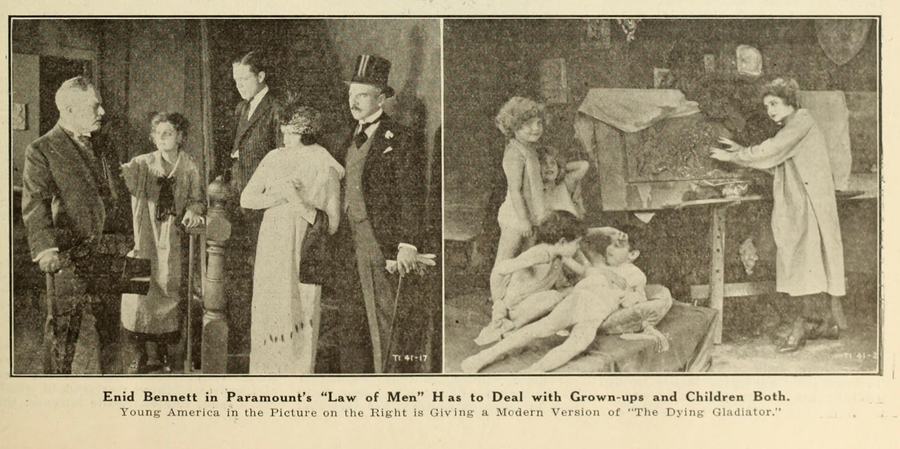
The ending, without revealing spoilers, is deeply satisfying in its complexity. It eschews simple resolutions, opting instead for a conclusion that is both emotionally resonant and intellectually provocative. It leaves the audience with much to ponder, long after the final frame fades to black, a hallmark of truly great cinema. This is not a film that offers easy answers; rather, it prompts introspection and discussion about the intricate interplay of morality, law, and human fallibility. The lingering questions and moral ambiguities echo the profound impact of films like Mellem de yderste Skær, which often leave viewers contemplating the deeper implications of human choices and fate.
In an era brimming with cinematic spectacles, ‘The Law of Men’ stands as a beacon of intelligent storytelling and compelling character development. It is a film that rewards careful viewing, revealing new layers of meaning with each subsequent watch. The direction is assured, the performances captivating, and the screenplay remarkably insightful. It is a powerful examination of the human condition, an intricate murder mystery, and a poignant commentary on the often-fraught relationship between art and society. This film is an essential watch for anyone who appreciates cinema that challenges, provokes, and ultimately, deeply moves its audience. It remains a powerful testament to the enduring appeal of well-told stories, proving that the most compelling dramas are often those that hold a mirror up to our own complex world, reflecting the best and worst of humanity with unflinching honesty. The enduring power of its narrative, its compelling performances, and its timeless themes ensure its place as a significant work in the annals of cinematic history, offering a rich viewing experience that transcends generations. Its nuanced portrayal of a woman fighting for her truth against a backdrop of powerful forces makes it an enduring classic, much like the timeless struggle depicted in Her Greatest Love or Marta of the Lowlands.
The intricate dance between public perception and private truth is a recurring motif, masterfully handled. As the sculptress navigates the treacherous waters of the investigation, her artistic creations, once symbols of her burgeoning freedom, become points of contention, scrutinized for hidden meanings or incriminating clues. This transformation of art from a personal expression into a piece of evidence underscores the film’s sophisticated understanding of how external pressures can distort even the purest intentions. The inherent drama in this conflict is expertly exploited, providing much of the film’s emotional weight. The way society casts judgment, often based on superficial evidence or preconceived notions, is a stark commentary that still resonates. This resonates with the unfortunate circumstances often found in films like In Bad, where characters find themselves entangled in situations that defy easy moral categorization and demand a deeper, more empathetic understanding.
Ultimately, ‘The Law of Men’ is more than just a suspenseful tale; it's a poignant exploration of identity, resilience, and the relentless pursuit of truth in a world rife with deception. The film’s lasting impact stems from its ability to delve into the psychological landscape of its characters, revealing the intricate motivations and hidden vulnerabilities that drive human behavior. It’s a narrative that refuses to simplify the human experience, instead embracing its complexities and contradictions. For those who appreciate cinema that challenges the intellect while stirring the emotions, this film is an absolute revelation, a timeless piece of storytelling that continues to captivate and provoke thought. The artistry woven into its very fabric, from the writing to the performances, ensures its legacy as a powerful and enduring work. One cannot help but be reminded of the compelling, albeit darker, explorations of human nature and societal decay found in a film like Der Yoghi, where the undercurrents of human depravity and the fragility of order are similarly brought to the fore.
The film’s ability to maintain a high level of suspense without resorting to cheap thrills is commendable. The tension builds organically, stemming from the deeply personal stakes involved and the constant threat looming over the protagonist. This sustained sense of unease is a testament to the meticulous direction and the powerful performances. The narrative never feels rushed, allowing the audience to fully absorb the gravity of each development and empathize with the characters’ plights. It’s a masterclass in controlled storytelling, where every revelation feels earned and every emotional beat lands with profound impact. Such sustained narrative control and character-driven suspense are qualities that elevate films like The Princess' Necklace, where a seemingly straightforward plot unravels into a complex psychological drama, keeping audiences guessing until the very end.
The legacy of 'The Law of Men' is secure, not just as a historical artifact, but as a living, breathing piece of art that continues to speak to contemporary audiences. Its themes of justice, ambition, betrayal, and the struggle for truth are universal and timeless. The film acts as a powerful reminder that while laws are written, the human interpretation and application of those laws are often flawed, making the pursuit of true justice a perpetually challenging endeavor. It’s a film that resonates because it dares to ask difficult questions, offering no easy answers but instead inviting us into a profound dialogue about the human condition. The film’s enduring relevance and its masterful execution solidify its position as a cinematic gem, a must-see for anyone interested in the rich tapestry of film history and the timeless power of compelling storytelling. The nuanced portrayal of its characters and the intricate plot ensure that it stands tall among its contemporaries and continues to inspire discussion and analysis, much like the enduring allure of The Raiders, a film celebrated for its gripping narrative and memorable characters.
IMDb —
1914
Community
Log in to comment.