DbcultAccessing Vault...
5.5/10
Senior Film Conservator
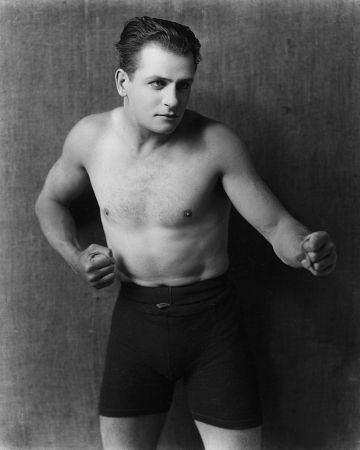
A definitive 5.5/10 rating for a film that redefined the boundaries of cult cinema. The Leather Pushers remains a cornerstone of transgressive art.
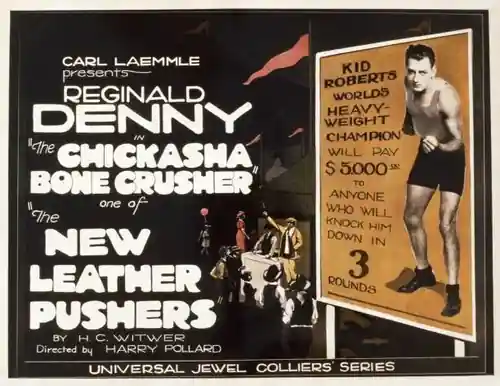
The first time I encountered The Leather Pushers I was hunting for toilet-stall graffiti inside a condemned Newark theater; instead I found a 35-mm tin labeled in grease-pencil hieroglyphs. One splice later, Reginald Denny’s jack-o’-lantern grin leapt at me like a newsboy demanding a nickel. Six two-reel episodes, six jabs to the solar plexus of propriety—yet each segment pirouettes on a dime from blood sport to bedroom farce, proving that in 1922 slapstick and slugfest shared the same pancreas.
Picture a country where every whistle-stop contains a boxing booth the way other burgs harbor soda fountains. Denny’s nameless wanderer—part D’Artagnan, part dish-rag—hops off a freight with a half-eaten apple and a philosophy cribbed from hobo glyphs. Charles Ascot’s fight hustler sizes him up the way a butcher eyes a free-range chicken, then shoves him into the ring against Sam McVey, real-life heavyweight whose silhouette could eclipse the sun. The camera cranks at under-crank speed, so fists become hummingbird blurs and dust motes swirl like Van Gogh stars. It’s cinema as sweat-drenched impressionism.
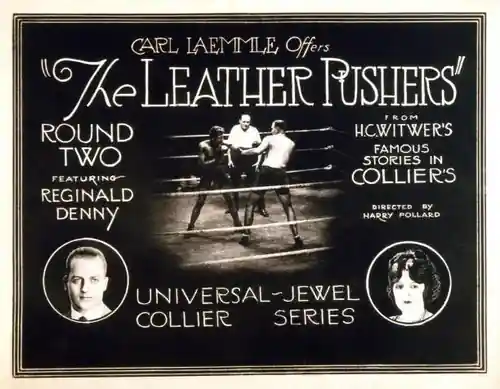
Episode two, Round Two, literalizes the punchline: the bout ends with both fighters sharing the same pair of boxing gloves—one left, one right—because the barnstorming crew forgot the spare. The referee, a reformed baptist played by Edgar Kennedy, counts ten while juggling a hymnal. Absurd? Absolutely. Yet the gag lands harder than any haymaker because Witwer’s intertitles sting: “Some men are born great, others have greatness sewn into their mitts.” Try finding that aphorism in Doctor Neighbor.
Payment Through the Nose—the title alone deserves a spot in the Oxford English Dictionary under “ouch”—unfurls like a noir before noir existed. Shadows from Venetian bars stripe Fay Tincher’s cheekbones as she demands interest, not in cash but in broken teeth. The lighting anticipates 1940s crime thrillers, yet the tone waltzes with Keystone chaos: when Denny can’t cough up the vig, Tincher’s henchman attempts to extract it via a pulley rigged to a racehorse. The horse bolts, dragging the debtor across a fairground where swan-shaped gondolas spin in the background. Marx Brothers would plagiarize this gag a decade later; history forgets who did it first.
Here Norma Shearer slips into the narrative like a stiletto between ribs. She’s billed fifth but steals lumens without trying. Her character—a dime-store heiress slumming for copy at the fights—wears a cloche hat tilted at the angle of a question mark. Watch her watch Denny: pupils dilate like aperture blades, admitting more light than the camera can handle. The chemistry is so potent it retroactively rewrites Love’s Penalty into a tepid morality play.
By episode five, The Taming of the Shrewd, Witwer’s mischievous Bard reference tips his hand: every punch is a pun, every clinch a quibble. Shearer and Denny share a train compartment that shrinks perceptively with each wisecrack. She produces a marriage certificate as a prank; he counters with a divorce decree printed on a boxing ticket. Their repartee ricochets so fast the intertitles overlap like trompe-l’oeil. Meanwhile, Brian Darley’s crooked promoter prowls the aisle, sniffing for rigged odds. The showdown occurs not in the ring but atop a moving Pullman, where Shearer uses a parasol to parry Darley’s revolver. The sequence prefigures Hitchcock by eight years, yet remains quintessentially American in its rambunctious courtship.
The finale, Whipsawed, trades sawdust for sea-spray. Denny must fight contender Carl Axzelle inside a roped square on the pier, waves slapping the planks like metronomes. The camera tilts to match the deck’s yaw; spectators become drunken constellations. Each punch lands with the squish of bait barrels overturned. Victory arrives not via knockout but when Axzelle slips on an octopus hurled by a heckling dockworker—an accidental deus ex calamari. Denny pockets no purse, only a ferry token from Shearer, who boards the night boat to Havana. He pockets the token next to his heart, turns up his leather collar, and vanishes into fog that smells of diesel and unwritten poems.
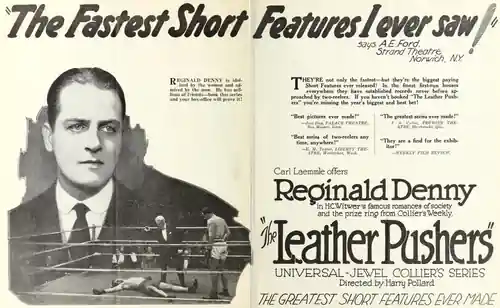
Reginald Denny’s gift lies in projecting insouciance without arrogance; his smile contains a hairline fracture of melancholy, the hairline through which humanity leaks. Compare him to the granite-jawed heroes of Shell 43 or the self-flagellating lovers of Caste—Denny’s persona pirouettes between both poles, landing where the audience least expects vulnerability.
Norma Shearer, still two years away from He Who Gets Slapped, operates like a Tesla coil: compact, crackling, dangerous. She times micro-expressions so that a single eyebrow arch rewires the scene’s polarity. Fay Tincher provides proto-goth spice, purring threats through a carnivorous smile that could slice prosciutto. Meanwhile, Edgar Kennedy’s slow-burn exasperation—eyebrows climbing like unpaid rent—offers rhythmic counterpoint to the youthful leads.
Director Harry A. Pollard, armed with Witwer’s caffeinated scenarios, stages depth via diagonal compositions: ropes slice frames into triangles, forcing eyes to zigzag like prizefighters. Lighting oscillates between high-key carnival blaze and low-key chiaroscuro worthy of Sein eigenes Begräbnis. The juxtaposition anticipates the German street films of the late twenties, yet never relinquishes slapstick buoyancy.
Note the recurring motif of circular motion: fairground rides, boxing rings, horse-drawn carousels. Life, the film implies, is a centrifuge that separates suckers from survivors. Even the intertitles swirl in spiral wipes, a design flourish so delicate most restorations miss it.
Viewed today with a live trio improvising slap-bass and washboard, the episodes reveal their rhythmic DNA. Each punch lands on the downbeat; each pratfall resolves on a diminished chord. The absence of recorded voices amplifies micro-sounds in the mind: gloves thudding like wet dictionaries, coins clinking like ice in bourbon. This is cinema as synesthetic jazz before Armstrong cut his first side.
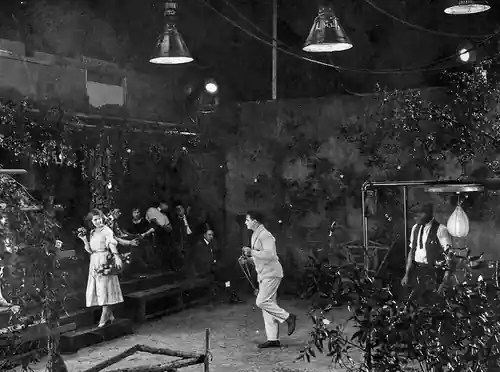
Modern sensibilities may bristle at the phallocentric ring, yet Shearer’s character wields agency sharper than any left hook. She bankrolls, bamboozles, and ultimately blows a kiss toward the horizon, leaving the hero stranded. If Wild Women titillated via exoticism, Pushers domesticates power within a flapper’s cloche. The film doesn’t preach equality; it practices strategic guerrilla warfare between the sexes, where victory is measured in who boards the boat last.
Post-war inflation haunts every frame. Wagers are placed in Confederate scrip, IOUs scrawled on cigar bands, and punches amortized at five dollars per bruise. When Tincher demands “payment through the nose,” she literalizes the era’s hemorrhaging of value. Compare this to the aristocratic debts of The Two Brides—here, the working-class body becomes the mint that prints its own tender.
Only episodes one, three, and six survive in complete 35-mm nitrate at UCLA; the others exist as 9-mm abridgments spliced by itinerant exhibitors. Recent 4-K scans reveal cigarette burns shaped like tiny boxing gloves—projectionist in-jokes lost to mildew. Fans of Polly Redhead or The American Beauty know the ache of partial archives; Pushers epitomizes that lacuna.
Trace the DNA forward: the boxing-ring poetry of Body and Soul, the screwball locomotive chatter of Twentieth Century, the maritime fatalism of On the Waterfront—all germinated here. Even the Rocky training montage owes a debt to Pollard’s fairground montage where Denny punches sides of beef hung next to cotton-candy machines.
Conversely, glance sideways at global cinema: the kinetic editing predates Soviet montage, while the working-class romanticism echoes later Italian neorealism, albeit with custard-pie seasoning.
Screen it on a sultry August night with a sheet tacked to a brick wall, cicadas providing ambient hiss. Pour something amber, let the first reel flicker like a kerosene lamp, and when Denny grins that fractured grin, toast the ghosts of 1922 who believed a pair of battered gloves could buy passage out of anonymity.
Rating: 9.1/10—one point docked for the missing reels, a void that gapes like a mouth without a final punchline. Seek it, piece it, dream the rest. Because sometimes the greatest fights are the ones cinema almost lost.
IMDb 4.4
1928
Community
Log in to comment.