DbcultAccessing Vault...
6.9/10
Senior Film Conservator
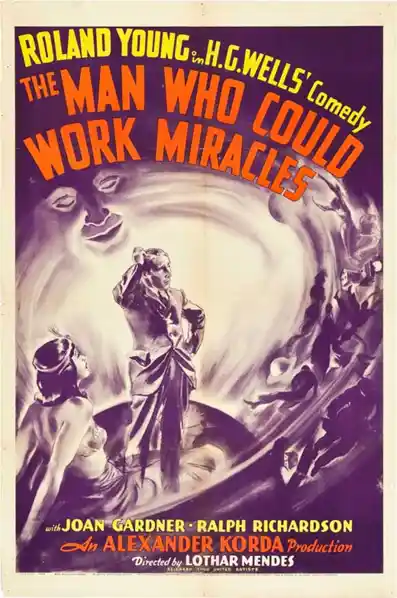
A definitive 6.9/10 rating for a film that redefined the boundaries of cult cinema. The Man Who Could Work Miracles remains a cornerstone of transgressive art.
Honestly, yes. If you like those old movies where the special effects look like they were made with string and mirrors but still feel magical, you'll dig this.
It is definitely for people who enjoy British whimsy and don't mind a bit of preachy 1930s philosophy at the end. If you hate slow pacing or guys in togas talking about the 'fate of man,' you might want to skip it.
I found myself watching this on a rainy Sunday and it just hit the right spot. It’s based on an H.G. Wells story, and you can really feel his fingerprints all over the script.
The movie starts with these three 'gods' or celestial beings floating in the stars. They look like they are wearing very shiny, very uncomfortable bathrobes.
They decide to give a random human power just to see what happens. It’s a bit like a cosmic prank, really.
Enter George Fotheringay. He is played by Roland Young, who has the most perfectly ordinary face you’ve ever seen.
The scene in the pub where he first realizes he can work miracles is probably my favorite part. He’s just trying to argue that miracles are impossible, and then suddenly, a lamp starts floating.
The way the other guys in the pub react is so dry. They aren't even that terrified; they're just annoyed that he's messing with the furniture.
There is a lot of charm in how small-scale the miracles are at first. He makes a rabbit appear, he fixes a broken plate, he makes some flowers grow.
It reminded me a bit of the simple, human stakes you see in something like Steady Company, even though this one has magic in it. It's just a guy trying to figure out his life, only now he can conjure gold out of thin air.
Then Ralph Richardson shows up as the Colonel. He is chewing the scenery so hard and it is wonderful.
He wants to use George’s powers to fix the world, but his version of 'fixing' mostly involves more discipline and better drainage systems. It’s very British.
One thing that bothered me was how long the middle section dragged. George goes to see a local preacher, and they just sit and talk about the ethics of miracles for what feels like an hour.
The preacher, Mr. Maydig, looks constantly like he’s about to sneeze. I couldn't stop looking at his nose.
The movie gets much better—and weirder—once George starts getting a big head. He decides he’s going to create a utopia, but he’s just a clerk, so he doesn't really know how a utopia should work.
There’s this great, awkward moment where he tries to make a girl love him, and it just... doesn't work the way he wants. It’s uncomfortable to watch, which I think was the point.
It’s not quite as dramatic as Circe the Enchantress, but it has that same vibe of 'be careful what you wish for.'
The ending is where things go absolutely off the rails. George decides to stop the Earth from rotating so he can have more time to think.
If you know anything about physics, you know that stopping the Earth would basically fling everyone into space at a thousand miles per hour. The movie actually shows this! Well, sort of.
You see people and cows and houses flying through the air. For 1936, the effects are actually pretty impressive, even if you can tell they are just toy models.
It's such a huge jump from 'making a lamp turn upside down' to 'destroying the entire planet.' The shift in tone is wild.
I also noticed a few weird things that probably weren't intentional. Like how the Colonel’s mustache seems to change shape between scenes.
Or how the crowd scenes in the later half feel a bit empty. It's like they ran out of extras and just hoped we wouldn't notice the same three guys in the background.
It's a bit like The Winning of Beatrice in how it focuses on a singular character's journey, but with way more explosions at the end.
The movie doesn't really have a 'villain' in the traditional sense. George isn't a bad guy; he’s just a mediocre guy who was given a god's toolkit.
That’s what makes it stay with you. It’s about how most of us would probably mess everything up if we were in his shoes.
A few things I took notes on:
Is it a masterpiece? Probably not. It's a bit too clunky for that.
But it's got a heart, and it’s genuinely funny in a way that doesn't feel forced. It feels like a real person's attempt to grapple with a big idea without having all the answers.
I’d take this over a polished, boring modern blockbuster any day. It’s got character, even if the seams are showing.

IMDb 5.6
1937
Community
Log in to comment.