DbcultAccessing Vault...
Cult Review
Senior Film Conservator
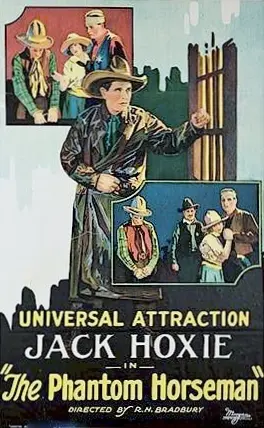
The Phantom Horseman, a silent western film from the 1920s, presents a complex narrative that probes the themes of loyalty, deception, and redemption, set against the backdrop of a small town threatened by the expansionist ambitions of the Williams Lumber Co.
The film masterfully crafts a story that not only entertains but also invites viewers to reflect on the moral dilemmas faced by its characters, particularly Sheriff Bob Winton, who finds himself at the center of a maelstrom of conflicting interests and loyalties.
In the quaint town, a mysterious figure known as 'The Hawk' has emerged as a bandit, earning the admiration of the townspeople for his audacious thefts from the Williams Lumber Co., a company notorious for its ruthless pursuit of land acquisition. This sets the stage for Sheriff Bob Winton's pursuit of 'The Hawk,' driven by a duty to uphold the law and maintain order.
However, the narrative takes an intriguing turn when Bob discovers that 'The Hawk' is, in fact, Fred, Dorothy's brother. This revelation presents Bob with a formidable challenge: his loyalty to his sweetheart and her family versus his commitment to justice. Complicating matters further is the Williams Lumber Co.'s mortgage on Dorothy's ranch, which threatens her family's livelihood.
Faced with this moral quandary, Bob decides to protect Fred, navigating a delicate balance between his duty as a lawman and his personal relationships. This decision, however, leads to a tragic sequence of events. Bob is accused of killing a guard at the lumber company, a charge that Fred cannot allow to stand.
In a poignant display of sacrifice and love, Fred confesses to being 'The Hawk' and subsequently takes his own life. This act not only clears Bob's name but also ensures that Dorothy's ranch is saved from the clutches of the Williams Lumber Co.
The film's conclusion is both heart-wrenching and thought-provoking, leaving viewers to ponder the implications of the characters' actions and the broader societal commentary that The Phantom Horseman offers. It is a testament to the enduring power of sacrifice and the complex interplay between personal loyalty and public duty.
In comparison to other films of its era, such as The Faithful Heart, The Phantom Horseman stands out for its nuanced exploration of moral ambiguity. While The Faithful Heart presents a more straightforward tale of love and loyalty, The Phantom Horseman complicates these themes with the addition of societal pressure and economic interests.
Similarly, when juxtaposed with Birthday Guests and Jungle Pests, a film that blends comedy and adventure, The Phantom Horseman demonstrates a more serious and contemplative approach to storytelling, highlighting the gravity of its themes and the depth of its characters.
The Phantom Horseman, while a silent film, leverages the visual and emotive storytelling capabilities of its medium to convey a powerful narrative. The performances of the cast, including George A. Williams, William McCall, and Jack Hoxie, contribute significantly to the film's impact, bringing depth and authenticity to their characters.
The direction and writing, credited to Isadore Bernstein, demonstrate a keen understanding of the western genre and its potential for exploring complex human emotions and societal issues. The film's cinematography and editing work in tandem to create a visually engaging experience, with each scene carefully crafted to enhance the story's emotional resonance.
The Phantom Horseman, in its exploration of loyalty, sacrifice, and redemption, leaves a lasting impression on viewers. Its portrayal of the human condition, set against the backdrop of the American West, offers insights into the universal themes that transcend time and geography.
For fans of western dramas and silent films, The Phantom Horseman is a must-watch, offering a unique blend of action, drama, and social commentary. Its historical significance, coupled with its artistic merit, makes it a valuable piece of cinema history, worthy of preservation and study.
Ultimately, The Phantom Horseman stands as a testament to the power of storytelling, demonstrating how films can engage, provoke, and inspire audiences. Its legacy continues to captivate viewers, offering a window into the past while remaining remarkably relevant in the present.

IMDb —
1932
Community
Log in to comment.