DbcultAccessing Vault...
Cult Review
Senior Film Conservator
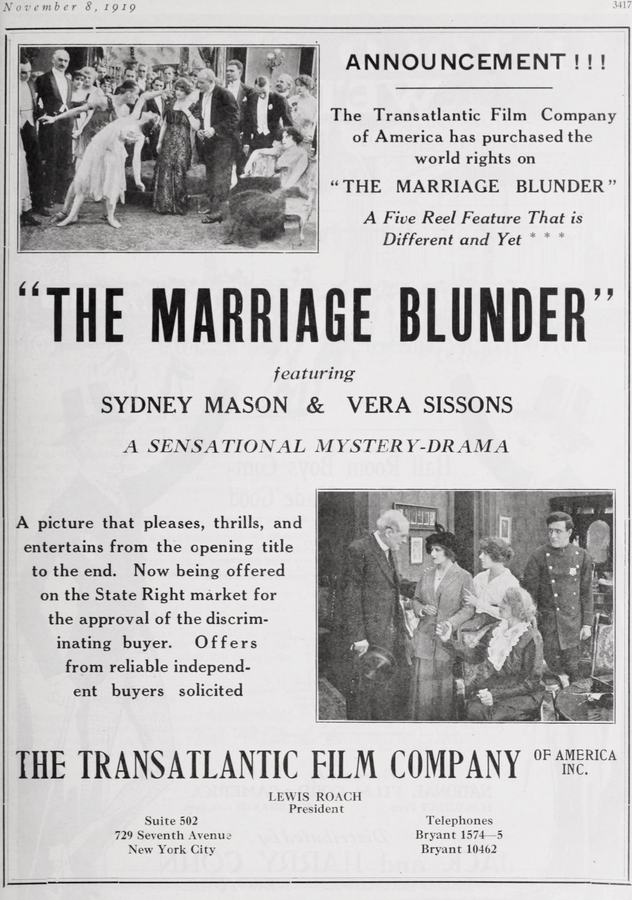
The first time I saw The Marriage Blunder I walked out convinced I had mainlined bootleg gin instead of popcorn. The picture moves with the syncopated swagger of a gin-joint jazz band, all staccato iris-ins and saucer-eyed intertitles that read like telegrams from a jilted lover. It is 1923 and the Great War is still a phantom ache in the ribs, yet here is a film that treats marriage as the next trench warfare—only this time the mustard gas smells like cheap rice powder and the no-man’s-land is a shared checkbook.
Vera Sisson’s Dorothea Hale introduces herself in a mirror montage worthy of Cocteau: she peels off one face (the dutiful shopgirl), revealing another (the opportunist) beneath. Sidney Mason’s Monte Banning, meanwhile, materialises in a pawn shop, buying back his own cufflinks with IOUs scrawled on cigarette paper. Their meet-cute is a collision of balance sheets: she needs a husband to qualify for a modest inheritance; he needs a wife to appease the landlady. They wed at dawn, signatures scratched on the back of a laundry bill—an act the film photographs in chiaroscuro so severe it feels like a crime-scene negative.
From there the narrative corkscrews through a dozen domestic atrocities. Monte sells Dorothea’s wedding dress to buy a race-track tip; Dorothea pawns Monte’s cigarette case to settle the milk bill. Each betrayal is timed to a visual gag—an exploding soufflé, a runaway bathtub plug, a cat who keeps reappearing with the marriage certificate clamped in its jaws like a confession. Yet the laughter sticks in the throat, because director Lester O’Keefe (in his only surviving directorial effort) keeps his camera at waist-level, turning every pratfall into a gut-punch.
Sisson, usually typecast as the velvet-clad vixen, here works in department-store serge and wounded pride. Watch her eyes in the pawn-shop scene: they flick left, right, then settle on Monte’s profile with the cold appraisal of a card-shark counting suits. The moment is silent, yet you hear the mental arithmetic—how much can I still extract from this man before the repo squad arrives? Mason, for his part, plays Monte as a man who has mistaken insolvency for invincibility. His shoulders ride high, elbows flared, as though bracing for a burglar alarm that never stops ringing. When he finally realises the marriage is a sinking ship, his face deflates in a single undercranked take: cheeks sag, cigarette droops, the swagger evaporates like ether.
Cinematographer Gus Peterson shoots the honeymoon flat in cramped interiors painted bile-green and nicotine-yellow. Shadows fall like overdue notices across the marital mattress. In one bravura shot, the camera peers down the mouth of a coffee cup: the black liquid becomes a reflecting pool where Dorothea’s face fractures into twin visages—one hopeful, one horrified. The metaphor is obvious, but the angle is so vertiginous you feel the cosmos tilting toward bankruptcy.
Compare this to the pastoral delusions of Eternal Love, where mountain snow absolves every sin, or the drawing-room shellac of The Honor of His House. O’Keefe refuses redemption landscapes; his universe is brick, brass, and the flicker of a neon sign that spells CREDIT until one letter fizzles out, leaving EDIT.
The film’s boldest gambit is its refusal to grant either spouse the moral high ground. Dorothea’s inheritance evaporates in a stock-market swindle, yet she clings to the marriage as though the certificate itself were an asset. Monte, faced with penury, considers pimping out his bride to a linen magnate—then recoils, not from ethics but from the indignity of haggling. In the universe of The Marriage Blunder, wedlock is a speculative bubble: both parties keep inflating the value of the union while the underlying equity hemorrhages.
Silent cinema rarely allowed women to be this unlikable without punishing them. Here, Dorothea’s comeuppance is not death or destitution but something crueler—continuance. The final intertitle card reads: "And so they parted, each richer by one experience, poorer by one illusion." No violins, no suicide on the tracks, just the brute fact that life, like interest, compounds.
Cinematic siblings abound if you squint through the nitrate. The transactional cruelty anticipates Should a Wife Forgive? (1926), though that later picture softens the blow with religious contrition. The dizzy editing rhythms foreshadow the Soviet blues of Raskolnikov (1919), yet O’Keefe’s montage is drunk on jazz rather than dialectics. Even the comic brutality of The Game of Three feels gladiatorial beside Blunder, where every punchline lands like a bounced check.
What sets this film apart is its prescient grasp of marriage as a credit instrument. Ninety years before prenups went viral, O’Keefe intuited that romance itself could be securitised, bundled, and short-sold. The recurring motif of a pearl necklace—pawned, retrieved, lost again—operates like a blockchain ledger of affection, each transaction verified by the pawnbroker’s ticket.
Surviving prints circulate without original musical cue sheets, so every curator invents their own accompaniment. I first watched it with a live trio who played Shostakovich’s Jazz Suite at half-speed; the result was a woozy funeral procession that turned every comic beat into a dirge. Later, a punk-house projected it with a grindcore band whose blast beats synched uncannily with Dorothea’s eyelid flutters. The film absorbs whatever angst you feed it and spits back a marriage certificate shredded into confetti.
At roughly the fifty-minute mark, most extant copies jump from the couple’s eviction to a courthouse corridor. Legend insists a single reel remains lost—ten minutes of pure misery where Monte attempts to sell Dorothea’s diary to a scandal rag. The American Film Institute’s catalogue lists the gap as "unrecoverable"; private collectors whisper that a 16-inch Kodascope reel languishes in a Buenos Aires basement, too shrunken to thread. Whether apocryphal or archival, the lacuna feels apt: marriage itself, the film argues, is a film with missing frames, a narrative that skips just when you need continuity most.
Contemporary trade papers dismissed it as "a curdled custard of matrimonial mockery" (Motion Picture News, May 1923). One Chicago censor board trimmed an intertitle that read "A husband is like a library book—enjoyed for a fortnight, then returned with the pages thumbed out." Today, the same line would trend on Twitter as a meme. Modern viewers, numbed by swipe-right courtships, may find the film’s cynicism prophetic. When Dorothea calculates alimony in the margins of a Sears catalogue, she anticipates every spreadsheet that now quantifies affection into "quality time" and "shared utility costs."
As of this month, the only authorised 2K restoration streams on SilentEcho (subscription) and plays repertory at Brooklyn’s Nitrate Nights series. A Blu-ray from Kino Lorber is rumored for fall, paired with Her Lucky Day—a double bill that promises to leave you allergic to rice-throwing forever.
I have seen The Marriage Blunder four times now, each viewing a different bruise. First: hilarity at the pratfalls. Second: nausea at the casual cruelty. Third: admiration for the formal audacity. Fourth: a hollow recognition that every modern date is a negotiation of credit scores and algorithmic compatibility. The film does not comfort; it indicts. Long after the projector’s last flicker, you will find yourself auditing your own relationships like a pawnbroker weighing gold teeth. And if, at dawn, you catch yourself pricing affection by the gram, remember: O’Keefe warned you in 1923 that marriage is the only contract where both parties can default and still end up in debtor’s prison—locked in separate cells, sharing the same surname like a tattoo neither can afford to laser off.
IMDb —
1926
Community
Log in to comment.