DbcultAccessing Vault...
6/10
Senior Film Conservator

A definitive 6/10 rating for a film that redefined the boundaries of cult cinema. The Pest remains a cornerstone of transgressive art.
The first miracle of The Pest is how it turns a threadbare one-reel yarn into a prism of metropolitan anxiety: every doorway yawns with rent-day menace, every passer-by might morph into creditor or savior. Stan’s book salesman arrives armed only with paperbacks and a grin that doubts itself; the city greets him with slamming gates, snarling curs, and the predatory arithmetic of lease renewals.
Director Renaud—little lionized beyond specialist circles—conducts this pandemonium with a metronomic instinct for escalation. Notice the opening tableau: a diagonal lattice of shadows from a picket fence slashing across the screen, foreshadowing the lattice of social traps about to ensnare our hero. The camera doesn’t merely observe; it prowls, a co-conspirator in the persecution. When the landlord first ogles the ingénue, the lens adopts his point of view, creeping forward like a spider, then snaps back to a wide shot to reveal the girl’s spatial vulnerability. In that blink, the film announces its alignment with the prey, not the predator.
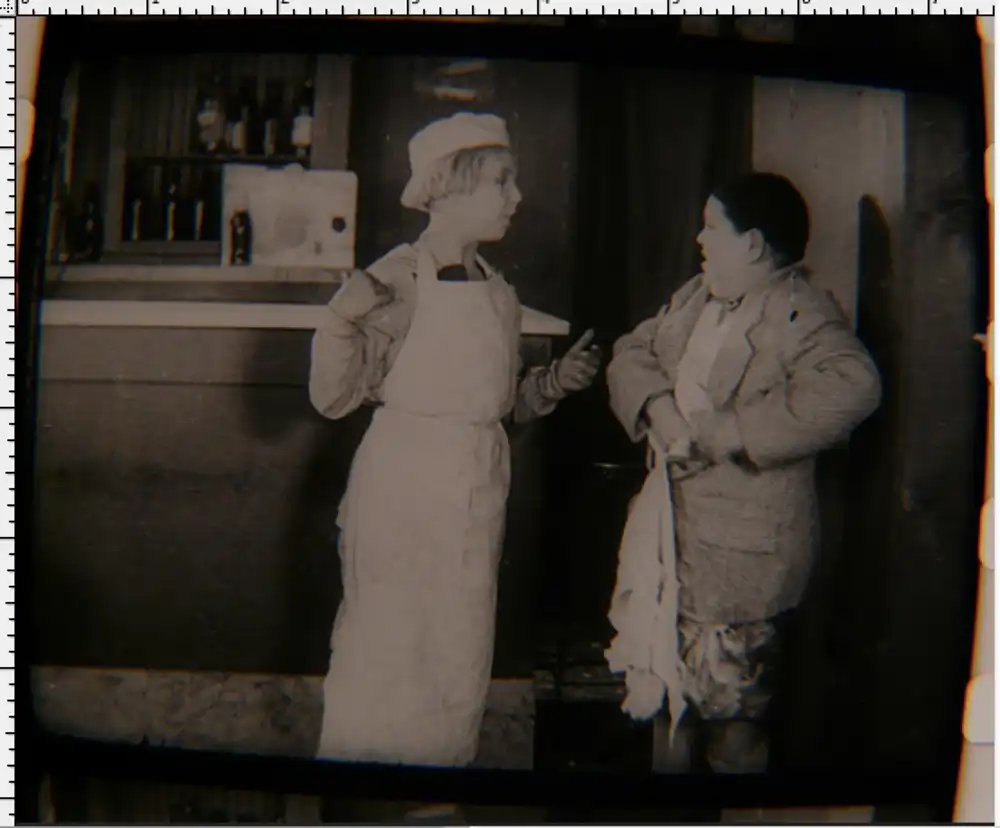
Stan’s transformation into “dog” is the set-piece cinephiles cite, yet the gag’s genius lies less in the costume (a mangy hide that seems exhumed from a taxidermist’s bin) than in the timing: he dons it in a doorway’s penumbra while the landlord’s silhouette looms nearer. Cross-cutting accelerates heartbeat-style, the paternal ticking of an unseen metronome underscoring the inevitable collision. Once unleashed, Dog-Stan becomes pure vector—ears flapping like vestigial thought, hind legs pedaling beyond the reach of logic. Children on the sidewalk shriek with delight; a cop fumbles for his nightstick; a flivver swerves, its driver cursing in delicious pantomime. The chase distends time: every fourth beat repeats, a proto-hip-hop stutter that prefigures the rhythm of modern music videos.
Yet beneath the fur and froth, the film smuggles a critique of property relations circa 1922. The landlord’s office—festooned with antlers, parchment leases curling like scrolls of minor tyranny—reeks of entitlement. His threat to evict is less a legal procedure than a courtship ritual; he dangles the key before the girl the way a decadent sultan proffers jewels. The Pest’s interruptions—she appears at transoms, behind window boxes, under awnings—function as Brechtian jolts, reminding viewers that comic coincidence can also be cosmic injustice wearing a clown nose.
Vocally, the picture is silent, but aurally it is noisy. Intertitles crackle with period slang: “Flip the flap, mac, the dame’s in hock!” reads one card, the consonants snapping like dry tinder. The absence of recorded voices amplifies every ambient clatter—hooves, trolley bells, canvas snapping in the wind. Critics who dismiss silent comedy as quaint forget how it weaponizes this sonic void; the viewer’s imagination fills the gap with a roar that no Vitaphone could rival.
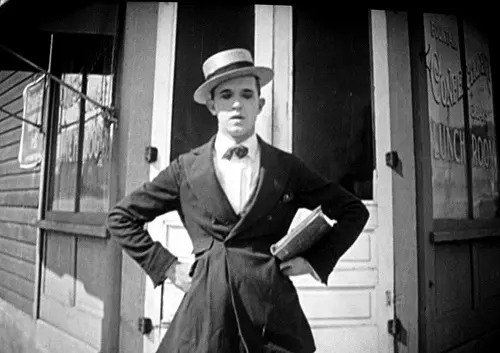
Performances oscillate between commedia archetype and proto-method naturalism. Stan, pre-Oliver Hardy, is already a master of negative space: note the way he lets his arms dangle a half-beat too long, as if the limb were a borrowed prop he’s unsure how to return. Glen Cavender’s landlord twirls mustachio into a moral statement—each waxed curl a clause in the contract of villainy. Hero (the actor’s actual billing) essays the sidekick with a deadpan that borders on existential resignation. And Vera Reynolds, as the imperiled tenant, projects a flinty luminosity; her close-ups shimmer with the unspoken calculus of a woman measuring escape routes.
The Pest herself—Joy Winthrop—deserves final focus. She is neither villain nor heroine but the film’s id: a flibbertigibbet who materializes when tension peaks, toppling the first domino toward catastrophe. She is the return of the repressed, the reminder that urban modernity breeds not only landlords and tenants but also meddlers who gum the machinery. Her final grin, directed straight to camera, constitutes a shattered fourth wall; we are implicated in the spectacle of eviction, harassment, and rescue. The film ends on a freeze-frame tableau—door slammed, lovers united, Pest triumphant—yet the unease lingers like a kettle’s last hiss.
Compared to Stan’s later Love and Lather, where sudsy chaos eclipses social critique, The Pest keeps one foot in the grit of lived precarity. Against Props, another backstage romp, this short feels less meta, more street-level. Meanwhile, Die Minderjährige – Zu jung fürs Leben mines similar territory of exploited youth yet without the slapstick balm that lets audiences swallow outrage with a grin.
Visually, the cinematography—credited to a forgotten artisan named only “Devlin” in studio logs—deploys chiaroscuro worthy of Expressionist Berlin. Note the sequence where Stan, still in dog suit, cowers beneath a streetlamp: the bulb flickers, a Morse code of despair, while the surrounding pool of darkness threatens to swallow him whole. The shot prefigures the noirs that would bloom two decades later, proof that comedy and dread share chromosomes.
Editing rhythms deserve special praise. Where contemporaries like The Third Kiss relied on stately tableaux, The Pest favors staccato cuts, each splice a punchline. The average shot length hovers near 2.8 seconds—astonishing for 1922—creating a propulsion that rivals today’s action cinema. Yet the montage never devolves into abstraction; geography remains legible, stakes tethered to character desire.
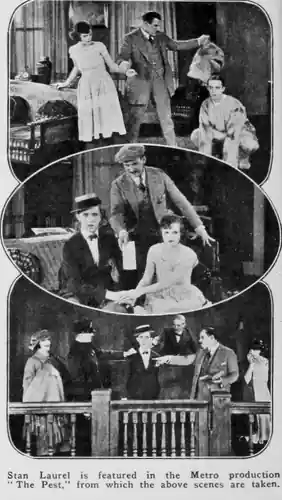
Gender politics, though filtered through slapstick, reveal tensions still unresolved. The girl’s peril is bodily—will the landlord claim rent or something more carnal?—but her agency surfaces in small rebellions: a slammed shutter here, a whispered warning there. The Pest, meanwhile, embodies the era’s discomfort with unruly femininity. She talks too much, intrudes too often, laughs too loudly; she is the suffragette as imagined by a nervous male gaze. Yet her persistence also wins the day; without her meddling, Stan’s rescue would falter. Thus the film equivocates: mocks the pest, yet needs her.
Soundtrack considerations for modern revival: anything more than a minimalist piano would glut the air. I recommend prepared piano—paper woven among strings to mimic rattling streetcars—intercut with single plucks that echo like distant foghorns. The aim is to honor the film’s urban cacophony without swaddling it in nostalgic schmaltz.
Restoration status: prints survive at the BFI and UCLA, but only in 16mm duplicates struck from a decomposing 35mm negative. The image flickers like a candle; some consider this decay romantic, others infuriating. A 4K scan could stabilize exposure without plasticizing grain, preserving the film’s celluloid soul while sparing viewers the stroboscopic headache.
Legacy: historians cite The Pest as a stepping-stone toward Laurel & Hardy’s mature synergy, yet the short deserves laurels on its own. It anticipates the Great Depression’s housing crises, the sitcom tropes of neighborly intrusion, even the furry fandom’s playful species swap. Each rewatch reveals micro-gestures previously masked by speed: Stan’s pinky twitch when the landlord sniffs the girl’s perfume, the Pest’s half-curtsey before crashing a garden party. These grace notes humanize archetypes, proving that even in 12 manic minutes, cinema can sketch a society.
Box-office lore is scant—second-billed on a 1922 Saturday matinee, traded to regional exchanges for pennies per foot—yet the laughter it provoked rippled across small-town balconies, from Paducah to Poughkeepsie. Trade papers praised its “merry melange of mirthful misadventure,” code for lowbrow slapstick that nonetheless sold tickets. Today, its value is archival gold: a time capsule of Sunset Boulevard’s storefronts, streetcar tracks, and sartorial silhouettes.
Final verdict: The Pest is not merely a footnote to Stan’s later immortality; it is a self-contained comic grenade whose shrapnel continues to sting. It lampoons landlords, celebrates persistence, and queers species boundaries—all in the span of a coffee break. Watch it once for belly-laughs, rewatch for socio-cinematic archaeology, quote it to friends who assume silent comedy equals dull. They will gape, then thank you, then ask why more films can’t cram this much life into a single, breathless reel.
IMDb 7
1930
Community
Log in to comment.