DbcultAccessing Vault...
Cult Review
Senior Film Conservator
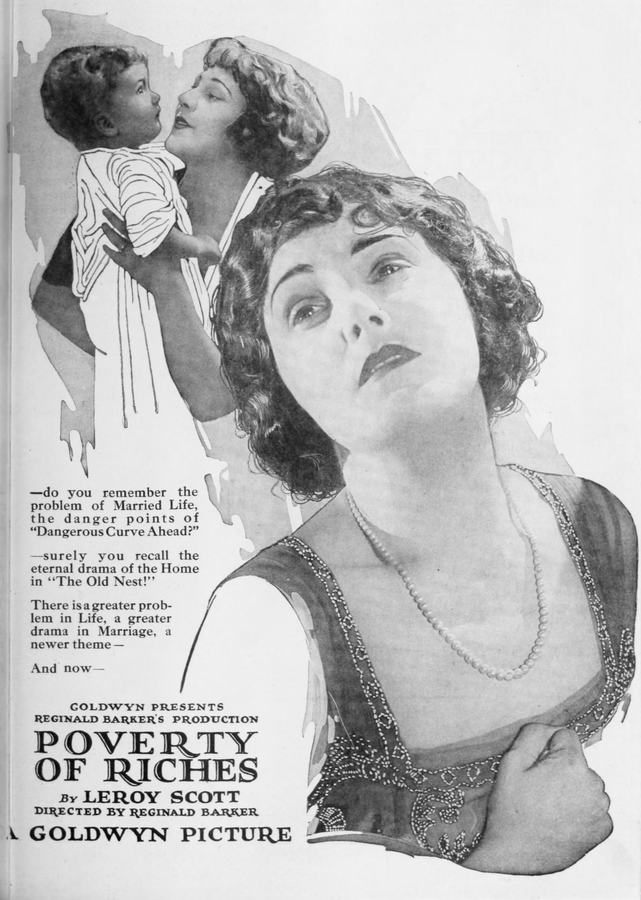
In the annals of early cinema, certain films, despite the passage of a century, continue to resonate with a haunting prescience, their silent narratives speaking volumes about the human condition. 'The Poverty of Riches,' a 1921 drama penned by Leroy Scott and Arthur F. Statter, stands as a stark, often brutal, testament to the illusion of material success and the irreplaceable value of intangible joys. This isn't merely a period piece; it’s a timeless allegory, meticulously crafted, that dissects the corrosive effects of unchecked ambition on the tender fabric of a marriage and the profound yearning for a life beyond the ledger sheet.
The film introduces us to Katherine Holt, portrayed with understated grace and burgeoning maternal longing, who enters into matrimony with John Colby. Their initial marital bliss, however, is quickly overshadowed by a stark incompatibility of desires. Katherine's heart beats with an insistent rhythm for children, a natural, deeply ingrained aspiration that defines her womanhood. John, conversely, is a man consumed by the relentless pursuit of financial and social ascendancy. His vision is singular, his focus unwavering: wealth and status must be attained before the perceived 'distraction' of family life can be entertained. This fundamental divergence establishes a tragic tension that permeates every frame, laying the groundwork for the emotional devastation to come. It’s a conflict that feels as relevant today, in an age of hyper-capitalism and career idolatry, as it did in the burgeoning post-war industrial landscape of the 1920s.
As John plunges headlong into the maelstrom of business, climbing the corporate ladder with an almost monomaniacal zeal, Katherine's quiet suffering becomes palpable. Her maternal instincts, denied an outlet within her own home, find an alternative, bittersweet expression in the lives of Grace and Tom Donaldson's children. These scenes, often imbued with a gentle warmth, serve as poignant counterpoints to the emotional sterility of her own marriage. They highlight Katherine's inherent capacity for nurturing, a capacity systematically starved by John's indifference and his unwavering commitment to his professional empire. The film subtly critiques a societal structure that often left women of Katherine’s era with limited avenues for fulfillment outside of domesticity, amplifying the tragedy of her unfulfilled desire.
John's ascent through wider social spheres, while ostensibly a triumph, serves only to exacerbate the emotional chasm between him and Katherine. His home becomes a mere pit stop, a logistical necessity rather than a sanctuary of shared affection. His continued refusal of Katherine's pleas for children, even as his financial standing solidifies, reveals a profound spiritual poverty beneath the veneer of material affluence. It's a classic cinematic depiction of a man sacrificing the present for a perpetually receding future, oblivious to the irreparable damage he inflicts in the process. This theme of a man lost in his own ambition, neglecting the very foundations of his personal life, finds echoes in films like 'Sloth', where the protagonist's inaction leads to ruin, though here it is John’s zealous action, or rather misdirected action, that paves the way for tragedy.
Amidst this emotional desolation, Katherine's character emerges as a beacon of unwavering loyalty and quiet resilience. When her former suitor, Phillips, re-enters her life, offering not just solace but a clear path to liberation through divorce, she steadfastly refuses. This pivotal moment underscores her profound commitment to her vows, her belief in the sanctity of her marriage, despite its current barrenness. It's a testament to her character that, even when presented with an escape route from her unhappiness, she chooses to remain, clinging to the hope that John will eventually awaken to the true values of life. Her refusal isn't born of weakness, but of a profound inner strength and an enduring, if increasingly strained, love for her husband. This moral steadfastness, even in the face of profound personal sacrifice, aligns her with protagonists in films such as 'Life or Honor?', where characters grapple with difficult choices that test the very core of their being.
The narrative builds to a moment of tantalizing hope. John, finally reaching the pinnacle of his professional aspirations with an appointment as manager, experiences a belated pang of conscience. He apologizes for his indifference, a long-overdue acknowledgment of Katherine's suffering, and promises to fulfill her deepest wish for children. This scene is imbued with a fragile tenderness, a glimmer of the shared future Katherine has so desperately yearned for. The audience, having witnessed her long years of quiet fortitude, is momentarily lulled into believing in a potential reprieve, a happy ending for the long-suffering heroine. This dramatic turn, where a character finally sees the error of their ways, is a classic trope, but 'The Poverty of Riches' is far from a simplistic morality tale.
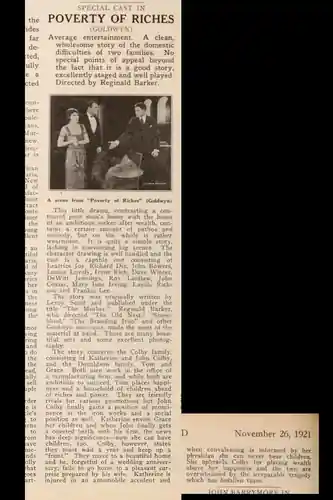
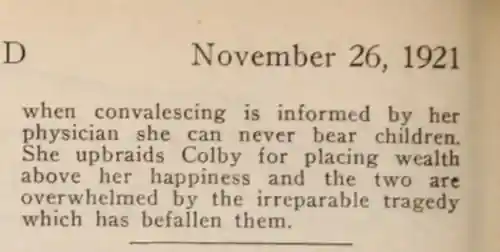
The film, however, is a tragedy, and its most devastating blow is yet to come. That very evening, in a cruel, almost Shakespearean twist of fate, Katherine is involved in an automobile accident. The injuries she sustains are not immediately fatal, but they are irrevocably life-altering: they render her incapable of bearing children. The irony is excruciating, the timing agonizing. The promise of a family, so long deferred, so recently offered, is snatched away with a brutal finality, not by human design, but by the capricious hand of destiny. This catastrophic event serves as the ultimate, crushing blow, transforming Katherine's quiet yearning into an open wound that can never heal. The suddenness and severity of the accident, a common yet impactful narrative device, might draw a superficial comparison to films like 'Dangerous Curve Ahead', but here its purpose is far more profound, serving as the ultimate tragic catalyst.
The aftermath is a raw, emotional crescendo. Katherine, broken and bereft, confronts John. Her reproaches, born of unimaginable grief and the bitter sting of ironic timing, are not mere accusations but a desperate articulation of a life irrevocably altered by his choices and fate's cruel decree. It is in this moment of profound loss that John finally experiences his own agonizing epiphany. The pursuit of wealth, which had defined his entire existence, suddenly appears hollow, meaningless, a gilded cage built upon the ruins of his wife's happiness and their shared future. He realizes, with a crushing weight, that he has sacrificed the very essence of life – love, family, connection – in a relentless, ultimately fruitless, chase after material gain. The 'riches' he accumulated are revealed to be nothing but a profound 'poverty' of the soul.
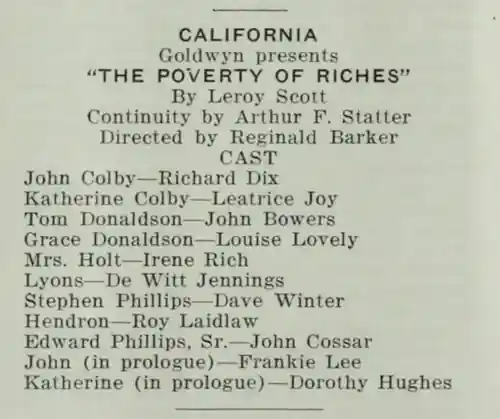
The performances, particularly that of the actress portraying Katherine (likely Irene Rich, though specific roles for the extensive cast list are not always clear without deeper research into contemporaneous reviews), are crucial in conveying the film's emotional depth without the aid of spoken dialogue. The nuances of expression, the subtle gestures, the silent tears, and the gradual erosion of hope are all communicated with a powerful physicality that transcends the limitations of the medium. The silent era, often underestimated, demanded a heightened sense of visual storytelling, and 'The Poverty of Riches' demonstrates this artistry with remarkable clarity. The pacing, characteristic of silent films, allows for moments of prolonged emotional impact, building tension and pathos through careful composition and editing. While the plot outline credits a long list of actors including Mary Jane Irving, Frank Coghlan Jr., Richard Dix, and Leatrice Joy, it is the central emotional dynamic that truly carries the film's weight.
The film's exploration of marital dynamics and the clash between individual desires and societal expectations places it within a broader cinematic conversation of the era. Similar themes of domestic struggle and the challenges faced by women are subtly hinted at in films such as 'Man and His Woman', though 'The Poverty of Riches' leans more heavily into the tragic consequences of ambition. The narrative arc, moving from hope to despair, and the profound moral lesson at its core, also connect it thematically to cautionary tales of the period, albeit with a more sophisticated emotional landscape than some of its contemporaries.
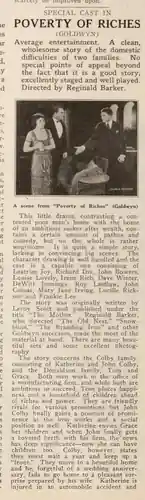
What makes 'The Poverty of Riches' resonate even today is its unflinching gaze at the false promises of materialism. It's a cinematic sermon, delivered without a single spoken word, on the futility of pursuing wealth at the expense of human connection, love, and the simple, profound joys of family. John's ultimate realization, though tragically belated, serves as a powerful indictment of a culture that often prioritizes accumulation over actualization. The film doesn't just tell a story; it poses a question: What are we truly sacrificing in our relentless pursuit of 'more'? And what happens when the very thing we deferred for success is irrevocably lost?
In its quiet, devastating conclusion, 'The Poverty of Riches' offers no easy answers, no comforting resolutions. It leaves the audience to grapple with the profound irony of its title, the devastating cost of a life misspent, and the enduring, universal truth that some losses are simply irreparable. This film, a gem from the silent era, reminds us that the most profound dramas are often played out not in grand gestures, but in the intimate, often unspoken, battles of the human heart. It’s a powerful, somber meditation on legacy, regret, and the true meaning of a rich life, solidifying its place as a significant, albeit melancholic, piece of cinematic history.
IMDb —
1922
Community
Log in to comment.