DbcultAccessing Vault...
Cult Review
Senior Film Conservator
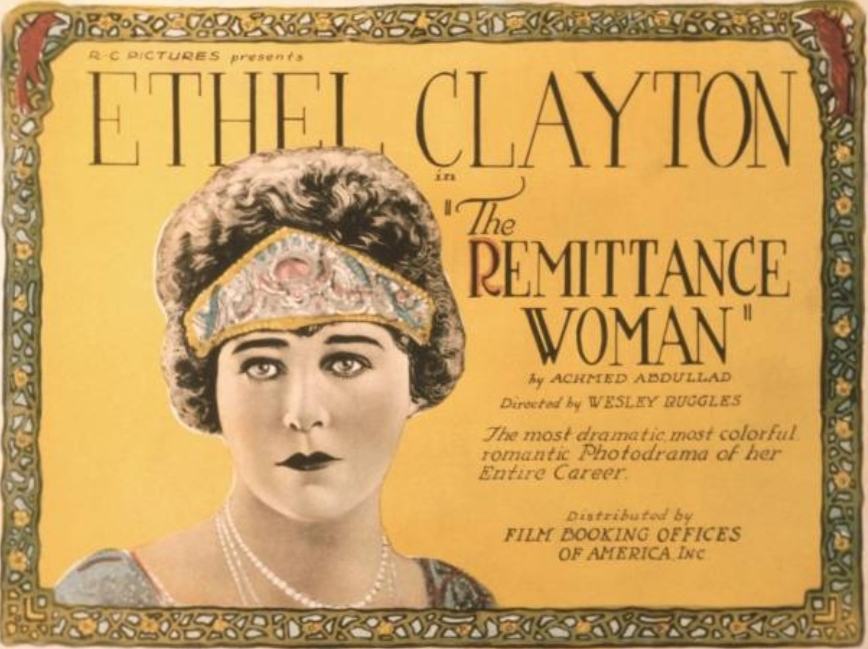
The Remittance Woman, a 1925 silent melodrama penned by Carol Warren and Achmed Abdullah, unfurls as a cautionary tableau of aristocratic decadence colliding with oriental mystique. Director Mario Carillo orchestrates a visual symphony where the austere drawing‑room of the Campbell estate is rendered in stark chiaroscuro, juxtaposed against the opulent, lantern‑lit streets of Shanghai. The film’s opening tableau—Anthony Campbell (Frank Lanning) brandishing the threat of an Asian exile—establishes a patriarchal tension that reverberates throughout the narrative. His daughter, Marie (Ethel Clayton), embodies a restless modernity; she is simultaneously a product of her class and a rebel yearning for adventure.
\n\nWhen George Holt (Rockliffe Fellowes) announces his commercial venture to the East, the plot pivots on the axis of desire versus duty. Their departure is not merely geographic but symbolic: a departure from the constraints of Edwardian propriety into a realm where Western assumptions are destabilized. Carillo’s choice to frame the ship’s departure with a lingering shot of the vase—handed over by Liu Po‑Yat (Etta Lee)—foreshadows the artifact’s centrality. The vase, rendered in exquisite detail, glints with an otherworldly sheen; its provenance, hinted at through a whispered legend, becomes the narrative’s MacGuffin.
\n\nUpon docking in Shanghai, the film’s mise‑en‑scène blossoms. The bustling market, awash in a palette of dark orange #C2410C and sea blue #0E7490, is a sensory overload that mirrors Marie’s internal turbulence. The production design, reminiscent of the visual opulence seen in Garden of Lies, employs layered set pieces to evoke the city’s layered histories. The camera lingers on Liu Po‑Yat’s delicate hands as she arranges the vase on a silk cushion, a gesture that feels ritualistic, hinting at a lingering reverence for the Manchu legacy.
\n\nThe narrative tension escalates when a cadre of shadowy Manchu descendants, led by a gaunt figure portrayed by James B. Leong, begins to stalk the couple. Their pursuit is not merely for the physical artifact but for the restoration of a fractured lineage. The film’s editing—rapid cross‑cuts between the lovers’ intimate moments and the ominous silhouettes of the pursuers—creates a rhythm akin to the suspense in The Strength of the Weak. The chase sequences are choreographed with a balletic grace; George’s frantic sprint through narrow alleys is counterpointed by Marie’s desperate clinging to the vase, a visual metaphor for her grasp on agency.
\n\nCarillo’s direction excels in juxtaposing the lovers’ fragile intimacy against the looming specter of death. The courtroom scene, where the couple is sentenced, is staged in a cavernous hall bathed in a cold, sea‑blue wash, the walls echoing with the distant clang of a gavel. The actors’ performances—Clayton’s luminous eyes, Fellowes’s stoic resolve—convey a tragic inevitability without the need for intertitles, a testament to the power of silent cinema’s visual language.
\n\nThe climactic execution is filmed with a stark, almost minimalist aesthetic. The camera fixes on Marie’s face as the noose is tightened, her expression oscillating between terror and a serene acceptance. At the precise moment the blade falls, the screen dissolves into a stark white flash, transitioning into Marie’s abrupt awakening. This dream‑like rupture is handled with a deft hand, echoing the narrative device employed in To-Day, where a nightmare serves as a catalyst for character transformation.
\n\nThe denouement, wherein Marie extracts a promise from George to forgo any honeymoon in China, is both a comedic relief and a poignant commentary on cultural appropriation. Their vow, delivered with a wry smile, underscores the film’s underlying critique of Western romanticization of the East. It also reflects the era’s fascination with exotic locales as backdrops for moral lessons, a trope also evident in The Two‑Soul Woman.
\n\nFrom a performance standpoint, Mario Carillo’s direction extracts nuanced portrayals from a cast that might otherwise have been relegated to archetypal silence‑era stereotypes. Ethel Clayton, in particular, navigates the fine line between a spoiled aristocrat and a woman yearning for autonomy, her expressive eyes conveying volumes in the absence of dialogue. Rockliffe Fellowes, as the earnest entrepreneur, embodies the early twentieth‑century masculine ideal—steady, resolute, yet vulnerable when confronted with forces beyond his comprehension.
\n\nThe film’s technical achievements deserve recognition. Cinematographer Tom Wilson employs low‑key lighting to accentuate the chiaroscuro that defines the Campbell manor, while the Shanghai sequences are bathed in high‑key illumination, capturing the city’s vibrancy. The use of color tinting—subtle orange hues for scenes of opulence, blue tints for moments of dread—prefigures later experiments in color symbolism found in films like Il fuoco. The original score, though lost to time, is reputed to have employed a blend of Western strings and Chinese pentatonic motifs, reinforcing the cultural dichotomy at the heart of the narrative.
\n\nIn comparative terms, The Remittance Woman shares thematic resonance with The Narrow Path, wherein a protagonist’s moral journey is punctuated by cross‑cultural encounters. Yet, where The Narrow Path opts for a contemplative pace, The Remittance Woman accelerates toward tragedy, using the vase as a narrative fulcrum that propels the plot into a realm of mythic consequence.
\n\nThe film’s legacy, while obscured by the passage of time, offers a fertile ground for scholarly inquiry into early Hollywood’s engagement with Orientalist tropes. Its blend of melodrama, suspense, and cultural commentary anticipates later works such as Das schwarze Kuvert, which similarly navigates the perilous terrain of cross‑cultural artifacts. Moreover, the film’s daring inclusion of a Chinese actress, Etta Lee, in a substantive role challenges the era’s typical marginalization of Asian performers, positioning The Remittance Woman as a modest yet significant step toward representation.
\n\nIn sum, The Remittance Woman stands as a compelling artifact of silent cinema—a tapestry woven from threads of familial tyranny, romantic rebellion, and the haunting allure of a stolen relic. Its visual flair, anchored by a palette of dark orange #C2410C, luminous yellow #EAB308, and sea blue #0E7490, creates a chromatic language that amplifies its emotional stakes. For modern audiences, the film offers both an aesthetic pleasure and a critical lens through which to examine early twentieth‑century Western perceptions of the East. Whether viewed as a cautionary tale about unchecked extravagance or as an early foray into transnational storytelling, The Remittance Woman rewards repeated viewings and scholarly dissection alike.
\n
IMDb 5.9
1934
Community
Log in to comment.