DbcultAccessing Vault...
Cult Review
Senior Film Conservator
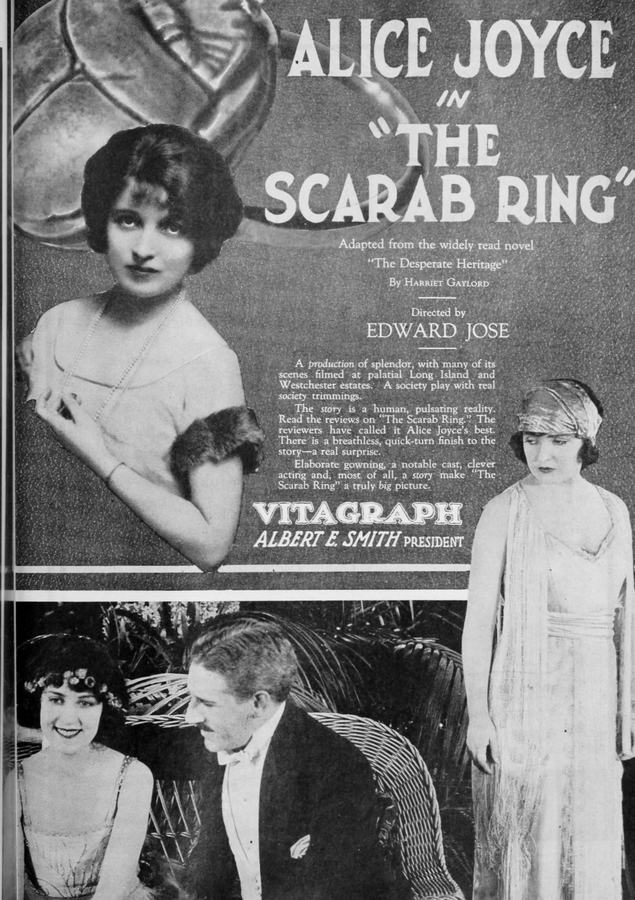
The Scarab Ring (1920) exists in a liminal space between silent cinema's nascent experimentation and the burgeoning sophistication of 1920s psychological thrillers. Directed by C. Graham Baker and co-written with Harriet Gaylord, the film is a masterclass in visual storytelling, where every gesture, shadow, and symbolic object (chiefly the titular ring) carries the weight of narrative consequence. Its themes of paternal guilt, sisterly loyalty, and the commodification of female virtue are rendered with a starkness that feels both archaic and disturbingly modern.
The film’s opening act establishes a tone of quiet dread: Constance Randall (played with weary grace by Alice Joyce) receives a terminal diagnosis for her father, a once-respected banker now reduced to a penitent figure. His confession—of having colluded in a crime—is not framed as a moral failing but a pragmatic survival tactic, a choice that haunts his final days. This act of confession, performed not for redemption but to secure his daughter's future, sets the stage for the film's central conflict: the tension between inherited guilt and the performative need for innocence.
Hugh Martin (Eddie Phillips) emerges as a character of calculated menace. His possession of documentary evidence—rendered in the film’s most effective visual metaphor as a stack of brittle papers—grants him power not through force but through the weaponization of truth. Martin’s demands that Constance manipulate her sister Muriel (Maude Malcolm) into marriage are not framed as a moral test but as a transactional exchange: his silence for her compliance. The film’s brilliance lies in its refusal to vilify Martin; instead, he is portrayed as a man operating within the same moral vacuum as Constance’s father.
Baker’s direction is marked by an almost obsessive attention to visual foreshadowing. The scarab ring, a recurring motif, is introduced early as a family heirloom worn by Constance. Its subsequent appearance near Martin’s corpse—mirroring the ring Constance wears—is not merely a clue but a narrative pivot. The ring becomes a symbol of cyclical fate, a physical manifestation of the guilt that binds the characters. The film’s set design, particularly the cavernous interiors of the Randall home, reinforces this theme: every room is a prison, every corridor a path to complicity.
The murder of Martin is executed with understated horror. Unlike the lurid violence of later thrillers, this act is implied rather than shown. The camera lingers on Constance’s face as she clutches the ring, her expressionless gaze betraying a storm of internal conflict. The trial sequence that follows—where she is acquitted due to insufficient evidence—is a masterstroke of narrative ambiguity. The film denies the audience the satisfaction of a clear moral resolution, choosing instead to linger on the ethical gray zone where Constance’s actions are both understandable and unforgivable.
Alice Joyce’s portrayal of Constance is a tour de force of silent film acting. Her face is a canvas of suppressed emotion, her eyes darting with the urgency of a woman constantly on the verge of collapse. In contrast, Eddie Phillips’ Martin is a study in controlled menace, his every gesture suggesting a man who enjoys the power of his knowledge. The sisterly bond between Constance and Muriel is rendered with delicate subtlety: their interactions are marked by glances that say more than words ever could, a silent language of trust and betrayal.
Ward (Fuller Mellish), Constance’s lover, is perhaps the film’s most underdeveloped character, but this lack of depth serves a narrative purpose. His forgiveness of Constance’s murder is not portrayed as a moment of catharsis but as a tragic capitulation. His role is to act as a mirror for the audience’s own conflicted response to Constance’s actions. Is his love for her rooted in genuine understanding, or is he merely another man who benefits from her sacrifice?
The Scarab Ring occupies a unique place in the history of American cinema, bridging the moral clarity of early silent films with the psychological complexity of pre-Code narratives. Its exploration of familial secrets and the performative nature of virtue prefigures films like The Black Butterfly (1949), though Baker’s film lacks the overt melodrama of that later work. The tension between public reputation and private corruption here is also echoed in A Law Unto Herself (1920), though The Scarab Ring distinguishes itself through its colder, more clinical tone.
Comparisons to En Aftenscene (1911) are inevitable given both films’ focus on moral dilemmas, but where the Danish film relies on naturalistic dialogue, Baker’s work is more stylized. The influence of German Expressionism is also evident in the film’s use of shadow and light, though Stronger Than Death (1929) would later refine this approach with greater technical flair.
For a film of its era, The Scarab Ring demonstrates remarkable technical ambition. The use of close-ups to convey psychological states—particularly in the trial scenes—is ahead of its time, and the editing rhythm, while conventional, avoids the stilted pacing that plagued many silent films. The absence of intertitles in key moments (such as Constance’s confession to Ward) is a bold choice, forcing the audience to read the subtext in the actors’ expressions.
Harriet Gaylord’s script deserves particular praise for its nuance. Unlike many early screenplays, which often reduced female characters to plot devices, Constance is portrayed as a fully realized agent of her own moral universe. Her choices are neither saintly nor demonic but humanly flawed—a quality that gives the film its enduring power.
The Scarab Ring is more than a relic of early cinema—it is a time capsule of a society grappling with the disintegration of Victorian values. Its themes of inherited guilt, the fragility of honor, and the performative nature of truth remain startlingly relevant. For modern viewers, the film offers a rare glimpse into the moral ambiguity that would later define the noir genre, albeit through a much more restrained lens.
While the film’s pacing may feel deliberate to contemporary audiences, this slowness is part of its charm. The tension is built not through rapid cuts or explosive action but through the patient unfolding of a moral puzzle. The final act, where Constance accepts Ward’s proposal, is not a resolution but a deferral of judgment—a testament to the film’s refusal to offer easy answers.
For fans of gothic cinema and psychological thrillers, The Scarab Ring is an essential viewing experience. Its influence can be seen in later works like Behind the Lines (1928) and Wolves of the Border (1928), but its originality lies in its unflinching exploration of the cost of preserving a lie.
This film is a reminder that cinema, even in its earliest days, was capable of profound moral inquiry. The Scarab Ring, with its haunting visuals and complex character dynamics, stands as a testament to the silent era’s untapped potential for narrative depth. It is a film that demands to be seen not as a curiosity but as a fully realized work of art.
IMDb —
1916
Community
Log in to comment.