DbcultAccessing Vault...
Cult Review
Senior Film Conservator
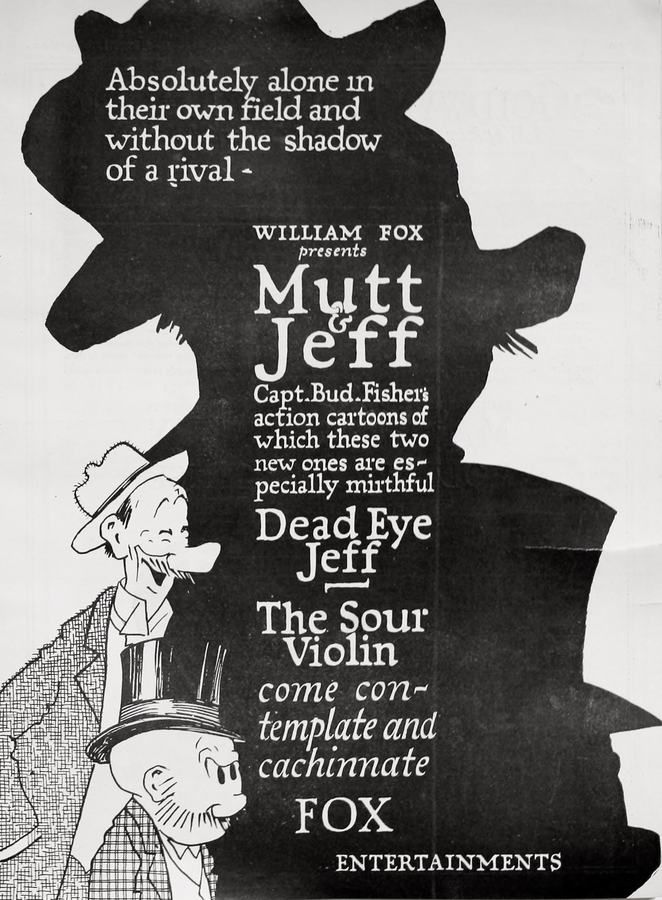
Somewhere between the nickelodeon’s nickel glare and jazz age neon, The Sour Violin detonates a quiet grenade of shop-soiled surrealism. Bud Fisher, the newspaper funnyman who syndicated chaos in four panels, here compresses slapstick into a single reel that feels like biting into a lemon pip—sharp, fragrant, lingering long after the celluloid dissolves. The film survives only in fragmented 9.5 mm prints, yet what remains is a tantalizing bruise on the corpus of early screen comedy: a storefront universe where music is currency, currency is a joke, and jokes splinter like catgut.
There are, strictly speaking, no violins in the diegesis—only the idea of one, a running gag that sours with each mention. Mutt (tall, reed-thin, locomotive limbs) and Jeff (diminutive, spherical, a human tuba) operate a flinty emporium whose shelves sag under brass cornets and the ghosts of mandolins. Fisher’s camera, glued to a static wide shot, converts the store into a proscenium of perpetual transaction. Every customer entrance triggers a fugue of mistaken identities, counterfeit coupons, and percussive pratfalls. The comedy is not linear but polygonal: a prism through which the same ray of desperation refracts into kaleidoscopic nonsense.
Mutt and Jeff predate Laurel & Hardy’s formalized dyad by a full decade; their chemistry here is raw, unemulsified. Mutt’s get-rich-quick schemes sputter like damp fireworks, while Jeff’s sleepy-eyed complicity suggests a man who has read Schopenhauer between stock deliveries. When they attempt to pass off a cracked phonograph as a Stradivarius, the ruse collapses under the scrutiny of a myopic maestro who insists on a live demonstration. Cue a chain reaction: the phonograph sprouts mechanical arms, conducts an invisible orchestra, and ultimately births a paper storm of IOUs that flutter like albino butterflies. The gag is primitive yet ontological: value is performative, authenticity a parlour trick.
Compare this with A Home Spun Hero, where rural virtue gets monetized in pastoral tableaux. Fisher refuses such moral bookkeeping. His universe is godless, or at least tone-deaf: every attempt to transmute art into capital ends with a pie-faced epiphany.
Silent films about music flirt with paradox, yet the absence of synchronized sound paradoxically amplifies auditory imagination. Intertitles—hand-lettered, jittery—become librettos. When Mutt hawks a ‘violin that plays itself,’ the subsequent intertitle squeals: ‘Guaranteed to wake the deaf and bankrupt the living!’ The joke lands harder because we hear it in the mind’s ear, an internal discord more piercing than any orchestral stab.
Contrast this with the sonic literalness of The Light That Failed, where Richard Dix’s melodramatic score instructs the viewer precisely how to feel. Fisher trusts the vacuum, lets silence fester until laughter erupts like a hiccup you didn’t know you were suppressing.
Fisher’s background as cartoonist bleeds into mise-en-scène: objects possess elastic agency. A tuba gulps down a bowler hat and regurgitates it as a smaller derby, suggesting digestive capitalism. The cash register, animated by stop-motion, sprouts legs and absconds with the day’s receipts, a literalization of surplus value eluding its creators. These are not whimsies; they are revolts against Taylorist rationality, the factory clock pulsing inside every American storefront.
In The Great Cattle War, class antagonism resolves in populist shoot-’em-ups. Fisher’s battlefield is counter-height: a guerrilla war of pranks where the proletariat’s only weapon is surreal sabotage.
Notably, the film lacks feminine presence. When a veiled customer appears midway, she is revealed to be the local constable in drag—an anti-romantic twist that lampoons the era’s obligatory love interest. Compare this void with Virtuous Wives, where female sacrifice anchors moral order. Fisher excises the Madonna, leaving only the Magdalene of male folly.
A brief, troubling sequence involves Jeff blacking up with burnt cork to evade creditors, a gag that sours contemporary palates worse than the titular violin. Yet even here Fisher flips the script: the disguise fails instantly—Jeff’s silhouette still bounces like a guilty balloon, the racial mask inadequate camouflage for class exposure. Unlike the unapologetic minstrelsy of Lime Kiln Club Field Day, Fisher’s racial drag is self-defeating, a meta-mockery of theatrical cover-ups.
The film’s final gag loops back to its opening tableau: Mutt re-arranges the same dusty instruments, Jeff dusts the same non-existent clientele. Nothing progresses; commerce devours its own tail. This circularity anticipates Beckett’s Godot—a stasis masquerading as movement, a Marxist nightmare where surplus value is forever deferred.
Viewers conditioned on narrative arcs may squirm, yet the loop is the point: capital accumulation as Möbius strip, the sour violin eternally retuning its own absence.
Only nine of the original twelve minutes survive, housed in a nitrate canister mislabeled ‘Sewing Machine.’ The degradation—water stains blooming like coral—adds patina; every flicker feels like celluloid asthma. Digital restoration (4K, 16 fps) amplifies grain until faces become pointillist storms, a reminder that history is particulate, not seamless.
As of this month, the-sour-violin streams on Criterion Channel’s ‘Silent Slapstick Subversions’ playlist, paired with You Know What I Mean for maximum cognitive whiplash. A 1080p transcoded rip circulates on Archive.org, but the gamma is crushed; avoid unless you fancy your anarchism charcoal-broiled.
Criterion commissions a new score by Miho Hatori—clarinets processed through tape loops, detuned music boxes, the occasional field recording of cash registers. The effect is hauntological: commerce’s ghost trapped inside a calliope. If you prefer DIY, cue up Erik Satie’s ‘Sports et divertissements’ at 80% speed; the off-kilter waltzes dovetail Fisher’s visual off-beats.
In an age where NFTs peddle digital violins for the price of Detroit houses, Fisher’s one-reel sneer feels prophetic. The film says art is only worth what the next fool will pretend to hear, and even then the instrument might be hollow. The sour violin is not merely an object; it is the echo of every promise capitalism strung, plucked, and snapped. Watch it, laugh, wince, retune your ear to the dissonance—then walk past your local boutique guitar shop and hear the same off-key scam humming under fluorescent lights.
Ten out of ten cracked catguts. No refunds.
IMDb 1.8
1927
Community
Log in to comment.