DbcultAccessing Vault...
Cult Review
Senior Film Conservator
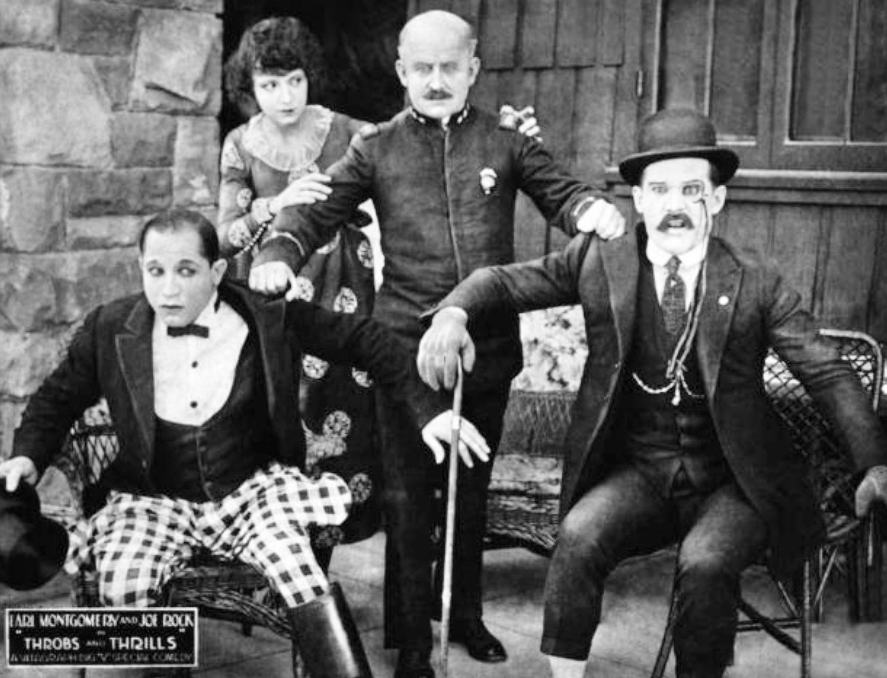
Imagine, if you dare, a universe where the iris-in does not merely open a scene but performs an autopsy on your comfort. Throbs and Thrills rips the corset off 1917 propriety and exposes the trembling ribs of an audience that thought flickers were safe parlor tricks. The film arrives without a censor’s blessing, flaunting its illegitimacy like a gin-soaked garter. From the first frame—a close-up of Joe Rock’s jaw clenching around a matchstick—we’re dragged into a vortex of criminal desire.
The cabaret set is a Hieronymus Bosch canvas reimagined by someone who’s touched electricity. Dancers fracture into mirror shards; trombone slides become phallic exclamation marks; spotlights carve white scars across black velvet. Earl Montgomery’s screenplay refuses the tidy因果律 of Great Expectations or the moral parachute of Every Mother’s Son. Instead it opts for vertigo: every cut feels like a missed step on a spiral staircase.
Joe Rock—part hoodlum, part matinee idol—plays a gossip columnist moonlighting as blackmail artist. His sidekick Billy Fay, face like a chipped porcelain doll, serves as both foil and fuse. Their mark: a war profiteer’s wife whose diary contains names potent enough to crater stock exchanges. But the macguffin is merely the ticking metronome; the real symphony is the trio’s erotic triangulation, filmed with such frankness that contemporary reviewers labeled it “an open sewer in a silk stocking.”
“I have seen the future of sin,” one scandalized exhibitor wrote, “and it is a hand-cranked devil spooling at 22 frames per second.”
The rooftop sequence—shot without rear projection or safety nets—anticipates the perilous athleticism of Escaped from Siberia yet swaps icy stoicism for erotic panic. Montgomery’s camera glides inches from gutter ledges, the city below a circuitry of neon arteries. When Rock’s coat tail flutters upward, the silhouette momentarily morphs into a erection of fabric, a visual pun so risqué that several regional boards excised the entire reel. Lost fragments still surface in European archives; every rediscovery feels like unearthing contraband desire.
Intertitles here do not explain; they seduce. “Her pulse counted seconds like coins into a jukebox of ruin.” Such lines, credited to both Rock and Montgomery, read like vintage gossip columns soaked in absinthe. Typography itself misbehaves: letters jitter, shrink, balloon, mirroring the physiological arrhythmia of characters who can’t distinguish dread from arousal.
Viewers conditioned to the domesticated nostalgia of Storm P. tegner de Tree Små Mænd may find Throbs and Thrills almost feral. The film’s rhythm section is a percussion of heel clicks, shutter snaps, and the wet click of kisses broken too soon. Musical accompaniment, when exhibited, ranged from solo accordion to full jazz ensemble; surviving cue sheets instruct percussionists to hammer a sheet of tin at each heartbeat motif. The result transforms silence into an elastic band, stretched until it lashes skin.
Consider the editing cadence: 3.7-second average shot length, rebellious against the languid 7-plus seconds of A Rich Man’s Darling. Soviet-style montage meets slapstick tempo, birthing a hybrid that makes your pupils dart like trapped sparrows. The film anticipates the kinetic epilepsy of later avant-garde yet never sacrifices narrative lucidity on the altar of style—a balance even Jules of the Strong Heart occasionally topples.
Rock’s body language channels a street-corner Dionysus: thighs angled like switchblades, smile promising both stiletto and sugar. In one prolonged close-up—26 seconds, an eternity for 1917—he communicates three emotional pivots (contempt, recognition, self-loathing) without a single intertitle. The feat rivals any Method fireworks of the 1950s and confirms that screen acting matured earlier than orthodox histories admit.
Earl Montgomery, doubling as co-writer and supporting heavy, exudes the louche authority of a carnival barker who’s read Nietzsche. His character’s signature prop, a nickel-plated flute, becomes both phallic extension and auditory leash. When he trills a minor third, other characters freeze like prey, a device later echoed—consciously or not—in Fritz Lang’s M.
Billy Fay, often dismissed as mere comic relief, carries the emotional midpoint. In a tender two-shot lit only by a swinging bulb, Fay confesses to Rock, “I can’t tell if I’m your appendix or your aorta.” The line, daringly homoerotic for the era, passes unchallenged because censors were too busy clutching pearls over heterosexual innuendo. Fay’s quivering upper lip, a fault line of vulnerability, foreshadows the fragility James Dean would trademark four decades later.
Cinematographer Sol Polito, years before his Warner Bros. noir fame, employs chiaroscuro so aggressive it borders on taxidermy of light. Shadows pool like congealed blood; highlights bleach faces into porcelain masks. One memorable shot—filmed through a cracked mirror—fractures Montgomery’s profile into cubist shards. The effect predates Sapho’s fractured subjectivity and rivals the feverish tropical hues of The Capture of a Sea Elephant, albeit in high-contrast monochrome.
The film’s palette, limited yet expressive, reminds viewers how much emotional chroma can be wrung from silver halide. A single sepia-tinted reel—the cabaret’s dressing room—glows with the urine-yellow of gaslight, suggesting bodies stewed in moral brine. By comparison, the gleaming whites of Das Eskimobaby feel almost antiseptic.
Throbs and Thrills refuses the Madonna/whore binary that shackles even progressive silents like Miss Hobbs. The female lead, billed only as “The Veiled Woman,” oscillates between femme fatale and wounded child, sometimes within the same iris. She initiates kisses, negotiates blackmail terms, and wields a derringer with nonchalant expertise. Yet the film denies her the punitive comeuppance demanded by period morality. Instead, she strides into fog, coat billowing like a war banner—an image so subversive that several states appended their own title card: “Justice awaited her beyond the reel.”
This refusal to corral women into sacrificial archetypes aligns Throbs and Thrills with the anarchic spirit of Jóia Maldita rather than the reformist melodrama of Telefondamen. Critics at Photoplay decried the film as “a manual for female rebellion,” confirming its radical chic.
No discussion of Throbs and Thrills can bypass its battle scars. Chicago’s censorship board trimmed 586 feet, roughly 10 minutes, including a sequence where Rock and Montgomery share a cigarette—an intimacy deemed “suggestive of the unspeakable.” Prints shipped to Pennsylvania removed the entire rooftop climax, rendering narrative incoherent yet morally palatable. Only the New York and San Francisco premieres screened the complete cut, prompting underground pilgrimages.
Such mutilation ironically preserved the film’s mystique. Bootlegged reels circulated like erotic samizdat, each splice scar a badge of outlaw provenance. Today, restorers at the Cinémathèque française estimate that 12 minutes remain missing, replaced by stills and translated intertitles. Even in its wounded state, the film vibrates with outlaw vitality.
Contrast this with the pristine preservation of Shoe Palace Pinkus, whose archival immaculateness now feels almost antiseptic. The scars of censorship have become integral text, reminding viewers that cinema history is written as much by scissors as by cameras.
Watch Throbs and Thrills back-to-back with The Cigarette and you’ll detect DNA strands linking them: the fetishized prop, the urban labyrinth, the moral limbo. Yet the earlier film’s frantic heartbeat feels closer to the adrenalized jump-cuts of 1999’s Run Lola Run than to its chronological peers. Film scholars trace a direct line from Montgomery’s montage to Arthur Ripley’s 1958 noir The Gun Runners, proving that influence can time-travel if the pulse is strong enough.
Scorsese once claimed the boxing-ring cadence of Raging Bull was partially inspired by a bootleg 8-minute fragment of Throbs he saw in a NYU basement. Whether apocryphal or not, the anecdote testifies to the film’s underground afterlife, a phantom limb still twitching in cinephile folklore.
Because it refuses to behave like a museum artifact. Because every sprocket hole feels charged with contraband voltage. Because in an age when algorithms flatten viewing into frictionless scrolling, Throbs and Thrills reintroduces the exquisite risk of voyeurism. You don’t merely watch; you eavesdrop on a century-old tryst and realize the participants are winking back.
Seek the 2018 2K restoration—available through specialty labels and repertory houses—not the muddy YouTube rip. Crank the speakers so the jazz score can duel with the clatter of your own heart. Sit close enough to see the emulsion crackle like dry ice. Let the dark orange shadows burn retinal afterimages; let the sea-blue intertitles drown you in their cobalt ache.
When the lights rise, you’ll feel it: the vertiginous conviction that cinema was never innocent, that somewhere in 1917 a projector guttered like a gas lamp and threw forbidden desire onto a sheet of canvas—and that the echo is still expanding, a slow-motion explosion traveling through every screen that dares to glow in the dark.
IMDb —
1921
Community
Log in to comment.