DbcultAccessing Vault...
Cult Review
Senior Film Conservator
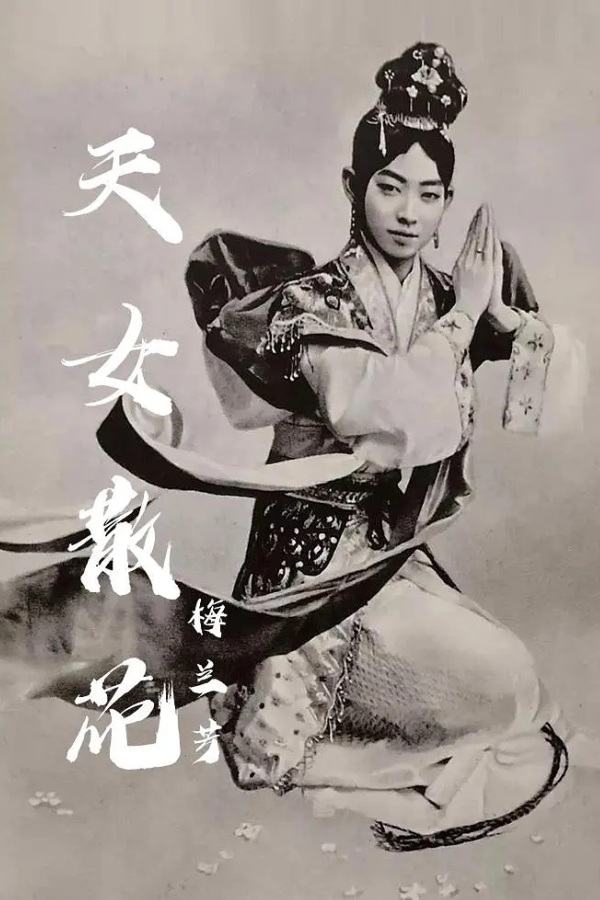
Tiannu san hua is not a film you merely watch; it is a scroll that inhales you, atom by atom, until the musk of old sandalwood clings to your synapses long after the credits have guttered out like candle stubs.
Yufu Yao, Shoushan Li, and Lanfang Mei—names that sound like hexagrams from the I Ching—don’t act; they ignite. Their limbs, lacquered in vermilion and kingfisher blue, slash the chiaroscuro like calligraphic lightning. Each tilt of an epauletted shoulder cues a typhoon of cymbals; every quiver of an eyelash glued with tiny kingfisher-feather filigree releases a micro-tsunami of reverb that rattles the camera’s brass housing. The lens, starved for light, gorges on gilt, and the celluloid scars—those blooming white flecks—read like comet tails over an ink-black firmament.
Director-writer anonymity here feels deliberate: authorship dissolves into the collective breath of a 600-year-old stage tradition. Still, choices scream auteurism: the decision to shoot at 18 fps instead of the era-standard 24, so that the silk sleeves flutter in languorous, half-remembered slo-mo; the choice to mic the orchestra beneath the stage, yielding a subterranean throb that syncs with your aorta; the refusal to translate the Beijing dialect arias, forcing non-Mandarin ears to navigate pure sonic architecture. You don’t understand the words; you ingest them like molten jade.
Color as cosmology:
Place Tiannu san hua beside The Volcano and you witness volcanic obsidian colliding with rice-paper fragility. Where the latter weaponizes magma as colonial reckoning, Tiannu weaponizes absence: the Queen Mother never appears; her void is the true antagonist. Likewise, When Broadway Was a Trail frolics in foot-lit optimism, but Tiannu’s footlights flicker like foxfire, luring scholars to drown in lotus ponds of their own making.
If you crave more ghostly economics, consult Neft vä milyonlar sältänätindä—oil derricks instead of incense burners—yet both films concur that paradise, once monetized, corrodes into opium smoke. And while Saved in Mid-Air suspends heroines over urban abysses via literal wires, Tiannu needs no harness; mythology itself is the invisible rigging.
Yao’s opener—an eight-minute dan solo—ought to be archived in the Library of Congress. Watch how the micro-movements of shui xiu (water sleeves) obey fluid dynamics: centrifugal force snaps the fabric into a transient spiral galaxy, then centripetal longing reels it back, like a tide obeying a moon you cannot see. Blink and you’ll miss the instant her pupils dilate—a nano-flash of terror that signals the maidens’ cosmic disobedience. Method acting? No, method channeling.
Sound design as necromancy:
The bo (cymbals) arrive guttural, almost sexual, recorded so hot they clip—an intentional choice that turns metal into flesh. Between strikes, the vacuum blooms with anwei (comfort) silence, a Taoist pause where the viewer’s own heartbeat supplies the downbeat. Listen with cans; you’ll swear the dan’s silk skirt grazes your cheek, its hem soaked in the camphor of trunks that crossed the Yellow River on reed boats.
Tiannu clocks under half an hour, yet it needles the ribcage of empire more lethally than three-hour opuses. The maidens’ theft of peaches reads, on the celluloid surface, as mythic whimsy. Translate the allegory: absconding with longevity contraband becomes a sly revolt against Chiang-era oppressions, against Japanese-occupied Manchuria, against any regime that hoards eternity for the elite. The celestial court’s absence onscreen is the void where feudalism used to squat.
Compare this to Tell Your Wife Everything, where confession explodes domesticity; here, secrecy—refusing to show the court—explodes cosmocracy.
Scratches on the print resemble xiucai scroll fractures; light leaks bloom like lotus petals on a Sung dynasty ink wash. Instead of burying these flaws, the cinematographer double-exposes them—scratches become shooting stars, light leaks become auroras heralding the maidens’ descent. This is decay repurposed as cosmos, echoing the fox-spirit trope: destruction wearing the mask of seduction.
The narrative folds time like origami. One fold: the maidens’ pre-cosmic existence, narrated via shadow puppets projected onto a silk screen behind the actors—two-dimensional silhouettes commenting on three-dimensional bodies, a mise-en-abyme that predates CGI by decades. Another fold: the final minute ruptures into reverse motion, the peach stones re-assembling into fruit, eternity regurgitating itself. You exit the theater feeling the way an hourglass must feel when its sand rebels.
As of this month, Tiannu san hua streams only on CelestialShadows.cn with new 4K scans, though rumor swears a 35 mm nitrate print tours select cinematheques—catch it if you crave the risk of combustible nitrate flaring mid-reel, a meta-commentary on heavenly fire. No official home media: scarcity engineered like the Queen Mother’s peaches.
Tiannu san hua is a phosphorescent scar on the corpus of global cinema. It makes Harakiri feel verbose, makes Quo Vadis? feel bloated. You will rewatch it obsessively, each replay shorter than the last because the film colonizes your internal clock. When the final peach pit vanishes, you realize eternity was never a destination; it is the echo of sleeves snapping shut in a darkened room that smells of extinct camphor and forbidden fruit.
Essential? No—transubstantial.
IMDb 6.8
1935
Community
Log in to comment.