DbcultAccessing Vault...
5.4/10
Senior Film Conservator
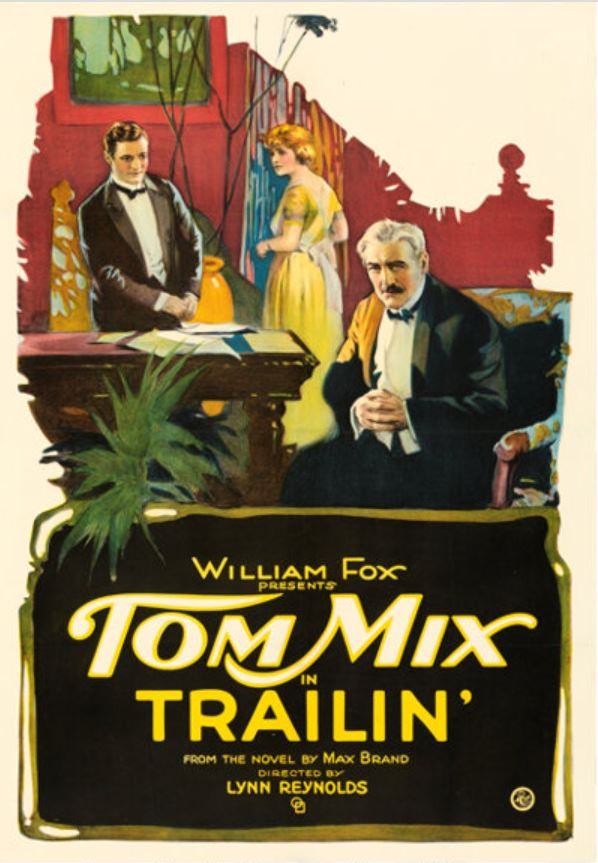
A definitive 5.4/10 rating for a film that redefined the boundaries of cult cinema. Trailin' remains a cornerstone of transgressive art.
A bullet fired inside a locked room is never just a murder—it’s an edit in the family manuscript.
That’s the first thing to know about Trailin’, the 1921 Lynn Reynolds/Max Brand collaboration that somehow slipped through the cracks of pop-Western memory like a coyote through barbed wire. The second thing is that it stars Tom Mix not as a cowboy messiah but as a pampered scion whose Stetson still smells of Parisian cologne, a man who must unlearn silk before he can earn dust. And the third, more disquieting truth: this is a frontier film that behaves like a séance, invoking the dead mother as both MacGuffin and moral ulcer.
Reynolds opens on a tableau of chandeliers and hushed footfalls—an Eastern manor that reeks of mahogany and denial. Tom’s father (James Gordon, all clenched jaw and silver sideburns) treats family lore like classified intel; the mother’s portrait is literally locked inside a cedar-lined vault, as though her face were nitroglycerin. Into this hothouse of repression bursts a grizzled stranger (Al Fremont, eyes like cracked leather) who brandishes a revolver the way other men brandish business cards. One cough of gunpowder later, patriarchal silence becomes patriarchal absence.
The only breadcrumb: a sepia print of a ranch scratched with the word “Trailin’,” a title that doubles as verb and purgatory. Cue Mix’s metamorphosis: he swaps velvet for rawhide, mounts his signature white steed, and rides west not so much to avenge as to authenticate his own origin story.
What distinguishes Trailin’ from contemporaneous oaters like Colorado or Her Inspiration is its refusal to treat landscape as mere backdrop. Reynolds—borrowing the poetic fatalism of Brand’s prose—renders Idaho’s Sawtooth Range as a half-erased manuscript: every ridge bears the overwritten scars of mining camps, Indian trails, and utopian communes that failed. When Tom gallops across these frame, the dust he raises feels like sedimentary time.
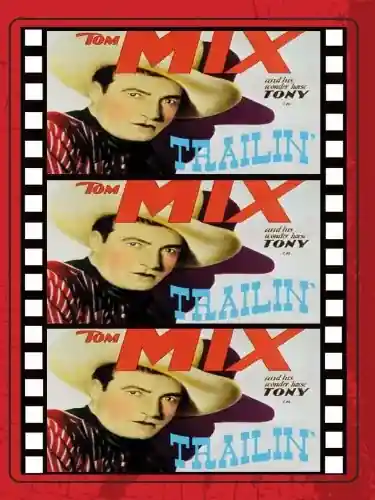
Cinematographer Frank Good (uncredited but identifiable by his chiaroscuro clouds) shoots twilight horizons at a drunken tilt, suggesting that even the sky is colluding in Tom’s disorientation. It’s the visual ancestor to later psychological Westerns—think Yellow Sky or Pursued—yet made when the genre was still teething.
Tom Mix, often dismissed as a circus act in chaps, reveals here a surprisingly nuanced stoicism. Watch the micro-moment when he first unrolls the photograph beside his father’s corpse: his gloved thumb hesitates a millimeter above the woman’s face, as though touching her might dissolve the emulsion. No intertitle is needed; the hesitation is genealogy.
Opposite him, Eva Novak plays ranch-heiress Barbara, a woman who already owns the myth Tom is chasing. Novak’s comedic elasticity—she could arch one eyebrow like a question mark—gets sandpapered into something harder here. In a genre where heroines often oscillate between schoolmarm and succubus, Barbara is neither: she’s a cartographer of family guilt, mapping Tom’s trauma onto her own inherited ranch.
Meanwhile, Duke R. Lee chews sagebrush as the marshal who may-or-may-not be shielding the killer, delivering lines through a mustache so thick it arrives a second before he does. Lee’s moral ambiguity prefigures the corruption that later Westerns would park at the heart of every frontier town.
Max Brand’s fingerprints are everywhere. Dialogue intertitles read like haikus soaked in whiskey: “A man can outrun his horse, but not the syllables his father never spoke.” The screenplay’s structural gambit—dividing acts into seasons titled Blood, Snow, Dust, Balm—risks pretension yet lands as liturgy. Each season is heralded by a single frame of elemental imagery: a crimson scarf, a white owl, a tan cyclone, a green shoot. It’s the silent-era equivalent of chapter headings in a Faulkner novel.
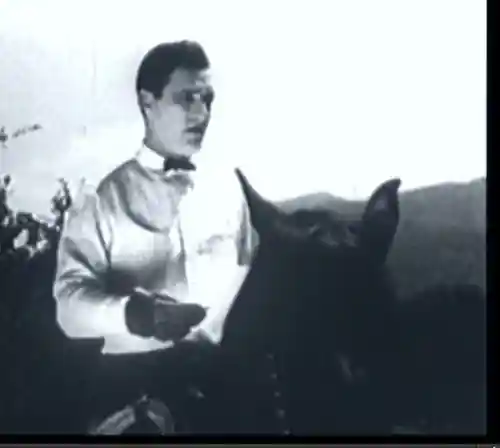
Surviving prints lack original scoring, but modern festival screenings have paired it with live bluegrass improvisations—banjo strings plucked until they weep. The result uncorks a hidden layer: the mother’s absence becomes a drone note under every scene, a frequency the characters can’t name but we, the audience, feel in the jawbone.
If The Moment Before interrogates the second prior to confession, and The Fettered Woman explores matrimonial chains, then Trailin’ is the Western obverse: it dramatizes the aftermath of revelation, the long hoof-beat journey after the gun has already confessed. Its closest spiritual cousin in the provided corpus might be Carolina Rediviva, another tale of erasing and rewriting lineage, though that film trades six-guns for archival documents.
1921 critics praised the stuntwork—Mix leaps onto a moving train from a galloping horse without evident under-cranking—but shrugged at the “morbid genealogy,” preferring their Westerns sunlit and uncomplicated. Variety’s one-paragraph notice yanked two stars for “too much brooding, not enough bronco bustin’.”
Modern viewers, jaded by nihilistic neo-Westerns, will find Trailin’ eerily predictive. The final tableau—Tom standing inside the ranch threshold while Barbara closes the door on the camera—anticipates the self-aware fade-out of The Searchers. We are not granted catharsis, only closure of the mechanical sort: a door shutting us back into our own century.
A 4K restoration by EYE Filmmuseum in 2019 salvaged a Dutch distribution print, revealing textures previously mummified in mold: the glint of Tom’s conchos, the bruised lavender of Idaho twilight. The restored edition streams on niche services, though it’s geo-blocked faster than a claim jumper. Physical media hunters can snag a region-free Blu from Edition Cinématographique, complete with a booklet essay by Tag Gallagher that reads like tumbleweed in prose form.
Great Westerns often ask whether a man can outrun his past; Trailin’ wonders whether he can outrun the photograph of a woman he never met. The answer arrives not in bullets but in architecture: the ranch house, once a foreign country, becomes the only shelter whose roof remembers his mother’s footsteps. That emotional circularity—grief as cartography—makes this obscure 65-minute flick feel closer to Greek tragedy than to Saturday-matinee escapism.
Go watch it before history edits itself again.
IMDb 6.7
1935
Community
Log in to comment.