DbcultAccessing Vault...
Cult Review
Senior Film Conservator
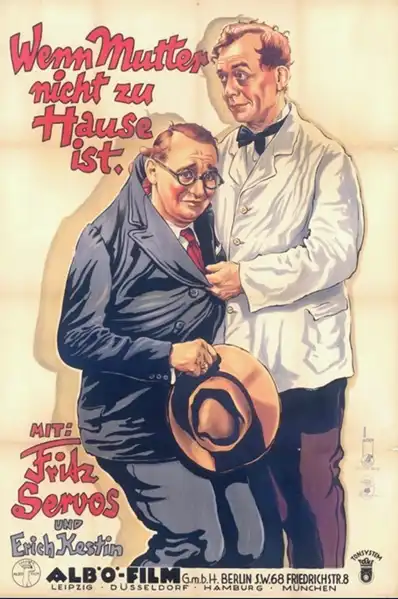
If you're hunting for a quiet afternoon escape, something that feels like a warm, slightly dusty blanket, Wenn Mutter nicht zuhause ist might just hit the spot. Folks who appreciate a certain vintage charm in their cinema, maybe a bit of old German humor, will probably get a kick out of it. Anyone expecting explosions or a super tight, modern plot should definitely look elsewhere, though. Seriously, this isn't for them. 🎬
Leonie Duval, as the titular 'mother,' has this *wonderful* way of looking at her husband, played by Armand Rommel, before she steps out the door. It’s not a glare, not a loving gaze, just this _heavy_ sigh that says everything about what she expects to happen the second she’s gone. It’s a brief moment, but it sets the tone perfectly.
Armand Rommel, as the husband, instantly relaxes the second that door clicks shut. You can practically *feel* the air leave his lungs. He checks his watch, then just… lets his shoulders drop. It's a tiny, almost overlooked gesture, but it tells you everything about the domestic dynamic without a single word. He then proceeds to immediately kick off his shoes. Classic.
The whole thing often feels like a quiet little stage play. The set, probably just a single living room and a tiny kitchen, feels lived-in, if a bit sparse. There’s a slightly crooked painting on the wall that I couldn’t stop staring at for some reason. It just felt… right.
There's a scene where Erich Kestin, perhaps a visiting friend or an older child, tries to fix a leaky faucet. It goes on for ages, honestly longer than you'd expect for something so mundane, and the struggle is surprisingly engaging. Or maybe I just found it funny how utterly incompetent he was with a wrench. The water just keeps spraying everywhere. 💧
A lot of the humor isn't big, belly laughs. It’s more like little chuckles. Like when Hugo Fischer-Köppe's character accidentally knocks over a vase, and the way everyone *freezes*. You can almost feel the movie trying to convince you this moment matters, but it’s just a vase. A broken vase. Oops.
The cinematography isn't flashy, not at all. Mostly static shots, letting the actors do their thing. But there's a certain warmth to the black and white, a real comfort. It feels authentic to its time, you know?
Sometimes the dialogue feels a little stilted, a bit too formal for the situation. But then again, maybe that’s just how people talked back then, or how they *acted* when they knew a camera was rolling. Or maybe it's the German of that era. I don't know enough to say.
I kept wondering what exactly the mother was *doing* while she was away. Was she at the market? Visiting a friend? The film never tells you, and honestly, it doesn't really matter. Her absence is the whole point.
The movie gets noticeably better once the characters stop trying to pretend everything is fine and just lean into the small chaos. Fritz Servos, who also wrote the film, has a particular knack for these moments of genuine, clumsy humanity. He plays a neighbor, I think, who drops by for coffee and just sort of gets caught up in the mess.
Hansi Dege has this one very short bit, a very quick scene, where he's just trying to balance a stack of plates. It's utterly pointless to the 'plot,' such as it is, but it made me smile. It’s those tiny, unnecessary moments that make it feel real.
The ending is very abrupt. Like someone just decided, 'Okay, that's enough.' No big lessons, no grand resolution. The mother just walks back in, surveys the scene, and you get the sense this happens all the time. A slight head shake. The film leaves you with a feeling, not an answer.
It’s not a film that will change your life, but it’s a nice little peek into a specific time and place. A pleasant diversion, especially if you’re into the old stuff. Don't go in expecting anything groundbreaking, just a quiet bit of human observation. 👍

IMDb 7.3
1919
Community
Log in to comment.