DbcultAccessing Vault...
Cult Review
Senior Film Conservator
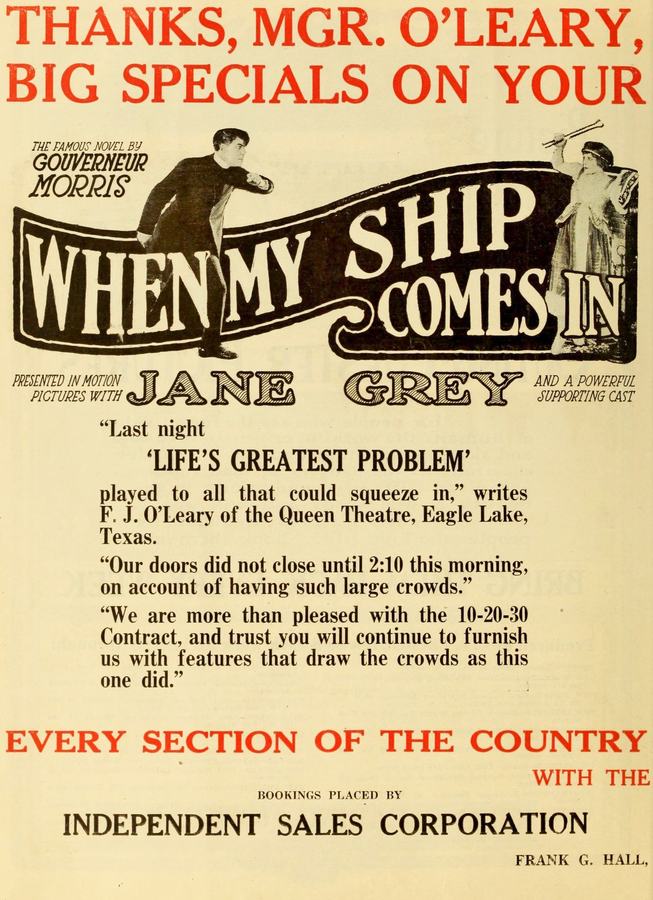
Step back in time to an era where flickering images on a silver screen captivated audiences, telling tales of grand romance, audacious villainy, and the unwavering spirit of human endeavor. In this silent cinematic landscape, When My Ship Comes In emerges as a compelling drama, a poignant exploration of artistic integrity, burgeoning love, and the insidious nature of ambition unchecked. Directed with a keen eye for human drama, this film, penned by the insightful Gouverneur Morris, presents a narrative that, while seemingly straightforward, delves into the moral complexities of creation and ownership, a theme that resonates as powerfully today as it did in its original release. It's a story that asks us to consider the true cost of success when built upon a foundation of deceit, and the enduring strength of character required to reclaim what is rightfully one's own.
At the heart of our narrative is Paul Grayson, portrayed with earnest conviction by Frank Andrews. Grayson is not merely a mining engineer; he is a man possessed of a creative fire, an unyielding passion that manifests in the meticulous crafting of a theatrical play. This isn't some amateurish scribble; it's a work of genuine merit, a testament to his observational skills and narrative prowess. One can almost picture him, late at night, a solitary lamp illuminating his desk, as he pours his soul onto paper, unaware of the treacherous path his creation is about to embark upon. His manuscript, a beacon of his artistic aspirations, is sent into the unforgiving world of theatrical production, landing, unfortunately, on the desk of McKay Hedden. William J. Kelly embodies Hedden with a chilling blend of charm and cunning. Hedden is not merely a producer; he is an opportunist, a predator lurking in the shadows of artistic endeavor, ever ready to pounce on unsuspecting talent. Upon reading Grayson's play, Hedden's initial reaction is not one of admiration for the author, but rather a cold, calculated recognition of its commercial potential. This is where the film truly begins to unravel its central conflict: the clash between pure artistic creation and the rapacious appetite of commercial exploitation. Hedden, with a Machiavellian flourish, decides the play is too good to simply produce; it is, in his twisted logic, worth stealing. He executes his plan with a chilling efficiency, making a meticulous copy and then returning the original with a dismissive note, a cruel psychological ploy designed to crush Grayson's spirit and deter any future claims of authorship. It's a moment that defines Hedden's character, painting him as a man utterly devoid of ethical boundaries when profit and prestige are on the line.
With the stolen manuscript tucked away, Hedden's gaze shifts to finding the perfect star for his ill-gotten production. His journey leads him to the picturesque Hanleytown Harbor on the New England coast, a setting that provides a stark, refreshing contrast to the cutthroat world of Broadway. Here, amidst the salty air and the rhythmic lull of the waves, he encounters Silver Sands, the daughter of a seasoned old sea captain. Jane Grey portrays Silver with an enchanting blend of innocence, natural beauty, and an untapped wellspring of charisma. She is a diamond in the rough, a genuine talent unpolished by the artificiality of the stage, and Hedden, ever the astute observer of market value, immediately recognizes her star potential. His decision to cast her is less about artistic vision and more about finding a fresh, compelling face to front his stolen goods. It is in this same idyllic harbor that destiny, with its usual dramatic flair, orchestrates a meeting between Silver and the true author, Paul Grayson. Their encounter is immediate and profound, a genuine connection that blossoms amidst the scenic beauty of the coast. This burgeoning romance adds a crucial layer of emotional depth to the narrative, transforming the tale from a mere legal dispute over authorship into a deeply personal struggle for love and justice. The contrast between Hedden's calculated interest in Silver and Paul's genuine affection is palpable, establishing a clear moral dichotomy that underpins the entire film. One cannot help but draw parallels to other tales of discovery and romance, though perhaps with a touch more dramatic irony than seen in, say, Little Pal, where innocence often meets a simpler, less complicated fate.
As Hedden whisks Silver away to the bustling metropolis of New York, the rehearsals for the 'new' play commence. Silver, with her raw talent and unwavering dedication, begins to blossom under the bright lights, transforming into the star Hedden envisioned. Yet, the seeds of deceit, once sown, rarely remain buried forever. The theatrical world, despite its glamour, is a tight-knit community, and whispers of Hedden's dubious ethics eventually reach the ears of a discerning drama critic, a friend to Paul Grayson. While the specific actor portraying this pivotal role isn't explicitly detailed in the synopsis, one can imagine a figure like Nigel Barrie, known for his distinguished presence, stepping into such a role, embodying the conscience of the theatrical elite. This critic, sensing foul play, swiftly notifies Paul of Hedden's treachery. It is a moment of critical exposition, a turning point that propels Paul from his idyllic coastal retreat back into the heart of the urban jungle, armed with righteous indignation and a burning desire for justice. His arrival in New York is not just about reclaiming his intellectual property; it's about rescuing Silver from Hedden's increasingly unwelcome advances. The producer, emboldened by his perceived success and the proximity of his star, begins to blur the lines between professional guidance and personal exploitation. This adds an urgent, almost thrilling dimension to Paul's quest, elevating the stakes from mere financial gain to the protection of a woman he has come to love. The confrontation between Paul and Hedden is inevitable, a dramatic crescendo where truth must inevitably clash with falsehood. The film expertly builds this tension, leading to a satisfying, if somewhat swift, resolution where Hedden, faced with undeniable evidence and Paul's resolute stance, is forced to acknowledge Paul as the true author. This moment of admission is a powerful vindication, not just for Paul, but for the very principle of artistic integrity. It reminds us that even in the most cutthroat environments, truth can, and often does, find a way to surface.
The resolution of the conflict paves the way for the play's triumphant premiere, now rightfully attributed to Paul Grayson. With Silver Sands in the leading role, her performance imbued with an authentic emotional resonance born from her journey, the play becomes an unequivocal success. This conclusion is not merely a happy ending; it is a profound affirmation of talent, integrity, and the power of genuine connection. Silver's success is not just a personal victory; it is a symbol of how raw talent, when nurtured honestly, can truly shine. The film, through this narrative arc, subtly champions the idea that true artistry cannot be stolen or manufactured; it must be cultivated with respect and honesty. The casting of Jane Grey as Silver Sands proves to be inspired, as her portrayal undoubtedly lends credence to the character's meteoric rise, making her success feel earned and authentic. One might compare her journey of unexpected stardom to the vibrant energy captured in films like Molly of the Follies, though perhaps with a more dramatic undercurrent of betrayal and redemption. The film's message, while delivered through the silent medium, speaks volumes about the timeless struggle between good and evil, honesty and deceit, and the eventual triumph of virtue. Gouverneur Morris's writing, even without spoken dialogue, manages to convey complex moral dilemmas and character motivations, a testament to the power of visual storytelling and well-structured plotting.
In the silent era, the burden of conveying emotion and character fell squarely on the actors' shoulders, demanding expressive physicality and nuanced facial performance. Frank Andrews, as Paul Grayson, masterfully communicates the character's initial idealism, his crushing disappointment, and his eventual resurgence of determination. His transformation from a naive engineer to a resolute champion of justice is rendered with a believable intensity that anchors the film's emotional core. William J. Kelly’s portrayal of McKay Hedden is equally compelling, albeit for entirely different reasons. He imbues Hedden with a smooth, almost seductive villainy that makes his actions all the more reprehensible. Kelly avoids the trap of caricature, presenting Hedden as a man driven by ambition rather than pure malice, making his eventual capitulation feel earned, a moment of reluctant acknowledgment rather than a sudden change of heart. Jane Grey, as Silver Sands, is the film's luminous heart. Her journey from an unassuming harbor girl to a celebrated stage star is handled with remarkable grace and conviction. Grey’s expressions convey a spectrum of emotions – from wide-eyed wonder and budding romance to burgeoning confidence and subtle vulnerability – making her a captivating presence whenever she graces the screen. Her chemistry with Andrews is palpable, adding a tender authenticity to their blossoming relationship. While Nigel Barrie's specific role isn't detailed, his presence in the cast list suggests a significant supporting contribution, perhaps as the discerning drama critic who sets events in motion, or another figure adding gravitas to the New York theatrical scene. The ensemble cast works in concert, each performance contributing to the rich tapestry of the narrative, ensuring that the emotional beats land with precision despite the absence of spoken words. The silent film format, far from being a limitation, forces a heightened sense of visual communication, and the actors here rise to that challenge admirably, crafting characters that resonate long after the final fade-out.
Beyond the performances, When My Ship Comes In showcases the burgeoning cinematic techniques of its time. The visual storytelling, from the serene beauty of Hanleytown Harbor to the bustling energy of New York, is handled with an eye for contrast and atmosphere. The use of intertitles, while a necessity of the era, is employed judiciously, allowing the visual narrative to take precedence. The pacing, a crucial element in silent film, maintains a steady rhythm, building suspense during Hedden's machinations and accelerating towards the dramatic climax in New York. The film’s exploration of themes like artistic theft and the struggle for recognition places it within a broader cinematic conversation. One could argue it foreshadows later narratives of ambition and betrayal in the arts, even finding thematic echoes in more adventurous serials like Die Herrin der Welt 1. Teil - Die Freundin des gelben Mannes, where the stakes are global but the underlying human drives remain similar. The idea of hidden truths and their eventual revelation is also a potent theme, reminiscent in its own way of the tension found in films like Sealed Orders, albeit within a different genre. The film serves as a valuable artifact, offering a window into the cultural anxieties and moral compass of its period. It reminds us that the struggle for ownership over one's creative output is not a modern phenomenon but a timeless challenge that artists have faced across generations. The narrative’s ultimate resolution, favoring integrity over deceit, speaks to a deeply ingrained societal belief in justice, a comforting notion in an often-unpredictable world. While it may not possess the grand spectacle of All for the Movies: Universal City, California, the Wonder City of the World, which celebrates the industry itself, When My Ship Comes In offers a more intimate, yet equally compelling, look at the human drama unfolding within that very industry. It’s a film that, despite its age, continues to resonate, demonstrating that stories of passion, betrayal, and redemption are truly universal.
When My Ship Comes In stands as a compelling example of early 20th-century filmmaking, a testament to the power of a well-crafted story and nuanced performances, even without the benefit of synchronized sound. Gouverneur Morris's narrative, brought to life by a talented cast including Frank Andrews, William J. Kelly, Nigel Barrie, and Jane Grey, navigates the treacherous currents of ambition and artistic ethics with admirable skill. It's a film that reminds us of the enduring value of integrity, the seductive allure of ill-gotten gains, and the ultimate triumph of truth. The journey of Paul Grayson, from hopeful playwright to vindicated artist, intertwined with Silver Sands' rise to stardom, creates a deeply satisfying emotional arc. It’s a tale that, while rooted in a specific era, speaks to universal human experiences: the struggle for recognition, the desire for love, and the fight against injustice. For enthusiasts of silent cinema, or anyone interested in the foundational narratives that shaped Hollywood, When My Ship Comes In offers a rich and rewarding viewing experience. Its themes of intellectual property theft and the exploitation of talent remain remarkably relevant, making this film more than just a historical curiosity; it is a timeless commentary on the ethics of the creative industry. The film's conclusion, with the successful play and the rightful attribution, provides a heartwarming sense of justice, a powerful reminder that sometimes, indeed, one's ship does come in, bringing with it not just fortune, but vindication and love. Its quiet strength and moral clarity make it a noteworthy entry in the annals of silent film, a narrative that continues to resonate with audiences who appreciate a story where good ultimately prevails, and true talent finds its rightful spotlight.

IMDb —
1934
Community
Log in to comment.