DbcultAccessing Vault...
Cult Review
Senior Film Conservator
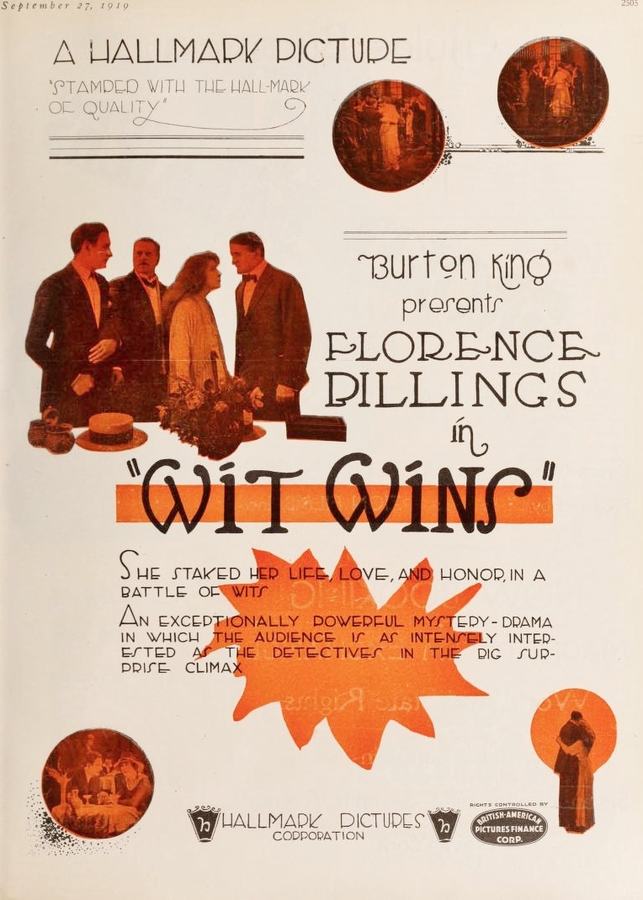
In the annals of early cinema, where narratives often relied on broad strokes and heightened melodrama, a film like 'Wit Wins' emerges not just as a historical artifact, but as a surprisingly intricate tapestry of human ambition, romantic entanglement, and corporate skullduggery. Directed and penned by the often-underestimated Leander De Cordova, this 1917 production, featuring the likes of John Nichols, Eugene Strong, Hugh Thompson, Joseph W. Smiley, E.J. Ratcliffe, and Florence Billings, deftly navigates a complex web of deceit that, even a century later, retains a compelling resonance. It’s a testament to its narrative ingenuity that a plot hinging on such classic tropes manages to feel fresh, or at least, timelessly engaging.
The film plunges us into the high-stakes world of a powerful financier, a man whose empire is built on shrewd decisions and unyielding authority. His decision to hire a new private secretary, a woman endowed with both exceptional efficiency and striking beauty, sets in motion a chain of events that will unravel the very fabric of his family and business. This initial premise, a seemingly innocuous administrative decision, immediately introduces a potent cocktail of professional necessity and personal intrigue. The secretary, intended as a cog in the corporate machine, becomes a catalyst for an unexpected romantic and familial upheaval. It's a classic setup, reminiscent of the intricate social dynamics explored in films like The House of Mirth, where a woman's presence in a powerful man's orbit invariably leads to complications that transcend mere professional boundaries.
The son, hitherto a figure of detached privilege, suddenly awakens to the allure of the business world, a transformation his astute father views with immediate suspicion. The elder financier, a man who understands human motivation perhaps better than his own offspring, correctly attributes this newfound enthusiasm not to a genuine passion for finance, but to the magnetic pull of the secretary. This paternal insight, sharp and unsparing, leads to a swift decree: if the son is to pursue business, it will be far from the tempting presence of the office. This banishment, while seemingly harsh, underscores the father's protective, albeit somewhat cynical, understanding of his son's vulnerabilities. It’s a power play, a strategic maneuver to separate the personal from the professional, yet it inadvertently pushes the son onto a path fraught with greater peril.
Isolated from his father's direct guidance, the son's independent ventures prove disastrous. His attempts to forge his own path are met with repeated failures, painting him as an incompetent dilettante. This vulnerability is then exploited with ruthless precision when he is framed for the theft of crucial bonds. The narrative here pivots from familial drama to a more sinister realm of corporate sabotage and personal ruination. The injustice of the accusation is palpable, yet the circumstances surrounding it are designed to make him appear unequivocally guilty, a common trope in early thrillers like On Dangerous Ground, where protagonists often find themselves ensnared in webs of false accusations.
Simultaneously, the son’s personal life descends into a maelstrom of jealousy and suspicion. His clandestine visits to the secretary's apartment are frequently punctuated by the sight of his father's cashier emerging from the very same dwelling. This recurring visual motif, subtle yet potent, sows seeds of doubt in the son's mind, culminating in a devastating confrontation where he discovers his sweetheart in the arms of the cashier. The emotional impact of this scene is expertly crafted, playing on the audience’s empathy for the son’s double plight: professional ruin compounded by romantic betrayal. The film uses these parallel crises to heighten the tension, making the eventual revelation all the more impactful.
It is precisely at this nadir – accused of theft, betrayed in love, and professionally disgraced – that the son's perception sharpens. The confluence of seemingly disparate misfortunes finally clicks into place. He realizes, with a chilling clarity, that the bond theft and the romantic betrayal are not isolated incidents but intertwined threads of a meticulously crafted conspiracy. The secretary and the cashier, far from being star-crossed lovers, are co-conspirators, their machinations aimed at the ultimate ruin of his father. This sudden enlightenment is the narrative's fulcrum, the moment where the film's title, 'Wit Wins', truly justifies itself. It's not brute force or emotional outpouring that saves the day, but the piercing insight of a mind pushed to its limits. This kind of intellectual triumph over adversity is a hallmark of compelling drama, reminiscent of the intricate reveals in films like The Girl in the Dark, where hidden truths slowly come to light.
De Cordova's screenplay, while perhaps not revolutionary by today's standards, demonstrates a sophisticated understanding of dramatic structure for its era. The initial misdirection, the gradual build-up of suspicion, and the climactic revelation are all expertly paced. The film doesn’t just present a plot; it unravels it, inviting the audience to piece together the clues alongside the protagonist. The performances, particularly from John Nichols as the son and Florence Billings as the duplicitous secretary, are nuanced, conveying the shifting emotional landscapes with a commendable subtlety given the conventions of silent film acting. Billings, in particular, manages to portray both charm and underlying malice, making her character's betrayal all the more impactful.
With the conspiracy exposed, the narrative moves towards its resolution, a satisfying culmination of justice and reconciliation. The father and son, their bond tested by suspicion and manipulation, emerge stronger, their business rivalry transforming into a renewed alliance. This restoration of familial harmony, built on a foundation of shared adversity, provides a powerful emotional core to the film. It speaks to the enduring strength of kinship and the ability to overcome even the most insidious forms of betrayal. The theme of redemption, both personal and familial, resonates strongly here, paralleling the journey of characters in films like The Hidden Scar or A Law Unto Herself, where protagonists must navigate moral complexities to find their way back to integrity.
The lovers, too, find their way back to each other, but not without acknowledging the arduous journey they have endured. Their romance, initially clouded by deceit and suspicion, is ultimately purified by the crucible of truth. The film assures them a "pleasant future," implying that the challenges faced have forged a stronger, more resilient bond. This resolution, while perhaps a touch idealistic, aligns with the romantic conventions of the era, offering a comforting sense of closure after the preceding turbulence. It reminds us that love, even when tested by the darkest of schemes, can ultimately prevail, much like the enduring spirit seen in The Primrose Ring, where love blossoms amidst hardship.
Leander De Cordova, primarily known for his prolific output in the silent era, demonstrates a keen understanding of character motivation and plot construction in 'Wit Wins'. While his name might not carry the same weight as some of his more celebrated contemporaries, films like this underscore his capability to craft engaging and intellectually stimulating narratives. The film's strength lies not just in its plot twists, but in its exploration of themes that remain perennially relevant: the corrupting influence of greed, the destructive power of jealousy, and the redemptive force of truth. It's a testament to the power of a well-told story, regardless of its vintage.
The cinematic language of the time, characterized by expressive gestures and intertitles, is utilized effectively to convey the emotional nuances of the story. The visual storytelling, though lacking the sophisticated cinematography of later eras, is clear and purposeful, guiding the audience through the intricate plot without confusion. The film's pacing is deliberate, allowing the tension to build organically, making the eventual revelations feel earned rather than gratuitous. For anyone interested in the evolution of dramatic storytelling in cinema, 'Wit Wins' offers a fascinating case study in how complex narratives were constructed and conveyed in the nascent years of the medium.
Ultimately, 'Wit Wins' is more than just a period piece; it's a timeless reflection on human nature. It explores the intoxicating allure of power, the fragility of trust, and the often-deceptive nature of appearances. The film's title itself serves as a thematic anchor, reminding us that in a world rife with cunning and manipulation, true intelligence – the ability to discern truth from falsehood, and to act upon that understanding – is the ultimate victor. It’s a message that resonates as powerfully today as it did over a century ago. The nuanced portrayal of characters caught in a web of their own making, or unmaking, invites introspection into the choices we make and the consequences they bear. Much like the moral complexities explored in The Curse of Eve or The Sin Woman, this film delves into the darker recesses of the human psyche, only to emerge with a message of hope and clarity.
In conclusion, 'Wit Wins' stands as a commendable example of early cinematic drama, a film that, despite its age, offers a compelling narrative, well-drawn characters, and a satisfying resolution. It’s a testament to the enduring power of storytelling that even without the technological marvels of modern filmmaking, a well-crafted plot and engaging performances can captivate and provoke thought. Leander De Cordova, through this work, carves out a niche for himself as a storyteller capable of weaving intricate tales of human drama and the ultimate triumph of intellect over deception. It's a film that deserves to be rediscovered, not just for its historical significance, but for its intrinsic merit as a piece of engaging cinema.
IMDb 5.5
1933
Community
Log in to comment.