DbcultAccessing Vault...
Cult Review
Senior Film Conservator
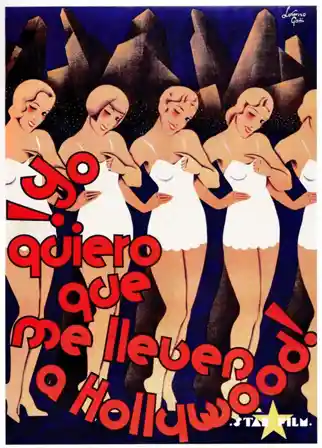
If you're hunting for a shiny, fast-paced modern flick, you can probably just keep scrolling past Yo quiero que me lleven a Hollywood. This one's really for the film history buffs, the folks who genuinely get a kick out of seeing how movies *used* to be made, especially those early Spanish talkies. Anyone expecting slick production values or deep, sweeping character arcs might find it a bit of a slow burn, but there's a certain **earnest, almost naive charm** to it all.
The whole premise, just from that title, makes you smile a little: "I want them to take me to Hollywood." It’s such a pure ambition. You can almost feel the longing, that very specific kind of glamour Hollywood represented back in 1934 Spain. It wasn't about global fame then, it was just about *Hollywood*. ✨
Julia Bilbao, she’s our main character here, and she carries that dream pretty well on screen. There’s this one scene where she’s just practicing lines in front of a mirror, a bit awkward, but you totally get the effort. Her expressions feel very *of the time*, a little grander than we’re used to now. She has this particular way of holding her head when she’s trying to look serious, almost like she’s posing for a portrait.
The film moves with this gentle, almost meandering rhythm. It’s not in any rush to get anywhere. There are these little musical numbers that pop up sometimes, a bit out of nowhere. One particular song felt like it went on about 30 seconds too long, but then the dancers seemed to be having such a good time, you kinda just went with it. 💃
Edgar Neville, the writer, really gives it a distinct flavor. It’s not always smooth, but it feels authentic, if that makes sense. You notice these small things, like the way a background extra looks directly at the camera for a second, then quickly away. Or how the sets, though simple, have these **specific little details**, like a floral pattern on a curtain that looks like it came straight out of someone's actual home.
There's a scene with Federico García Sanchíz, playing what feels like a supportive, maybe slightly exasperated, mentor figure. He has this wonderful, almost theatrical way of gesturing with his hands when he's trying to make a point. It’s a small thing, but it really stuck with me. Like he’s conducting an orchestra of ideas.
The sound quality, as you’d expect for 1934, can be a bit... fuzzy. Sometimes the dialogue feels a little distant, like you’re listening through a thick wall. But honestly, it just adds to that old-world feel, in a strange way. It's not a flaw, it's just *part of it*.
What really makes it stick, I think, is how it captures that specific kind of hope. The hope of escaping to something bigger, something glamorous. It's not a cynical film at all. It just lays out this dream, and lets you watch someone try to reach for it. There’s a moment near the end, a quiet shot of Julia looking off into the distance, and you really feel the weight of what she’s wishing for. It’s **surprisingly poignant**.
It's not a perfect movie, not by a long shot. Some of the editing jumps are a bit jarring, and you can tell they were still figuring things out with sound and picture sync. But for a glimpse into early Spanish cinema, and a sweet, uncomplicated story about big dreams, it's definitely something. It’s a little slice of history, really. 🎬
IMDb 5
1930
Community
Log in to comment.