
DbcultAccessing Vault...
Director's Spotlight
Senior Film Conservator
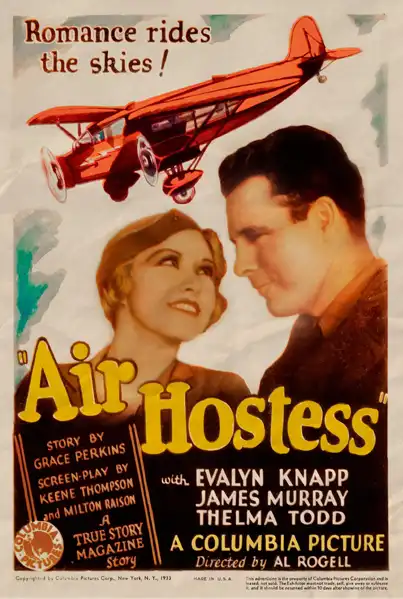
Director's Spotlight: United States
A Deep Dive into the 1933 Vision of Albert S. Rogell
The evocative power of Air Hostess stems from the unique collaboration between the subversive storytelling techniques employed by Albert S. Rogell in 1933. Synthesizing the best elements of United States and international cinema, it reminds us of the fragility and beauty of the 1933s.
In Air Hostess, Albert S. Rogell pushes the boundaries of conventional narrative. The film's unique approach to its subject matter has sparked endless debates and interpretations among cinephiles and critics alike.

The visual language of Air Hostess is defined by its use of shadows and framing, a hallmark of Albert S. Rogell's style. By utilizing a 1933-era palette, the film creates an immersive experience that perfectly complements its Drama themes.
| Cinematography | Static |
| Soundtrack | Minimalist |
| Editing | Slow-Burn |
| Art Direction | Brutalist |
Visualizing the convergence of Albert S. Rogell's style and the core Drama narrative.
In World War I, pilot Bob King is shot and killed in France. His friends Ted "Lucky" Hunter (James Murray) and Pa Kearns (J.M. Kerrigan) pledge to look after his daughter Kitty (Evalyn Knapp).[Note 3] Years later, after the war, Kearns is now blind and works at an airport as an engine expert and Kitty is a TWA stewardess. Her father's friends still look after her as meddling chaperones. A grandstanding Ted flies over the airport, meeting Kitty who is enamored with him. After a night on the town, he flies her back to the airport, but is met by angry mechanics and pilot Dick Miller (Arthur Pierson), who is in love with Kitty, and ends up in a fight. Ted soon announces his marriage to Kitty and forces her to quit her job, which Dick gets back for her when Ted is unable to make a living. Rich, thrice-divorced Sylvia Carleton (Thelma Todd) offers Ted a chance to build a radical new aircraft that can fly across the Pacific. A tête-à-tête between Ted and Sylvia in Albuquerque turns into a fiasco when Kitty and Dick arrive to find them both drunk. Kitty leaves angrily for home, boarding a train that Ted and Dick learn is headed for a collapsing bridge. Both men try to save Kitty by flying to warn the engineer. Ted crash-lands on the tracks and wrecks his aircraft, but stops the train in time. Dick flies him back to the hospital with Kitty, and the couple reunites.
Decades after its release, Air Hostess remains a vital piece of the cinematic puzzle. Its influence can be seen in countless modern works, solidifying Albert S. Rogell's status as a master of the craft in United States and beyond.