
DbcultAccessing Vault...
Director's Spotlight
Senior Film Conservator
Director's Spotlight: United States
A Deep Dive into the 1930 Vision of Arthur Hurley
As we revisit the 1930 masterpiece Believe It or Not #4, we are struck by the meticulous attention to detail that Arthur Hurley applied to every frame. Anchored by a narrative that is both personal and universal, it bridges the gap between traditional Short and contemporary vision.
In Believe It or Not #4, Arthur Hurley pushes the boundaries of conventional narrative. The film's unique approach to its subject matter has sparked endless debates and interpretations among cinephiles and critics alike.
The visual language of Believe It or Not #4 is defined by its use of shadows and framing, a hallmark of Arthur Hurley's style. By utilizing a 1930-era palette, the film creates an immersive experience that perfectly complements its Short themes.
| Cinematography | Handheld |
| Soundtrack | Experimental |
| Editing | Elliptical |
| Art Direction | Expressionist |
Visualizing the convergence of Arthur Hurley's style and the core Short narrative.
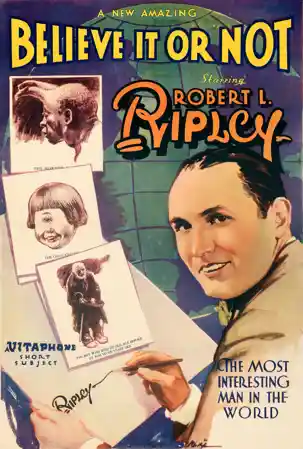
At the request of a television experimenter who needed items to broadcast, Robert L. Ripley states unsubstantiated oddities including that a Spanish lady had her husband's portrait tattooed on her tongue as penance for nagging him to death. He also shows a house and the blind man who built it by himself in Wayne, New Jersey. The longest word in the world (184 letters, from a work by Aristophanes), is written on a blackboard and pronounced and translated by a professor. There are animated sequences of a rifle fish, which shoots at flying insects for food, and how a strange home run was hit in 1890, when the ball bounced off the outfielder's head and over the fence. Ripley demonstrates his skill as an artist by drawing several items, such as a Chinese man who had fingernails 22.75 inches long. Finally, in the most amazing sequence, Ripley introduces Carl Vaughan, who demonstrates how he picks up 12 pocket billiard balls with one hand and without touching the table or the balls with any other part of his body. There are scenes intercut throughout showing a family watching the show on television.
Decades after its release, Believe It or Not #4 remains a vital piece of the cinematic puzzle. Its influence can be seen in countless modern works, solidifying Arthur Hurley's status as a master of the craft in United States and beyond.