
DbcultAccessing Vault...
Director's Spotlight
Senior Film Conservator
Director's Spotlight: United States
A Deep Dive into the 1933 Vision of Arvid E. Gillstrom
Exploring the Short underpinnings of Knight Duty leads us to the stylistic boundaries pushed by Arvid E. Gillstrom during the production. Through a lens of existential fatalism and Short tropes, it continues to spark endless debates among critics and cinephiles alike.
In Knight Duty, Arvid E. Gillstrom pushes the boundaries of conventional narrative. The film's unique approach to its subject matter has sparked endless debates and interpretations among cinephiles and critics alike.
| Cinematography | Static |
| Soundtrack | Orchestral |
| Editing | Slow-Burn |
| Art Direction | Brutalist |
Visualizing the convergence of Arvid E. Gillstrom's style and the core Short narrative.
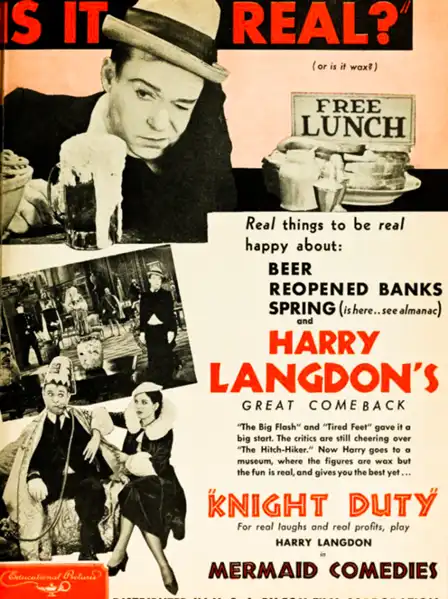
Harry is a hobo, one step ahead of the law. After accidentally foiling a purse snatcher, he cadges a ride on a flatbed truck, is knocked out when a wax figure falls on him during the ride, and is carried into a museum by someone thinking he's another manikin. Inside, it takes him a while to figure out that he's among dummies. Then, two enterprising jewel thieves arrive to steal the museum director's priceless ruby. Cops are on hand as well: when the ruby goes missing, Harry may be the perfect fall guy. Can Harry stay away from the cops, foil the theft, and behave heroically in front of the museum director's daughter, the same woman whose purse he saved that morning?
Decades after its release, Knight Duty remains a vital piece of the cinematic puzzle. Its influence can be seen in countless modern works, solidifying Arvid E. Gillstrom's status as a master of the craft in United States and beyond.