
DbcultAccessing Vault...
Recommendations
Senior Film Conservator

Navigating the complex narrative architecture of The Bandolero is a character-driven intensity experience, the legacy of The Bandolero is a beacon for those seeking the unconventional. Unlock a new level of cinematic understanding with these Romance alternatives.
The artistic audacity of The Bandolero ensures it to sustain a sense of mystery that persists after the credits roll.
When his wife is killed by the evil Marques de Bazan, Spanish army officer Dorando becomes a notorious outlaw known as El Bandolero. He kidnaps Bazan's son Ramon and has him raised by one of his own men. When Ramon grows up to be a man he meets and falls in love with El Bandolero's beautiful daughter Petra. Bandolero forbids his daughter from seeing Ramon, so Ramon leaves to become a bullfighter. A vengeful young woman he has spurned sets up Ramon to be gored by a vicious young bull. Complications ensue.
Critics widely regard The Bandolero as a cult-favorite piece of Romance cinema. Its character-driven intensity is frequently cited as its strongest asset, solidifying its place in United States's film legacy.
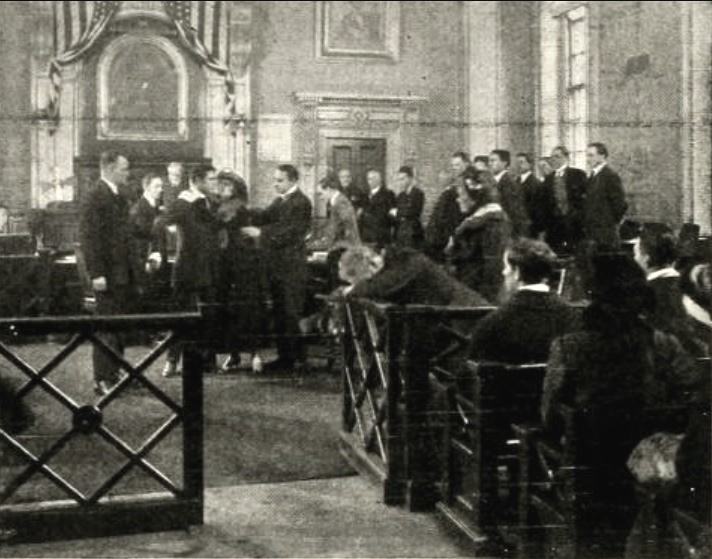
Based on the unique character-driven intensity of The Bandolero, our vault has identified these titles as the most compelling follow-up experiences for fans of Romance cinema:
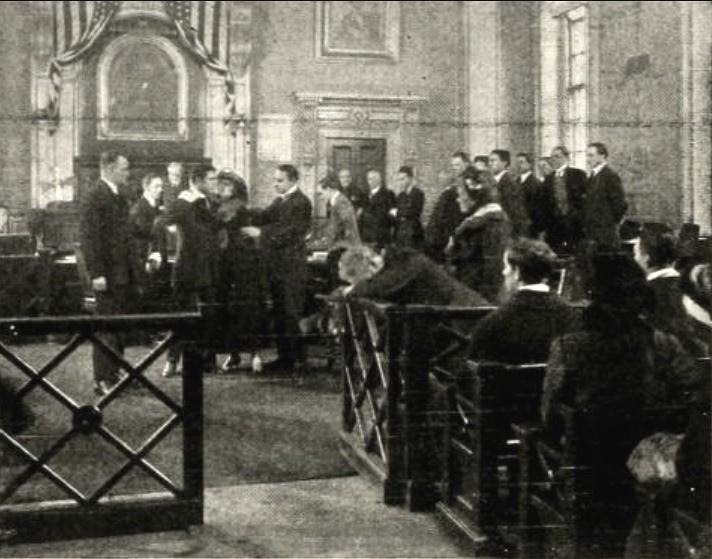
Dir: Tom Terriss
At a dance given by Earl Dexter, his wife, for the gratification of a whim, wears a beautiful pearl necklace recently purchased by Viscount Acheson. Craig Dare, who is a gentleman thief, makes love to Earl Dexter's wife, and at the same time succeeds in stealing from her the pearl necklace and handing it out of the window of the house to Tony Oscaros, a chauffeur, who is none other than Dexter, who is leading a dual life. The party ends in confusion at the announcement of the loss of the necklace. Craig Dare learns that Viscount Acheson, who carries with him a considerable sum of money, is going to be at an inn (owned by Dexter's father) in the neighborhood. Dare goes with Acheson to the inn and allows him to fall into the hands of Tony Oscaros and his gang. Shortly before this happened, Earl Dexter comes to the inn to see his father, who, however, is absent at the time. Dexter's father returns to his inn in time to find the murdered Acheson, and see Tony Oscaros dashing out of the house. By a peculiar coincidence, Oscaros looks so much like Earl Dexter that even his father is deceived by the resemblance. Later, Earl Dexter is accused and convicted of the murder of Acheson. At the last moment. Tony Oscaros' little boy recognizes the fact that Dexter is not his father, and so gives the clue to the guilt of Tony Oscaros. The police follow up the clue and after finally encounter and capture Tony Oscaros.
View Details
Dir: Tom Terriss
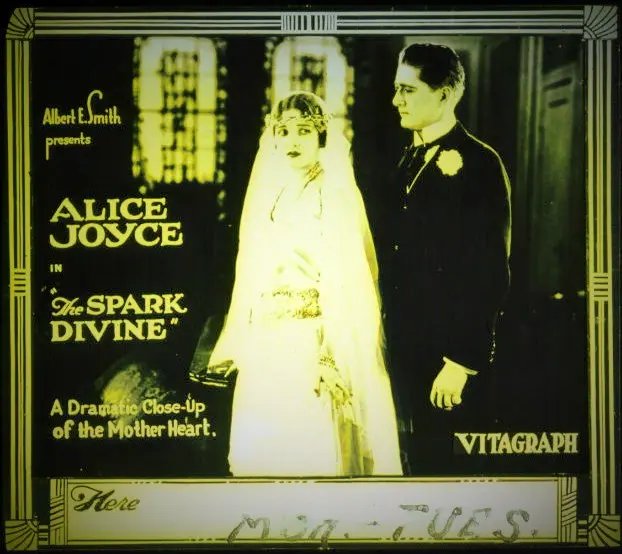
Due to her parents' coldness and constant struggle for social recognition, Marcia Van Arsdale grows into womanhood despising love. When mine owner Robert Jardine comes to New York, he causes the near bankruptcy of Marcia's father by manipulating the copper market. Marcia's parents bring about a marriage between their daughter and Robert, although Marcia makes it clear that she can never love. Marcia gives birth to a baby boy and is indifferent to the child until he is kidnapped one day. Marcia realizes her heart is filled with maternal love and also confesses her love for Robert. Christmas Eve brings only sadness to the Jardine home until Robert confesses that he arranged the kidnapping to kindle Marcia's emotional spark. The child returns to a happy family.
View Details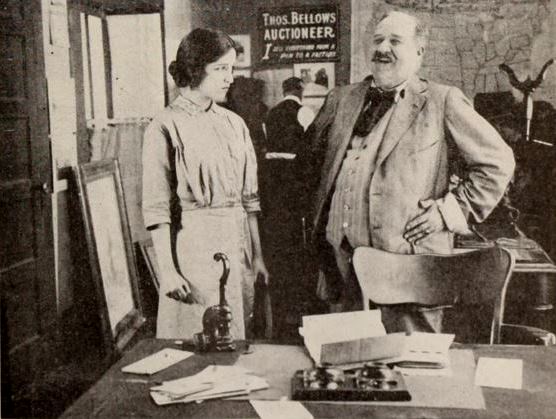
Dir: Tom Terriss
The story concerns a young girl who spends her entire life in trying to obtain money to pay off the mortgage on her farm. But the day comes when she can no longer meet the claims, and Jarvis, the man who holds the mortgage, gives her the alternative of selling herself to him in return for the land. She spurns his offer, but adopts a plan to sell herself in service for one year to the highest bidder. Her old sweetheart arrives too late to save her and later proves that he was not worthy of her. The year passes without her "master" claiming her. Then the girl learns that Jarvis had bought her services because he had really loved her and she, having learned to care for him, marries him. - New York Dramatic Mirror, July 27, 1918.
View Details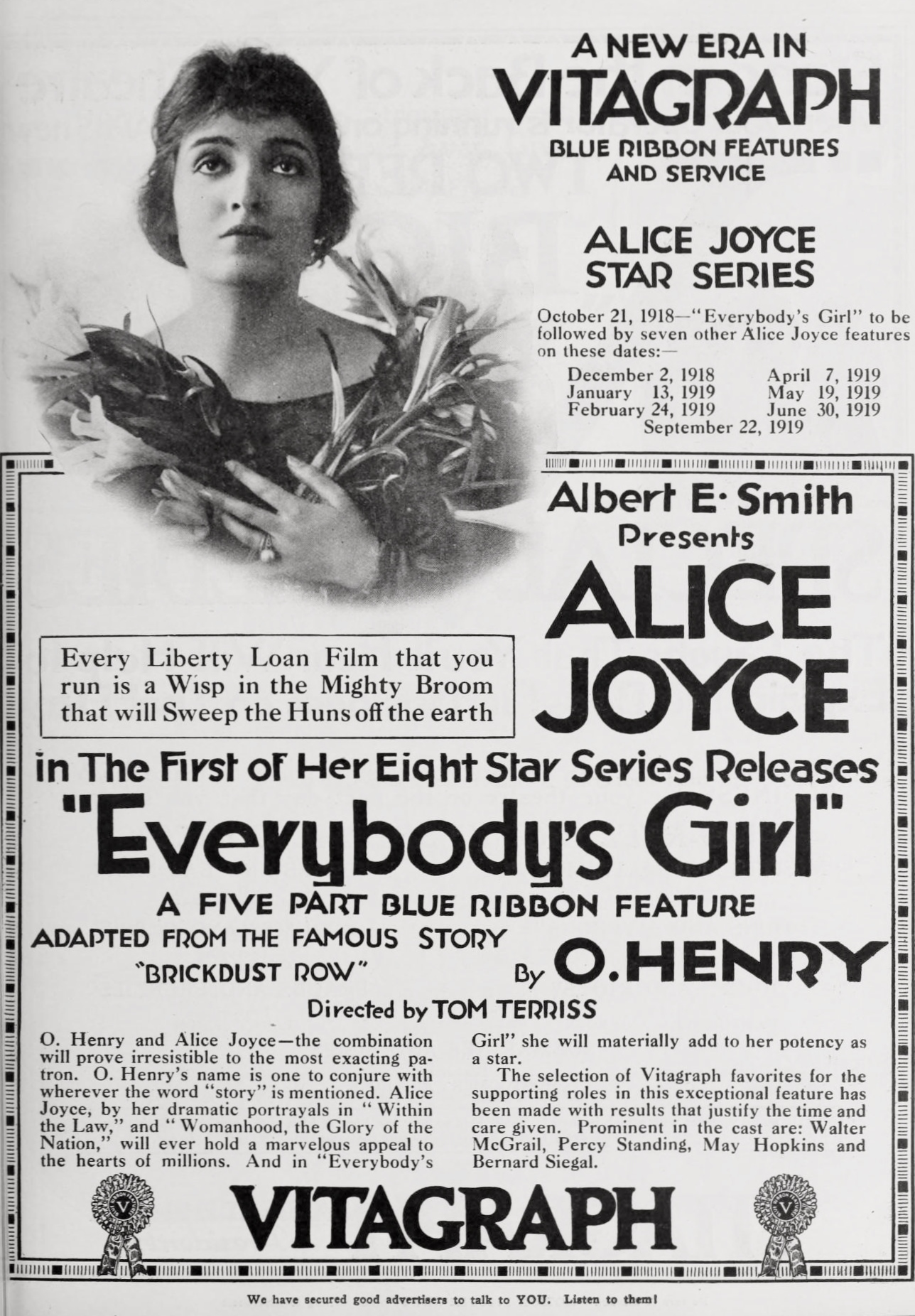
Dir: Tom Terriss

Florence is a little milliner who shares a room in "Brick Dust Row" with Ella, a fellow worker. It is all the home she has and the girls have to receive their company in the parks because there is no reception room, the millionaire owner of the Row having sublet the parlors. They see no harm in chance acquaintances. Then Florence meets Blinker, and real love comes into her life; but Blinker learns of what to him seems her promiscuous acquaintances and makes it plain that he cannot marry such a woman. There is a fire on the excursion boat on which they are traveling, and Bill, a gun-packing husky, who has constituted himself Florence's champion, saves them both. Then he learns Blinker's attitude, and a visit to the young millionaire owner of the Roy shows Blinker that his own greed is basis for Florence's actions and a changed Row is Florence's wedding present. - Moving Picture World 1918.
View Details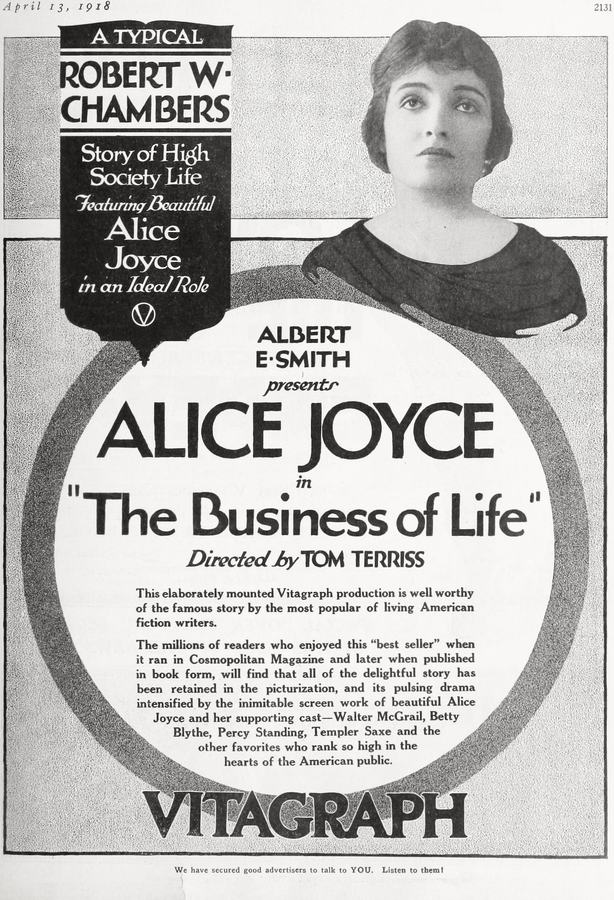
Dir: Tom Terriss
Carrying on with the antique business of her deceased father, Jacqueline Nevers (Alice Joyce) is asked to catalog James Desboro's (Walter McGrail) collection. When they fall in love, it induces the jealousy of Elena Clydesdale, a married woman who is also in love with James. Jacqueline and James marry, but Elena endangers their happiness by announcing that she and James are having an affair. When Elena becomes ill, she becomes reconciled with her husband and confesses her lies to Jacqueline, permitting the newlyweds to live in peace.
View Details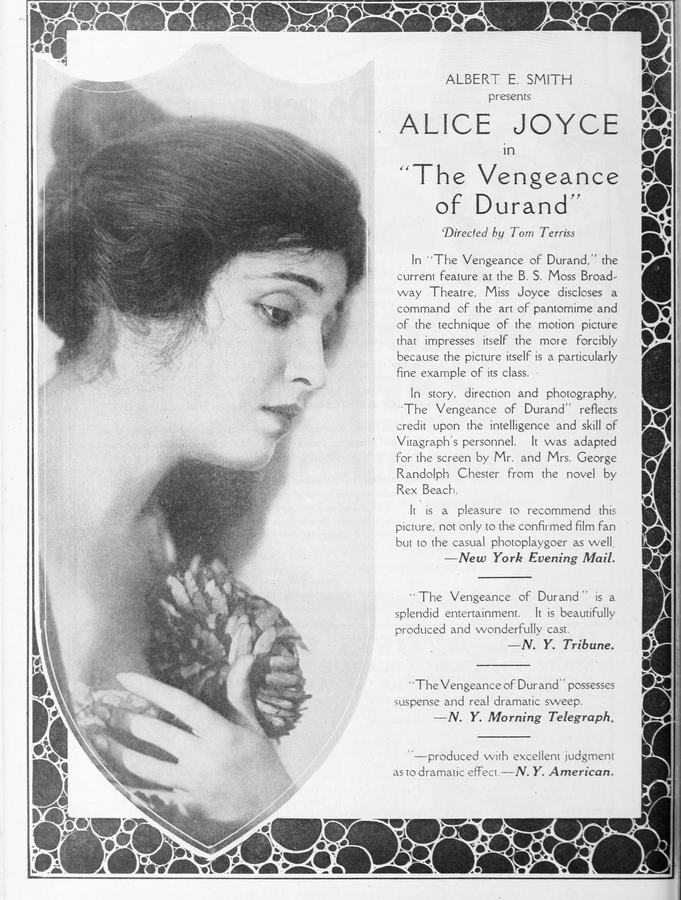
Dir: Tom Terriss
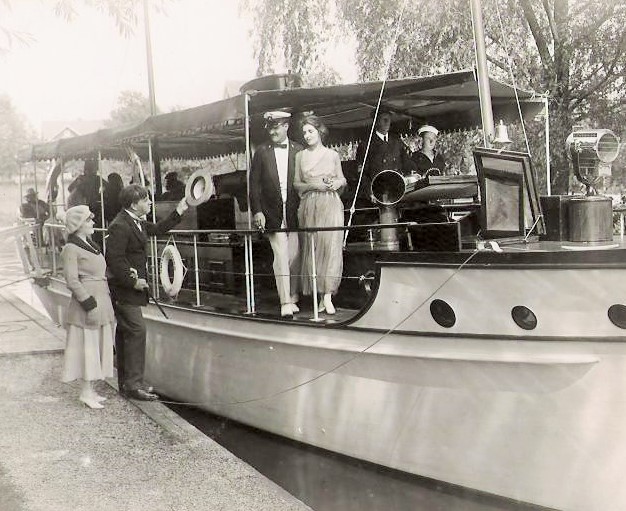
Henri Durand of the French nobility is insanely jealous of his beautiful American wife Marion's innocent conversations with her many male admirers. Durand provokes her suicide when, egged on by a rejected suitor of Marion's, he accuses her of having illicit relations with her visiting childhood friend, Tom Franklin. Twelve years later, when Tom returns after a long expedition, the vengeful Durand coaches his daughter Beatrice, who resembles Marion, to court Tom. After they become engaged, Durand forces Beatrice to flirt with other men, but when Tom, overcome with jealousy, is about to kill himself, Beatrice admits her real love for him. Durand is at first furious with Beatrice's supposed betrayal, but he is pacified when he receives a confession from Marion's refused suitor that absolves Tom of any guilt. Durand then permits the marriage of Beatrice and Tom.
View Details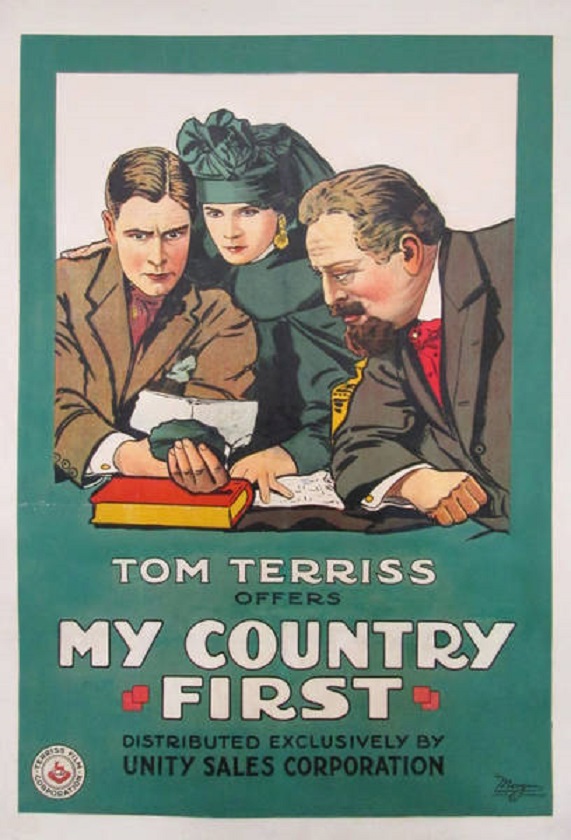
Dir: Tom Terriss
Frank Draper, a patriotic young American, has invented the most wonderful explosive in the world which he intends giving to the United States. In defending a pure girl from the machinations of an enemy, he is involved in a serious crime which sends him, an innocent man, to prison. Angered at this interruption to their plans and desirous of obtaining the explosive for a foreign government, international spies connive successfully at Draper's escape. They then hold him a prisoner and the young patriot is given the choice of sacrificing his own life or that of his country. He chooses the preservation of the latter, and his sands of life have almost run out, when trapped and bound, he is rescued at the eleventh hour. Thankfully acknowledging his escape and returning to freedom, he gives to his country a wonderful weapon of preparedness and together with the nation's thanks, he receives the love of the girl he once defended.
View Details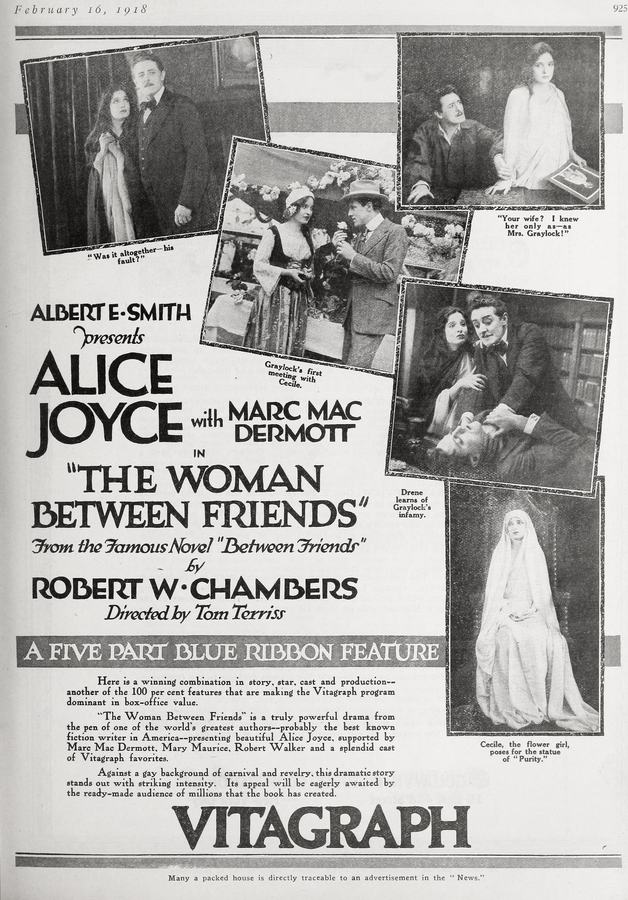
Dir: Tom Terriss
The friends of the story are John Drene, a sculptor, and Jack Graylock, a painter. Both men swear eternal friendship on the night before Drene's marriage. Later on the artist runs away with the sculptor's wife. The couple tire of each other, and the woman becomes an outcast. Then Graylock falls honestly in love with a flower girl, one of those sweetly innocent young women found in romance of the Chambers school Her name is Cecelie, and she follows the painter back to Paris. He installs her with the housekeeper of the studios where he lives, and introduces her to Drene, who is at once inspired to employ her as the model for a half completed statue posed by his wife. Drene, who was present when the runaway woman paid for her folly be being accidentally burned to death, has never suspected his friend, but Cecelie unintentionally betrays him. Drene is filled with a determination to kill Graylock at once. He then concludes that this would not be sufficient punishment, and informs the artist that on a certain day he must shoot himself or be killed. As a further revenge, Drene makes up his mind to wind Cecelie away from Graylock. He starts to put his plan in operation, not knowing that the girl has already fallen in love with him. Her gentleness and devotion soften his heart toward his one time friend, and he tries to prevent Graylock from carrying out the compact. The artist fires the shot as agreed, but only wounds himself, and Drene finds peace and happiness with Cecelie. - Moving Picture World.
View Details
Dir: Tom Terriss
Maurice Dumars, a journalist, is enamored of Madeline Renard of a French opera company. She is to sing Marguerite in Faust and induces Monsieur Morin, a gold worker, to make a past replica of a string of pearls, which belong to her mother and which is worth $20,000, for the great jewel aria. Morin makes the counterfeit gems, and the next day is found dead. The $20,000 which Mr. Morin received from Madame Thibault to invest for her is missing from his effects but a note from him to Madeline which is found saying he had done her a great favor in making the jewelry casts suspicion upon the opera singer. When she makes her appearance as Marguerite in Faust she is hissed, and she tells of her business relations with M. Morin and of her mother's jewels. Simultaneous with her leaving the convent a year or so later, where she had gone to seek refuge, Dumars finds pinned on the walls of Mme. Tibault's inn the $20,000 in bank notes which M. Morin had given her and which she had carelessly left there . With the mystery cleared, Madeline is again sought by Dumars and all who had done an injustice. - Moving Picture World.
View Details
Dir: Tom Terriss
Young, innocent, confiding, it is a shock to Ann Fenton to learn that her supposed husband is not a business man, but a gambler, and that her marriage is bigamous. The child is taken from her by a Helping Hand Society and apprenticed to a brutal farmer. She is left upon her own resources. Seven years later Fenton again crosses her path, but she finds happiness in honorable marriage while her betrayer is taken away to face a murder charge, and the Song of the Soul now rises in full, pure tones from the breast of the happy wife and mother.
View DetailsAnalysis relative to The Bandolero
| Film Title | Atmosphere | Complexity | Similarity |
|---|---|---|---|
| The Pursuing Shadow | Tense | Abstract | 98% Match |
| The Spark Divine | Gritty | Layered | 85% Match |
| To the Highest Bidder | Gothic | High | 85% Match |
| Everybody's Girl | Gritty | Abstract | 87% Match |
| The Business of Life | Gritty | Layered | 95% Match |
This guide was algorithmically generated using the cinematic metadata of Tom Terriss's archive. Last updated: 6/25/2026.
Back to The Bandolero Details →