
DbcultAccessing Vault...
Recommendations
Senior Film Conservator
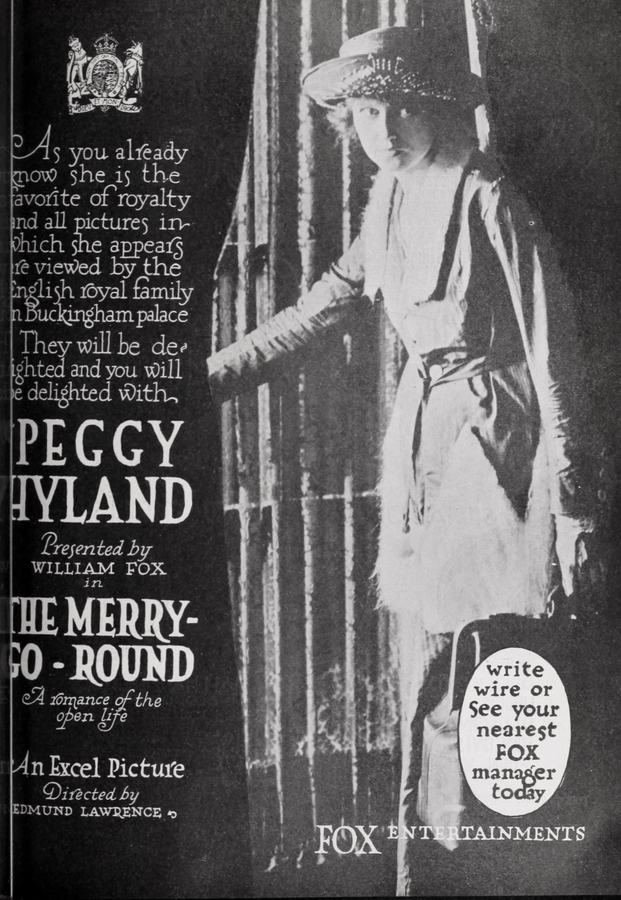
Looking back at the 1919 milestone that is The Merry-Go-Round, the cinematic shorthand used by Edmund Lawrence is both ancient and revolutionary. Dive into this collection and find the spiritual successors to Edmund Lawrence's vision.
As Edmund Lawrence's most celebrated work, it defines to articulate the unspoken anxieties of United States's 1919 era.
Crump's Colossal Combined Carnival Show barely survives financially by hiring thieves and pickpockets to rob customers. One day, clubman Jack Hamilton buys the circus when his car breaks down on his way to meet a deadline to avoid bankruptcy and he needs the circus tractor to haul his auto out of a ditch. Hamilton leads the circus to financial success and falls in love with Gypsy, the ticket-taker. To convince Jack to marry Gypsy, her supposed mother, fortune-teller Carlotta, says that she was kidnapped as a baby and shows Jack a photo in which he recognizes Gypsy's mother as the wife of Andrew Pomeroy, the financier who ruined him. Gypsy's subsequent life with her real parents is miserable since they find her lack of manners offensive and try to get her to marry a cousin, but Jack rescues her, and the minute she turns 18 he marries her with the Pomeroys' belated consent.
Based on the unique cult status of The Merry-Go-Round, our vault has identified these titles as the most compelling follow-up experiences for fans of cult cinema:
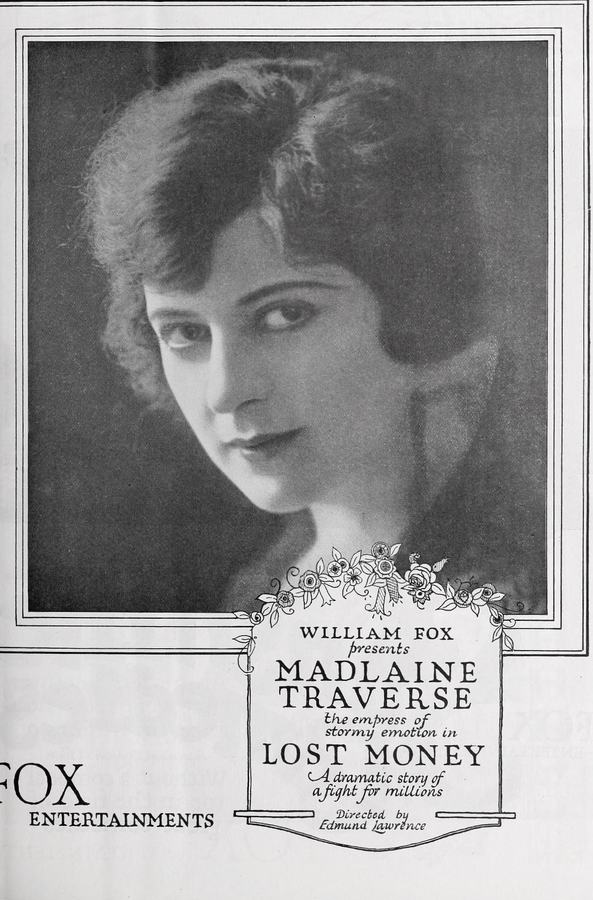
Dir: Edmund Lawrence
Judith Atherstone goes to her father's South African diamond fields not knowing that he is nearly broke. Atherstone's wealthy neighbor, Ox Lanyon, entrusts his diamond fields to Atherstone while he attempts to rescue prospectors endangered by a Zulu uprising. Believing Ox to be dead, Atherstone, encouraged by his engineer Caton Cooper, who loves Judith, uses Ox's wealth to keep Judith in luxuries. When Ox returns demanding his fortune, Atherstone and Cooper fight him, and, although they are bested, they retain Ox's wealth. For revenge, Ox takes Judith to the desert, where, near death, she is given the small amount of water he finds. After they are saved, Judith realizes his sacrifice and falls in love. When Cooper finds them, Judith saves Ox by saying they are married. She returns to her sick father's house where Cooper dies a coward when they are attacked by Kaffirs. After soldiers brought by Ox quell the revolt, Ox forgives Atherstone and marries Judith.
View Details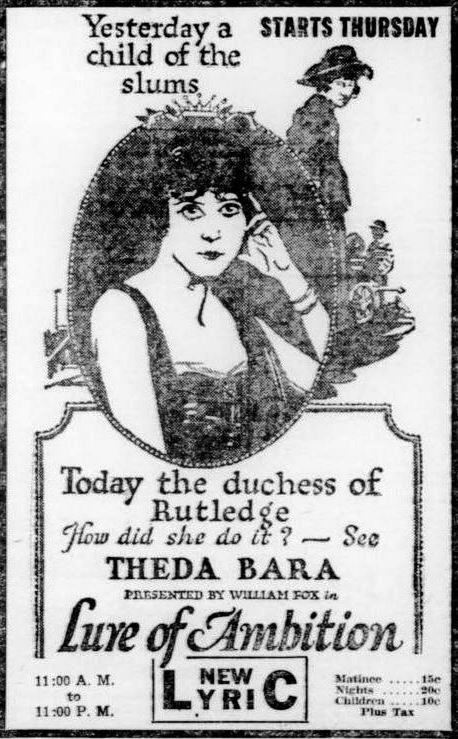
Dir: Edmund Lawrence
Poor Olga Dolan works as a public stenographer at a fashionable New York hotel. After she charms the Honorable Cyril Ralston and introduces him to her uncouth father and squalid home, Ralston persuades her to accept a suite of rooms in a hotel, promising he will marry her "some time." When Ralston returns to England, Olga vows revenge. She goes there working as the secretary to Lady Constance Bromley, and once there, learns that Ralston is her employer's son and also that he is married. Interested in the Duke of Rutledge, Olga makes Ralston introduce her to him. After Ralston becomes obnoxious in his advances, Olga becomes the duke's private secretary, impressing him when she flirts with a Spanish diplomat to make him sign some papers. When the duke's insane wife escapes from her secluded room in the castle, Olga stops her from killing the duke. The duchess' subsequent fatal heart attack brought on by intense jealousy allows Olga to marry the duke.
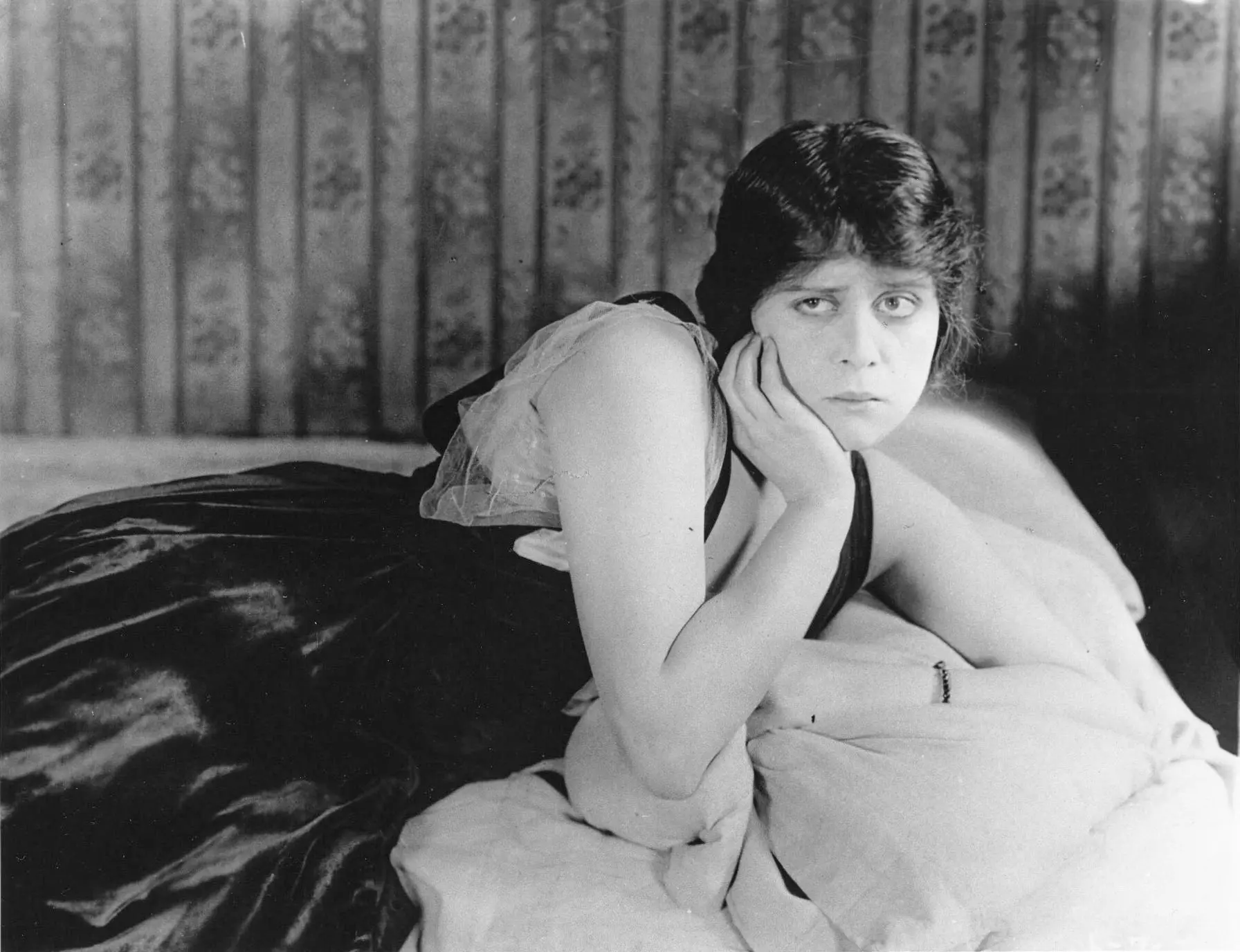
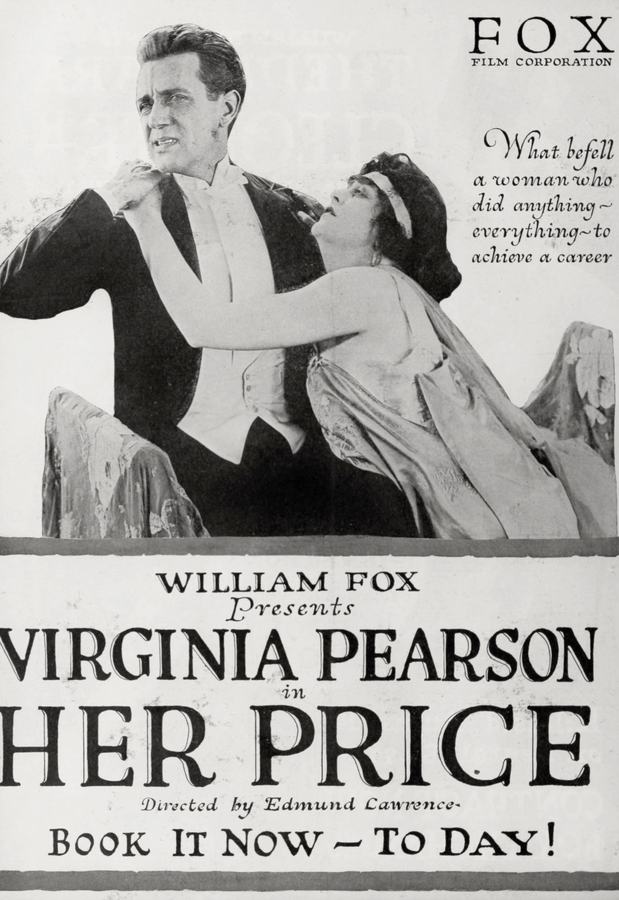
Dir: Edmund Lawrence
Marcia Calhoun, a talented but penniless singer, leaves her Southern home hoping to study opera in New York. Her instructor, Professor Didot, promises her a contract on the condition that she receive formal training in Italy for one year. Didot introduces Marcia to millionaire Philip Bradley, who offers to pay for her studies if she will accompany him to Italy as his mistress. Desperate for money, she agrees, but he abandons her several months later. Marcia continues her studies, and on the night of her highly-successful debut in Paris, Robert Carroll, with whom she has fallen deeply in love, proposes. When Marcia confesses her past, however, he deserts her, whereupon she vows to ruin Philip and his family. Because Philip has died, she seeks her revenge through his brother John, who comes to love her so dearly that he reveals all of his business secrets to her. Through dealings with his rivals, Marcia ruins John, but he proposes anyway, promising to right his brother's wrong.
View Details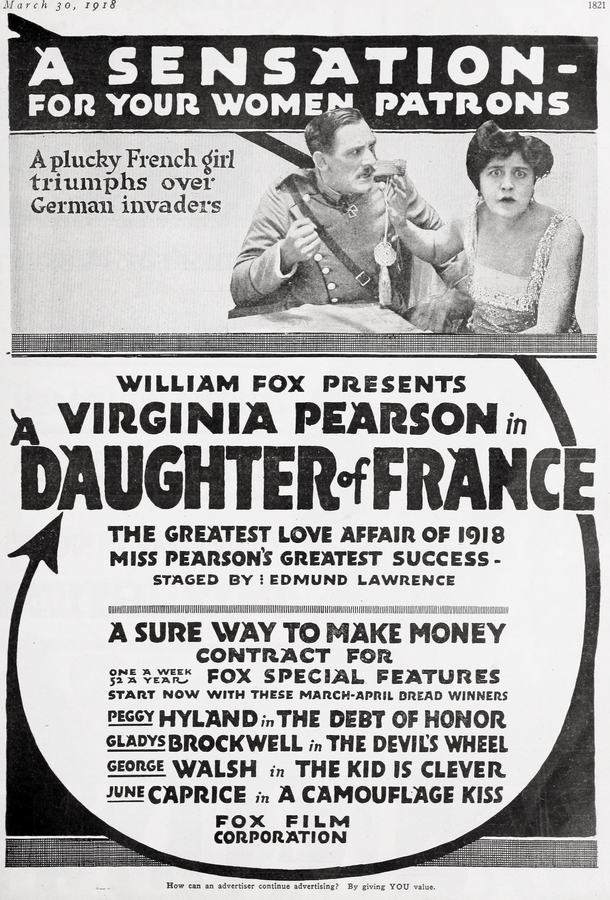
Dir: Edmund Lawrence
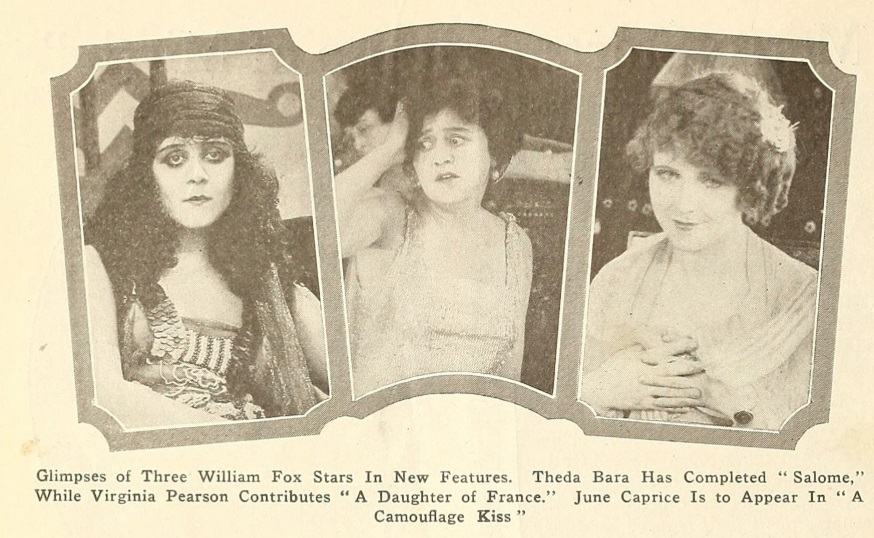
During World War I, Louise, a French girl, refuses to leave her château after the invading Germans take it over for use as their headquarters. A German officer, Col. von Knorr, makes repeated advances on her, but she rebuffs him. When another German officer lures her to an inn and attacks her, the colonel kills him. When the colonel tries to apologize to Louise for his past behavior towards her, she gets the wrong idea and stabs him. Complications ensue.
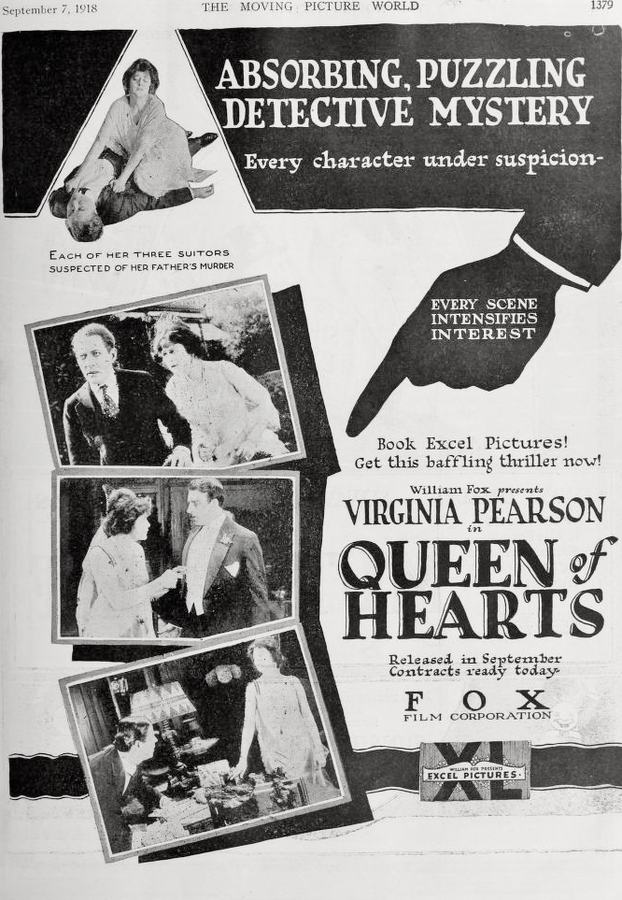
Dir: Edmund Lawrence
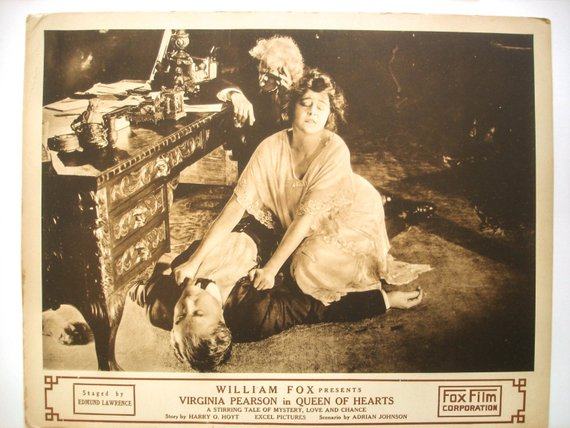
While his daughter Pauline attends school in France, Emil Cheraud establishes a fashionable gambling-house in New York. Upon her return, Pauline begs her father to close the establishment, and he promises to do so that very night at midnight, but when she enters his library shortly after the appointed hour, she finds him dead. Determined to bring the murderer to justice, Pauline assumes control of the gambling-house, hoping to trap the criminal into a confession. Three men are suspected, all of them in love with Pauline: one who owed her father a fortune; another who boasted that he would kill a man to win her affections; and a third, Jimmie Dreen, whose coat button was found at the scene of the crime. The evidence points strongly to Jimmie, with whom Pauline is in love, until Pierre, Emil's servant, confesses that he killed his employer upon learning that he had lost his job. Much relieved, Pauline agrees to marry Jimmie.
View Details
Dir: Edmund Lawrence
A fascinating piece of cinema that shares thematic elements.
Dir: Edmund Lawrence
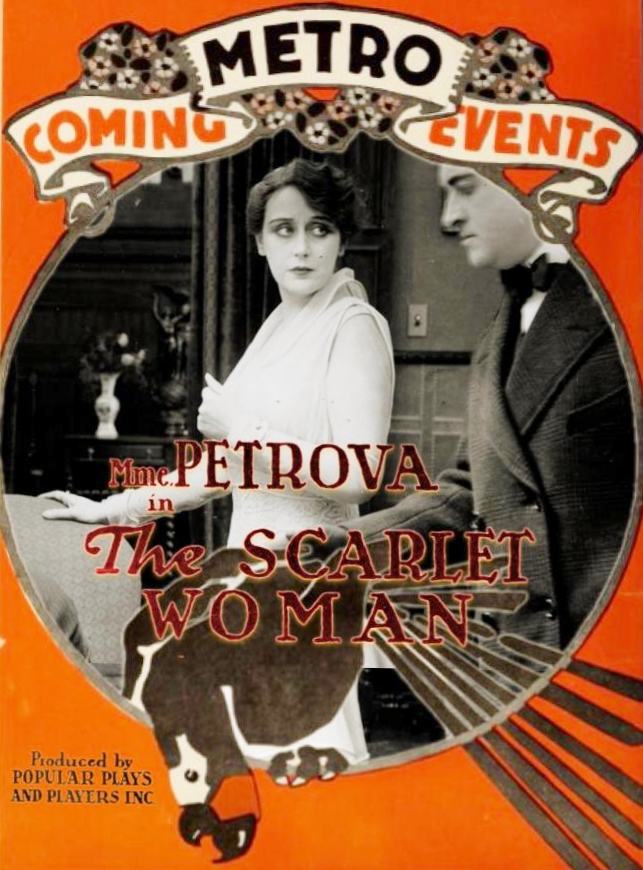
Hanlin Davis, vice-president of a bank, has been gambling in stocks, and loses heavily. While in the act of robbing the bank he is surprised by another official, and Davis kills him. Davis is arrested and his wife goes to Hastings, the District Attorney, and makes a plea in his behalf. Hastings is a corrupt official and does not hesitate to make an improper proposal to Thora. He agrees to let her husband off with a light sentence after she accepts his demands. When Davis is released from prison and learns of the sacrifice his wife has made he openly denounces her and turns her into the street. Then he gets a divorce. Ignored by all her friends and driven out of society, she is thrown upon her own resources and becomes known as "the scarlet woman," void of heart and conscience. The District Attorney becomes notorious for his association with the sporting element along Broadway, and is believed to be a graft taker. Robert Blake, a wealthy young man, institutes a reform investigation and the District Attorney is exposed. Disbarred and disgraced, Hastings decides to revenge himself upon Thora, whom he considers the cause of his downfall. He cultivates the friendship of Paula Gordon, an unscrupulous society woman, who is much in the company of Blake and holds his respect. Hastings has evidence of a crooked transaction in which Paula participated, and he threatens exposure unless she does his bidding. Through Paula, Thora is introduced to Blake. He is made to understand that she is a pure woman, and she is led to believe that he knows about her past. They fall in love and soon afterward are quietly married. After the wedding Hastings confronts the couple and denounces Thora, telling Blake of her past and that she is the notorious "scarlet woman." Blake gives Hastings a beating, but hears Thora confess that he has told the truth. Before he can regain composure, following this blow, and speak to her, Thora is gone. She secures employment in a factory hidden from her former friends. Paula now hopes to win Blake's love, but he remains steadfast in his love for his wife. Blake becomes a melancholy weakling in his deep sorrow. Paula goes to Thora and tells her she is wrecking his life; that if she would save him she must divorce him and openly return to her old life of the street and café. This Thora does. It proves the severest blow of all for Blake, and he is about to yield to Paula's persuasion to come to her when he learns the truth. He seeks out Thora, begs her to forgive him, as he long ago has forgiven her, and they are happily reunited.
View Details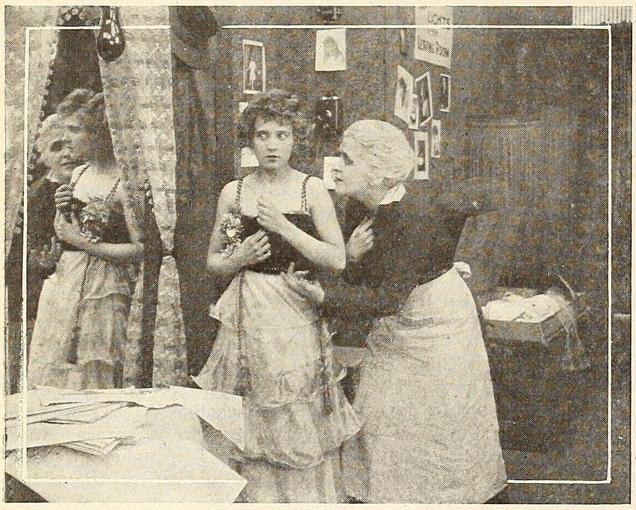
Dir: Edmund Lawrence
Young Janet Osborne is stuck in a loveless marriage; her only source of pleasure is her daughter. Janet always dreamed of a career on the stage but never had the chance. One day she meets theatrical agent Geoffrey Allen and decides to try her luck at becoming an actress. But when her husband Mark finds out, he orders her out of the house and keeps their daughter Marcia. Her acting career sputters to a halt also, and Geoffrey takes advantage of her situation to make her his mistress. Years later she finds out that Marcia has become an actress--and has also become involved with Geoffrey.
Dir: Edmund Lawrence
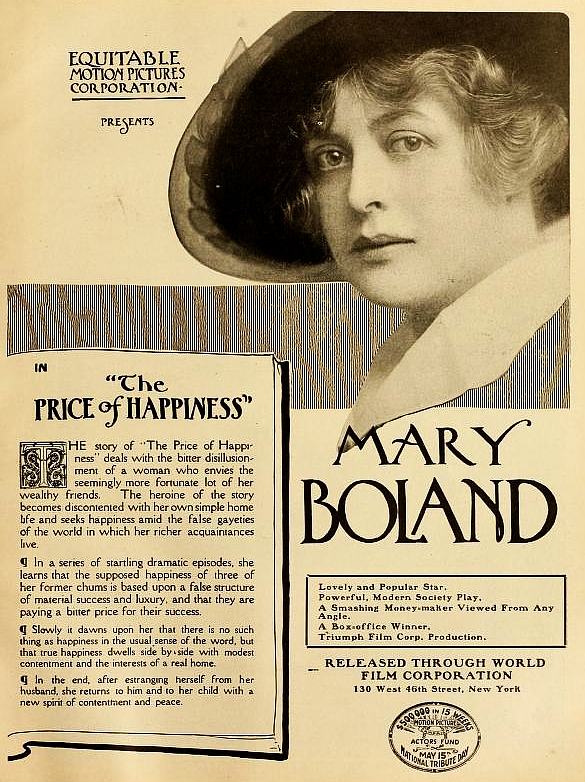
Bertha Miller is the young wife of an industrious artisan. The couple live comfortably but hardly luxuriously, and sometimes Bertha can't stifle the envious longings aroused in her by reports of her former girl friends' material success. Three of these former chums have had particular success, in the sense of having all the things that money can buy. Bertha and her three friends reunite when they meet a steamer that is bringing back one of the group who has become an opera singer. Bertha is invited to visit each of her three friends. She first visits Ruth Taylor's beautiful home, where she receives the first intimation that things are not as pleasant in Ruth's world as they appear on the surface. She finds Ruth in a nervous state and learns that she has written letters to an admirer and fears her husband will discover it. Bertha agrees to help Ruth out of her trouble and in doing so nearly estranges herself from her own husband. Lucille, the opera singer, has a handsome suite of rooms in a fashionable hotel. Bertha finds Lucille in despair over the fact that her expected operatic role has been given to another singer. Bertha learns to her surprise that Lucille's lot is in no way so happy as she had thought at first. The climax of this scene comes when Lucille has Bertha meet the man whom Lucille loves and expects to marry. This man Bertha discovers to be the owner of the house in which she and her husband live. Lucille is broken-hearted when she learns that her lover is married and the father of a family. The third seemingly-successful friend, Evelyn, lives in a pretty apartment, and when Bertha visits her she seems to have no cares or worries. Induced to go out to a gay party with Evelyn that evening, Bertha discovers to her horror that Evelyn's lovely gowns and luxurious living are being paid for in the old way of the underworld. It is in this scene, amid the false gaiety of Broadway night-life, that Bertha receives her final disillusionment and discovers the whole false fabric of her friends' careers. All envy is wiped from her heart and she returns to her steady, hard-working husband and her little child conscious that hers is, after all, the real success in life.
View Details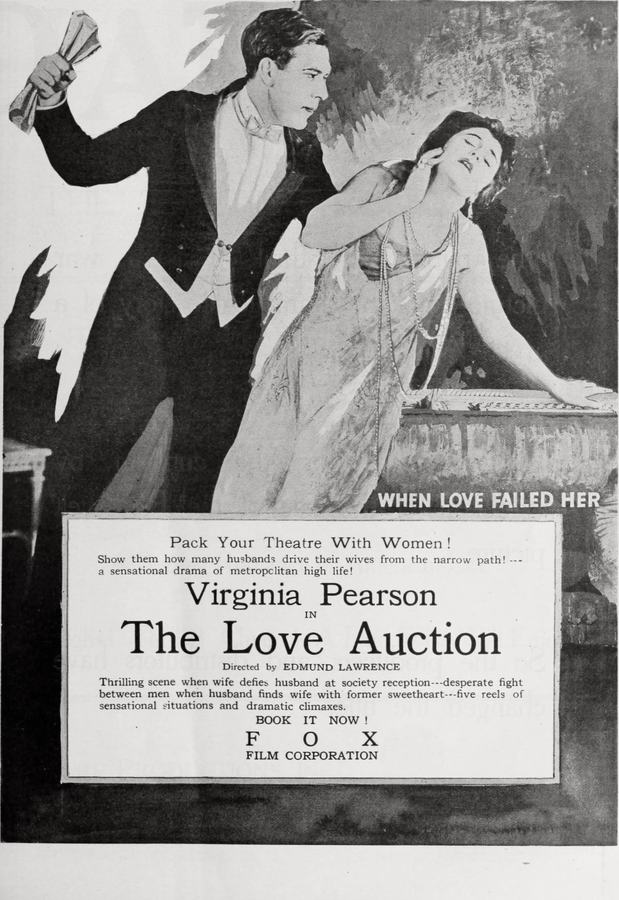
Dir: Edmund Lawrence
Lea Montrose (Virginia Pearson) marries Dorian Vandeveer (Hugh Thompson), but soon finds that he is a drunk. Dorian tries without success to reform and Lea abandons any hopes for her marriage. Instead she joins a cult headed by Dr. Studholm Charters (Thurlow Bergen). One of Lea's former boyfriends, Jack Harley (Edwin Stanley), returns to town, having become wealthy, and he and Lea rekindle their relationship. Lea has a baby, which inspires Dorian to once again attempt to give up drinking. Dr. Charters, however, suspects that Jack, rather than Dorian, is the child's father, and demands that Lea submit to him in return for his silence. Dorian learns of Charters' demand, gets drunk and kills him, then commits suicide. See "The Fox Plan of Photoplay Writing" by Vera Casparay, ghostwriting for Charles Donald Fox.
View DetailsAnalysis relative to The Merry-Go-Round
| Film Title | Atmosphere | Complexity | Similarity |
|---|---|---|---|
| Lost Money | Tense | Abstract | 89% Match |
| Lure of Ambition | Gritty | Linear | 90% Match |
| Her Price | Gritty | Linear | 97% Match |
| A Daughter of France | Tense | Dense | 86% Match |
| The Queen of Hearts | Gritty | Dense | 96% Match |
This guide was algorithmically generated using the cinematic metadata of Edmund Lawrence's archive. Last updated: 6/23/2026.
Back to The Merry-Go-Round Details →