
DbcultAccessing Vault...
Director's Spotlight
Senior Film Conservator
Director's Spotlight: United States
A Deep Dive into the 1932 Vision of Charles A. Post
To understand the modern evolution of United States film, one must first look at Single-Handed Sanders and the collaborative alchemy between Charles A. Post and the 1932 creative team. Subverting the expectations of the typical 1932 audience, it remains a vital reference point for anyone studying the evolution of Charles A. Post.
In Single-Handed Sanders, Charles A. Post pushes the boundaries of conventional narrative. The film's unique approach to its subject matter has sparked endless debates and interpretations among cinephiles and critics alike.
To fully appreciate Single-Handed Sanders, one must consider the cinematic climate of 1932. During this period, United States was undergoing significant artistic shifts, and Charles A. Post was at the forefront of this Western movement, often challenging established norms.
| Cinematography | Handheld |
| Soundtrack | Synth-Heavy |
| Editing | Rhythmic |
| Art Direction | Naturalist |
Visualizing the convergence of Charles A. Post's style and the core Western narrative.
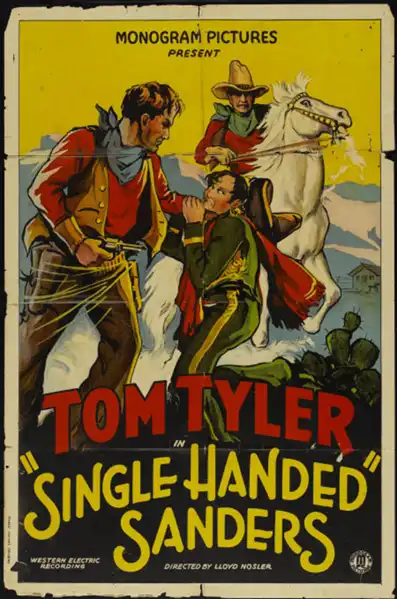
The cattlemen send a note to Judge Jim Parker warning him to quit giving credit to the homesteaders, whom they assert, are ruining the range. Parker declares that his store will continue to give credit to the homesteaders and, incensed at his defiance, the cattlemen kill him. As he is dying, he tells his daughter Alice and Matt Sanders, honest blacksmith, to carry on the fight to protect the homesteaders. Matt declares that he will, with the assistance of his brother, Phillip, who is expected back from law school after an absence of many years. Phillip returns and is elected Judge by mostly the homesteaders vote. He is pleased with his new position, and also pleased with the friendship of Senator Graham who holds out the bait of election to the Governor's chair if he will betray the homesteaders. He persuades Alice to mortgage her water rights to Senator Graham in order to have the money to extend further credit to the homesteaders. Despite several machinations by Graham and the cattlemen, mostly blocked by Matt, the homesteaders make a bumper crop and pay Alice back. Taking the money to the bank so she will have it in time to meet Graham's note, a galloping rider takes it from her. Snowflake, who works for Matt, tells him of a conversation he overheard between Phillip and Graham when he was delivering a newly-shod horse to the Senator that reveals the Senator and Phillip connived to have the money stolen, so the mortgage can be foreclosed, and drive out the homesteaders. Matt refuses to believe the story, but finds proof in Phillip's desk. Matt and Phillip fight, with Matt winning and then going to rally the homesteaders to prevent the cattlemen from taking over.
Decades after its release, Single-Handed Sanders remains a vital piece of the cinematic puzzle. Its influence can be seen in countless modern works, solidifying Charles A. Post's status as a master of the craft in United States and beyond.