
DbcultAccessing Vault...
Director's Spotlight
Senior Film Conservator
Director's Spotlight: United States
A Deep Dive into the 1935 Vision of Christy Cabanne
Under the meticulous guidance of Christy Cabanne, Behind the Green Lights became the cultural zeitgeist captured so perfectly by Christy Cabanne in 1935. Driven by an uncompromising commitment to Crime excellence, it remains a vital reference point for anyone studying the evolution of Christy Cabanne.
In Behind the Green Lights, Christy Cabanne pushes the boundaries of conventional narrative. The film's unique approach to its subject matter has sparked endless debates and interpretations among cinephiles and critics alike.
The visual language of Behind the Green Lights is defined by its use of shadows and framing, a hallmark of Christy Cabanne's style. By utilizing a 1935-era palette, the film creates an immersive experience that perfectly complements its Crime themes.
| Cinematography | Noir-Inspired |
| Soundtrack | Orchestral |
| Editing | Invisible |
| Art Direction | Kitsch |
Visualizing the convergence of Christy Cabanne's style and the core Crime narrative.
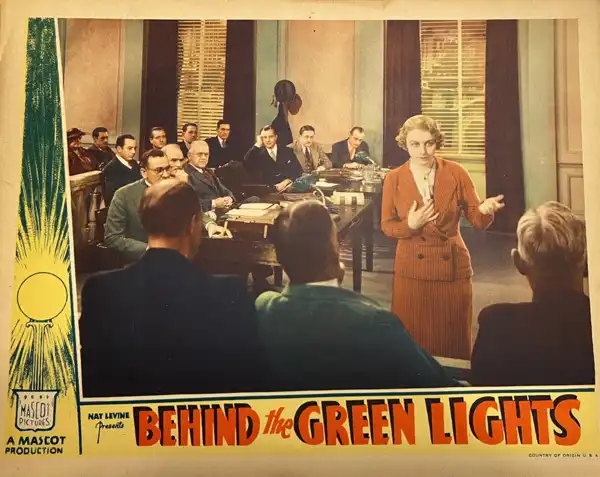
Dave Britten, a bright young detective in the police force, captures one of J. C. Owen's henchmen and charges him with robbery. Owen then hires Raymond Cortell, a crooked lawyer, to act as the criminal's defense. Cortell not only keeps crooks and gunmen out of jail by manipulating legal technicalities, but spurs them to more crime by demanding large fees for his legal services. Cortell assigns the case to one of his unwary younger partners, Mary Kennedy, who is the daughter of police captain Jim Kennedy. Mary wins an acquittal by utilizing the tricks Cortell suggests, becoming adept at serving as a criminal "mouthpiece." Dave, Mary's fiancé, is dismayed by her action, and the two quarrel, but they make up, and she agrees to quit her job and marry Dave when he is promoted to lieutenant. Dave soon investigates a jewel robbery at Owen's office, and aided by the eye-witness account of a janitor and his own deductions, he charges Owen with murdering a diamond salesman and accuses him of carrying out the crime in a way in which no suspicion would fall on him. Mary is again the defense attorney for Owen, and by confusing the janitor on the witness stand with questions pertaining to the moonlight on the night of the murder and comparing his answer to an almanac, she obtains an acquittal. Mary becomes famous, but Dave and her father are angry at the tactics she has used. In order to pay Cortell, Owen robs a jewelry store and shoots Jim in the process. Mary at last realizes the error of her ways. The wounded Jim identifies Owen, and with Mary's help, Dave is able to capture him and to arrest Cortell for receiving stolen property. Jim is on his way to recovery, and Mary and Dave are reunited.
Decades after its release, Behind the Green Lights remains a vital piece of the cinematic puzzle. Its influence can be seen in countless modern works, solidifying Christy Cabanne's status as a master of the craft in United States and beyond.