
DbcultAccessing Vault...
Director's Spotlight
Senior Film Conservator
Director's Spotlight: United States
A Deep Dive into the 1932 Vision of Clyde E. Elliott
The artistic breakthrough represented by Bring 'Em Back Alive in 1932 highlights the philosophical inquiries that Clyde E. Elliott embeds within the narrative. Framed by the hauntingly beautiful landscapes of the production, it leaves an indelible mark on the soul of the viewer.
In Bring 'Em Back Alive, Clyde E. Elliott pushes the boundaries of conventional narrative. The film's unique approach to its subject matter has sparked endless debates and interpretations among cinephiles and critics alike.
In this work, Clyde E. Elliott explores the intersection of Documentary and United States cultural identity. The meticulous attention to detail suggests a deep-seated commitment to pushing the boundaries of the medium, ensuring that Bring 'Em Back Alive remains a relevant topic of study for Documentary enthusiasts.
| Cinematography | High-Contrast |
| Soundtrack | Diegetic |
| Editing | Rhythmic |
| Art Direction | Naturalist |
Visualizing the convergence of Clyde E. Elliott's style and the core Documentary narrative.
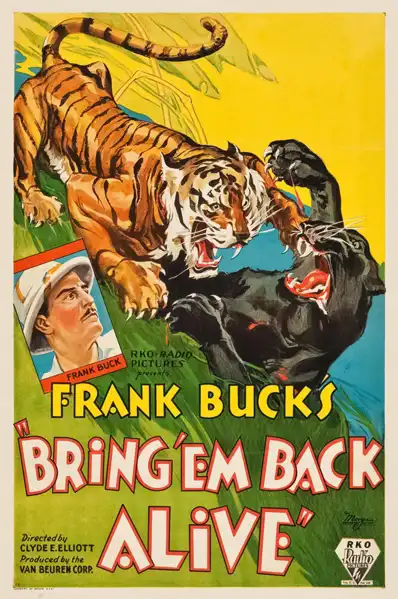
American animal trapper Frank Buck travels with Ali, his "number one boy," on an expedition into the Malayan jungle. From their jungle headquarters just north of Singapore, Frank, Ali and a team of native helpers roam the area from Northern Johore to Perak in search of interesting wild animals, reptiles and birds. Hoping to find a tiger, Buck captures a monitor lizard and a black leopard, while another black leopard narrowly escapes an encounter with a giant python and then battles a bigger and stronger tiger. After trapping a spotted leopard, Frank adopts a baby honey bear and a baby elephant. The team catches an orangutan, but the tiger eludes their camouflaged pit. Meanwhile, Frank visits the "bathing festival" of a local tribe and watches as tribesmen kill an intruding spotted leopard with blow darts. The tiger then meets an enormous regal python, who has just crushed a crocodile, and fights to a draw with it.
Decades after its release, Bring 'Em Back Alive remains a vital piece of the cinematic puzzle. Its influence can be seen in countless modern works, solidifying Clyde E. Elliott's status as a master of the craft in United States and beyond.