
DbcultAccessing Vault...
Director's Spotlight
Senior Film Conservator

Director's Spotlight: United States
A Deep Dive into the 1915 Vision of Colin Campbell
As a cultural artifact of the 1915s, Sweet Alyssum provides the global recognition that Colin Campbell garnered after the release of Sweet Alyssum. Elevating the source material through Colin Campbell's unique vision, it solidifies Colin Campbell's reputation as a master of the craft.
In Sweet Alyssum, Colin Campbell pushes the boundaries of conventional narrative. The film's unique approach to its subject matter has sparked endless debates and interpretations among cinephiles and critics alike.
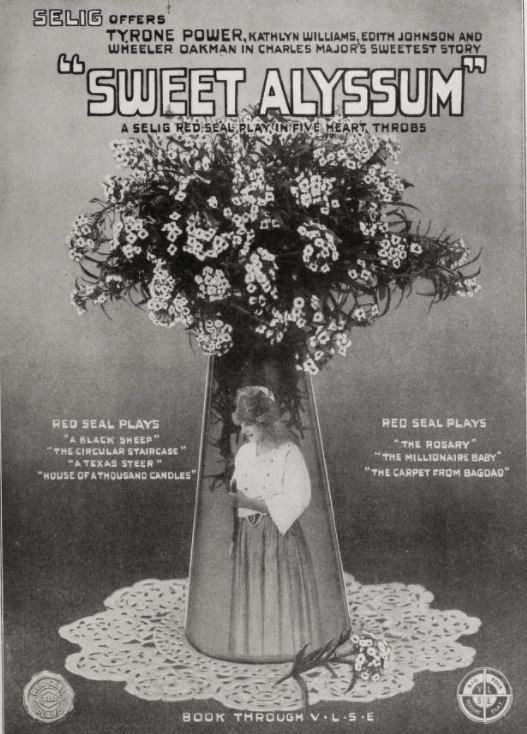
To fully appreciate Sweet Alyssum, one must consider the cinematic climate of 1915. During this period, United States was undergoing significant artistic shifts, and Colin Campbell was at the forefront of this cult movement, often challenging established norms.
| Cinematography | Deep Focus |
| Soundtrack | Minimalist |
| Editing | Slow-Burn |
| Art Direction | Brutalist |
Visualizing the convergence of Colin Campbell's style and the core cult narrative.
Daisy Brooks, wife of Roanoke Brooks, night watchman in the factory of Robert Garlan, does not love her husband or her daughter, Elizabeth. Instead, she loves his money and she enters the primrose path with Garlan in order to satisfy her love for finery. Garlan, a roué, also neglects his infant son, Wynne, for worldly pleasures. In time Daisy Brooks' double life is discovered by her husband, and she kills herself in Garlan's mansion. At the appearance of Roanoke, who has followed, Garlan jumps from a window and kills himself. Roanoke buys a little farm where he lives with his daughter. With the passing years, Elizabeth, daughter of Roanoke, reaches womanhood and is known to her father as "Sweet Alyssum." Wynne Garlan, son of Robert Garlan, has grown to manhood and has married a woman of the world. Wynne, a poor bank clerk, is unable to provide for his wife in the way she wishes and she enters into an affair with Thurlow, the cashier of the bank where Wynne is employed. Thurlow steals from the bank and causes Wynne to be suspected of the crime. Wynne, in terror of arrest, escapes, and arrives in the country near Roanoke Brooks' farm. Sweet Alyssum dreams that her father's land has developed into an immense oil field. She pleads with him to dig for oil and he does so. Wynne Garlan, who has assumed the name of Wyatt, secures employment on Roanoke Brooks' farm. Wynne, later becomes a school teacher and Sweet Alyssum, his pupil, loves him dearly. He, for a time, withstands the innocent young girl's endearments but finally succumbs to her beauty and they elope and are married. When Roanoke Brooks hears of the marriage he is overcome with anger, but as he confronts the pair upon their return to the farm, oil is discovered. Joyful because Alyssum's dream has been realized, Roanoke Brooks forgives the couple and they reside with him. Two years pass by and Sweet Alyssum has become a mother. The oil fields have prospered and all is happiness in Roanoke Brooks' home. Thurlow, the crooked bank clerk, has not prospered during these years and finally wanders to the oil fields. There he sees Wynne Garlan. Thurlow informs the sheriff of the county that Wynne Garlan, known there as Wyatt, is a crook, and that if he is married he is guilty of bigamy for he has a wife living. The sheriff, upon Thurlow's instigations, telegraphs to New York and receives a reply to hold Wynne Garlan, who is wanted by the law. The justice of the peace, who is a friend of Roanoke Brooks and of Sweet Alyssum, goes to Roanoke's home to break the sad news. Roanoke determines to take the law into his own hands. The prosecuting attorney of the county also appears to get information from Sweet Alyssum concerning her husband's actions. When Sweet Alyssum is informed that her husband is accused of bigamy, she sacrifices even her own reputation for him and exclaims: "He cannot be charged with bigamy, for we were never married." Wynne Garlan leaves the magistrate's office and goes to Roanoke Brooks' home. As he enters the gate, he is seen by Roanoke Brooks, who seizes a rifle. As he is about to fire on Wynne, Sweet Alyssum places her little child between her father's rifle and her husband. Then a message comes from the police department of the city which reads as follows: "Garlan obtained divorce two years ago. No charge against him for bank robbery. Hold Thurlow. He is your man." Then it is that the girl tells her father that what she said about Wynne not marrying her was false as she wanted to protect him from arrest. And as Roanoke Brooks gathers his beloved daughter into his arms and shakes Wynne by the hand, the magistrate and the prosecuting attorney retire from the scene and are later instrumental in capturing Thurlow.
Decades after its release, Sweet Alyssum remains a vital piece of the cinematic puzzle. Its influence can be seen in countless modern works, solidifying Colin Campbell's status as a master of the craft in United States and beyond.