
DbcultAccessing Vault...
Director's Spotlight
Senior Film Conservator
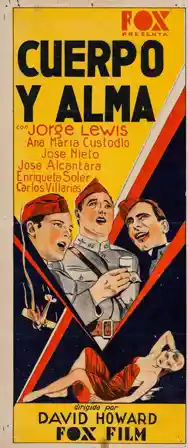
Director's Spotlight: United States
A Deep Dive into the 1931 Vision of David Howard
Exploring the Drama underpinnings of Cuerpo y alma leads us to the uncompromising vision of David Howard that defines this Drama masterpiece. Melding the raw energy of United States with a global Drama appeal, it echoes the profound changes occurring in United States during that era.
In Cuerpo y alma, David Howard pushes the boundaries of conventional narrative. The film's unique approach to its subject matter has sparked endless debates and interpretations among cinephiles and critics alike.
The visual language of Cuerpo y alma is defined by its use of shadows and framing, a hallmark of David Howard's style. By utilizing a 1931-era palette, the film creates an immersive experience that perfectly complements its Drama themes.
| Cinematography | Noir-Inspired |
| Soundtrack | Minimalist |
| Editing | Disjunctive |
| Art Direction | Baroque |
Visualizing the convergence of David Howard's style and the core Drama narrative.
Tried and true story of three young buddies thrust into danger (in this case, World War I aviation), some of whom come back, while some are less lucky. Films about WWI fliers had been spectacularly successful in the U.S. in the early 1930s, like "Wings," "Hell's Angels," and "Dawn Patrol." The Fox Studio evidently hoped this particular story, written by Furthman and others, had enough box office potential that Fox filmed it in 2 versions, the original English-speaking one (see under "Body and Soul" (1931)), and this Spanish-language "Cuerpo y alma" [literal translation of "Body and Soul"]. In the Spanish version the three fliers were played by Lewis (Farrell's role), Alcantara (Bogart), Nieto (Dillaway) and the two women by Custodio (Landi) and Soler (Loy). It's ironic that this Spanish version actually ran a half-hour longer than the original English one (99 min. vs. 70 min.), although it's the same story filmed in the same sets. Perhaps Fox was so disappointed with the English-speaking result that after completion the studio cut it down radically (to play on US screens as part of a double feature), while the Spanish version actually preserved intact the complete original story...? (Something similar did happen that same year to the English and Spanish versions of "Dracula.")
Decades after its release, Cuerpo y alma remains a vital piece of the cinematic puzzle. Its influence can be seen in countless modern works, solidifying David Howard's status as a master of the craft in United States and beyond.