
DbcultAccessing Vault...
Director's Spotlight
Senior Film Conservator
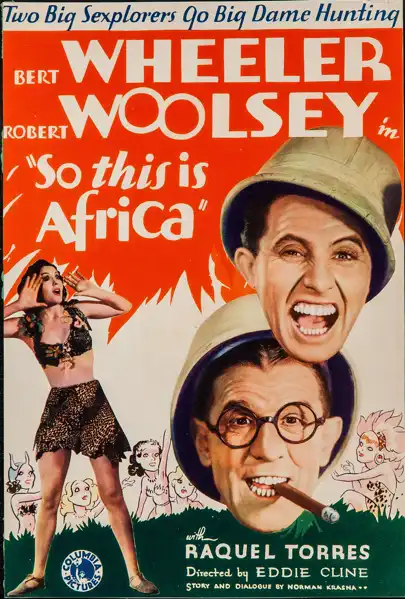
Director's Spotlight: United States
A Deep Dive into the 1933 Vision of Edward F. Cline
To understand the modern evolution of United States film, one must first look at So This Is Africa and the collaborative alchemy between Edward F. Cline and the 1933 creative team. Subverting the expectations of the typical 1933 audience, it remains a vital reference point for anyone studying the evolution of Edward F. Cline.

In So This Is Africa, Edward F. Cline pushes the boundaries of conventional narrative. The film's unique approach to its subject matter has sparked endless debates and interpretations among cinephiles and critics alike.
| Cinematography | Noir-Inspired |
| Soundtrack | Minimalist |
| Editing | Slow-Burn |
| Art Direction | Brutalist |
Visualizing the convergence of Edward F. Cline's style and the core Comedy narrative.
Bert Wheeler and Robert Woolsey play a couple of broke, hungry vaudevillians who are holed up in a hotel room with a few (tame) lions. They are hired by a movie producer who wishes to send them and their lions to Africa with a great naturalist to make a jungle picture. An earlier expedition by this same naturalist was a failure because she is afraid of animals. They all head to Africa and the lions are not mentioned again. Once in the jungle they have to fend off the amorous advances of the naturalist, of a vine-swinging native girl, and of a gorilla. They then run into the fearsome Amazon tribe, made up entirely of nubile females. Eventually they disguise themselves as Amazons to avoid being "loved to death." But these disguises lead to further difficulties when the all-male tribe of Tarzans show up for their annual mating ritual with the Amazons.
Decades after its release, So This Is Africa remains a vital piece of the cinematic puzzle. Its influence can be seen in countless modern works, solidifying Edward F. Cline's status as a master of the craft in United States and beyond.