
DbcultAccessing Vault...
Director's Spotlight
Senior Film Conservator
Director's Spotlight: United States
A Deep Dive into the 1924 Vision of Edward Laemmle
The brilliance of The Shooting Star (1924) is inseparable from the visionary mind of its creator, Edward Laemmle. Serving as a mirror to the anxieties of a changing world, it persists as a haunting reminder of our own cinematic history.
In The Shooting Star, Edward Laemmle pushes the boundaries of conventional narrative. The film's unique approach to its subject matter has sparked endless debates and interpretations among cinephiles and critics alike.
While deeply rooted in United States, The Shooting Star has achieved a global reach, influencing directors from various backgrounds. Its ability to translate Short tropes into a universal cinematic language is why it remains a cult staple decades after its 1924 release.
| Cinematography | High-Contrast |
| Soundtrack | Orchestral |
| Editing | Slow-Burn |
| Art Direction | Brutalist |
Visualizing the convergence of Edward Laemmle's style and the core Short narrative.
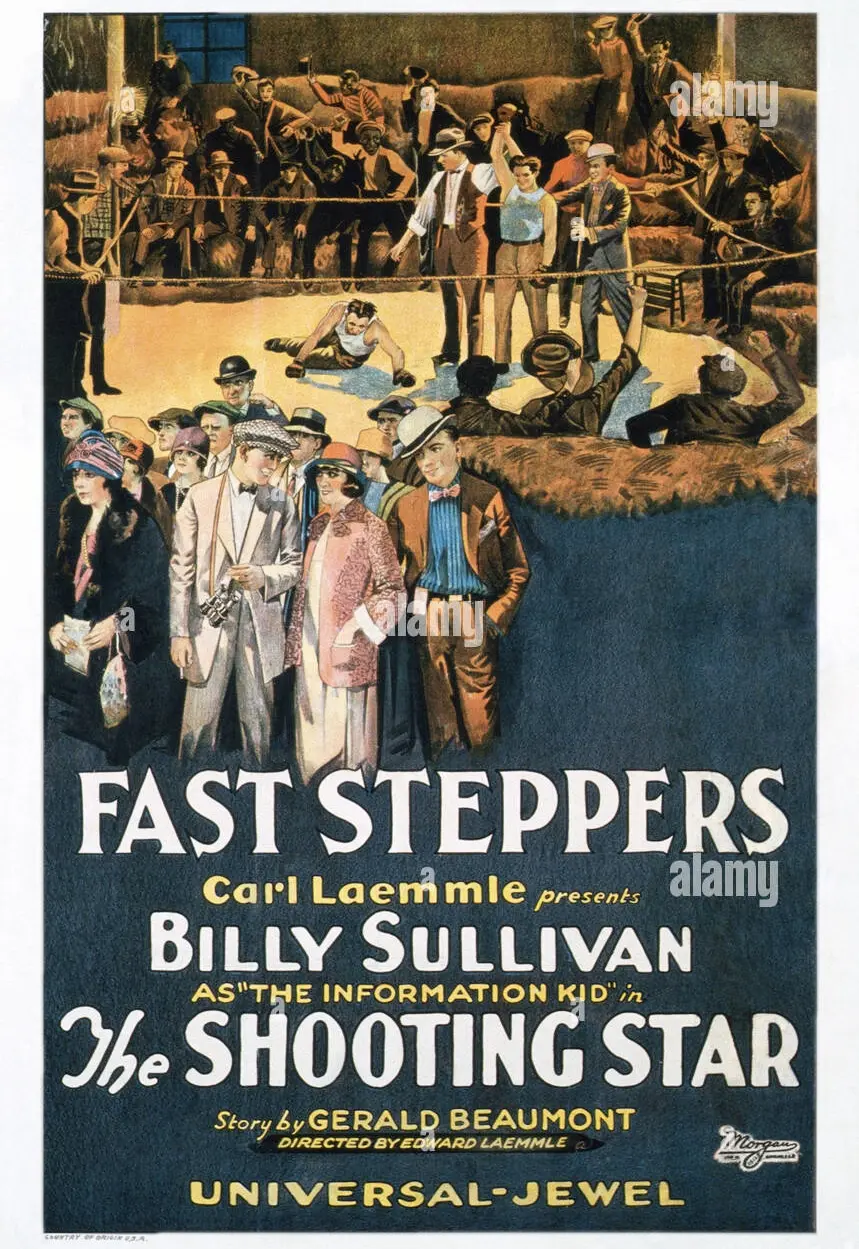
The erratic Shooting Star replaces the lame Monitor in her race against Iron Duke, the English entry. The Information Kid has bet the Doll's roll on Monitor, and as Shooting Star is a stable entry, the bet has to be transferred onto the temperamental racer. The Kid sells Shooting Star's trainer the idea of having her rider hold Shooting Star in until the last quarter, either by letting her get pocketed, or allowing her to get away to a poor start. Iron Duke goes to the post a heavy favorite. Shooting Star is pocketed, conserving her speed for the homestretch, where she romps home, saving the championship for America and earning the Kid a hundred-dollar tip from the winner's owner. The Kid has a fight with a backer of the English horse. The Doll, dressed as a boy, sneaks into the barn where the fight has been staged just in time to see the Kid getting the worst of it. Henry, seeing his side-bet disappearing, rushes out and gets the cops to stop the fight. They arrive just as the Kid has knocked out the Englishman with a lucky punch. All manage to escape, and that night an armistice is signed over a table at the Cantina.
Decades after its release, The Shooting Star remains a vital piece of the cinematic puzzle. Its influence can be seen in countless modern works, solidifying Edward Laemmle's status as a master of the craft in United States and beyond.